
Summary
- Iraq produces somewhere somewhere between roughly 31,000 and 110,000 tons of solid waste a day, depending on which official estimate is used — and the government's own institutions have not agreed on a number. A 2023 Ministry of Environment statement implied a figure nearly four times higher than the estimate most commonly cited in international reporting, itself evidence of the data gap this article is about.
- Collection reaches about nine in ten urban residents but only about six in ten Iraqis overall, and of the 224 disposal sites counted in JICA's national baseline, just 67 were sanitary landfills; the other 157 were open dumps. What is not collected, or is dumped uncontrolled, accumulates along roadsides, in drainage canals, and in informal dumps that residents, waste collectors, and sometimes municipalities eventually set on fire. Open burning is not a fringe practice in Iraq. It is the default.
- Iraq's formal posture has not matched this reality: Paris Agreement commitments that name the waste sector, an environmental protection law in force since 2009, and a growing portfolio of donor-financed pilot projects. The gap between that posture and daily practice is the subject of this piece.
- The most concrete recent development is real but narrow: in February 2025, Iraq's Council of Ministers approved a government-financed waste-to-energy plant for Baghdad, contracted to Shanghai SUS Environment, designed to process 3,000 tons of municipal waste a day. That is a genuine step — and, on the low-end national estimate, still under a tenth of what the country generates daily.
- The drivers of open burning are structural, not behavioral: insufficient collection coverage, landfills that are full or informally inaccessible, and municipal budgets that sector analysts consistently describe as covering only a sliver of what waste management actually costs. Communities do not choose open burning. They arrive at it.
Iraq's waste, by the numbers that keep changing
Iraq is estimated to produce roughly 31,000 tons of solid waste a day, a figure repeated across NGO and industry reporting through 2025. It sits alongside a very different number: in an October 2023 interview with the state-linked newspaper Al-Sabah, a Deputy Minister of Environment put the country's annual waste generation at 40 million tons — equivalent to nearly 110,000 tons a day, almost four times the more commonly cited figure. Enlil cannot resolve which estimate is closer to the truth, and neither, it appears, can Iraq's own ministries. What both numbers agree on is direction: whichever the real figure is, the country's collection and treatment capacity falls far short of it, and the size of that shortfall is itself something the state has not settled on.
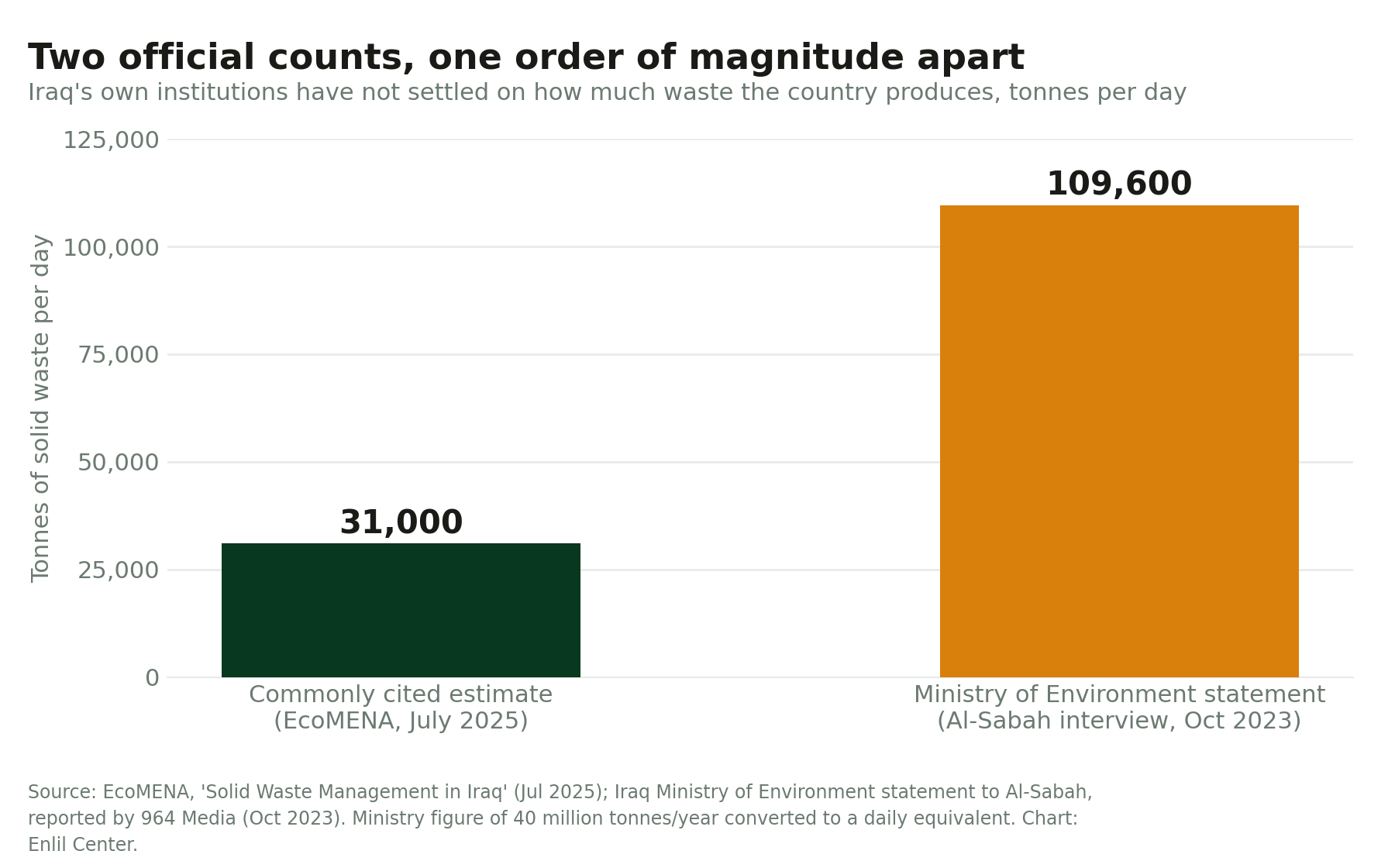
Caption: Iraq's own institutions have not converged on how much waste the country produces each day. Sources: EcoMENA, Solid Waste Management in Iraq (July 2025); Iraq Ministry of Environment statement to Al-Sabah, reported by 964 Media (October 2023).
This is not a new problem. What has changed since 2009 is Iraq's formal posture: Nationally Determined Contribution commitments under the Paris Agreement that name the waste sector as an emissions source, an environmental protection law that has been in force for over fifteen years, and a growing number of donor-financed pilot programs. Open burning at informal sites around Baghdad, Basra, and dozens of smaller cities continues largely undisturbed by any of it — a pattern of fires that satellite fire-detection imagery of the kind NASA's MODIS instruments generate has repeatedly picked up clustering around Basra's informal dumpsites, according to reporting that has reviewed this data.
This is a governance failure more than a technical one. The infrastructure gaps are real, but they did not appear by accident.
From centralization to collapse
Before 2003, waste collection in Iraq was a centralized function. Baghdad set the standards, municipalities executed them, and while the system was never efficient, it maintained basic service coverage in most urban areas. The 2003 invasion did not just change governments. It dismantled the administrative architecture that kept municipal services operational. Local governments, understaffed and financially severed from Baghdad, could not sustain waste collection through the years of sectarian conflict, displacement, and insurgency that followed.
Decentralization reforms in later years were supposed to correct this. They transferred responsibility to local governments without transferring the capacity or the funding to go with it. Many municipalities inherited obligations they could not meet and legal mandates they could not enforce. Donor-financed projects began filling selective gaps, but on an ad hoc basis and with no systemic integration. The result is the current arrangement: a fragmented, underfunded, and largely informal waste management sector operating inside a formal legal framework that exists mostly on paper.
The institutional picture
Responsibility for waste in Iraq is divided between the Ministry of Health and Environment, which handles regulation and environmental monitoring, and the Ministry of Construction, Housing, Municipalities and Public Works, which oversees waste collection infrastructure and landfill operations. Municipal governments execute both mandates at the local level. In practice, this division produces gaps. Coordination between ministries is inconsistent, and municipal budgets are, by the consistent account of sector analysts, a small fraction of what waste management actually requires — Enlil treats the frequently repeated figure of under one percent of municipal budgets as a sector estimate rather than an audited number, but has found nothing in the available reporting that contradicts its direction.
Iraq's waste stream is not simple. Household waste makes up most of the stream by volume. Industrial waste, especially in oil-producing governorates, is disposed of informally in many cases. Medical waste is often unsegregated and enters the general waste stream. Electronic waste is increasing in volume and remains almost entirely unregulated. Managing this mix would challenge a well-resourced system. Iraq's current system is not that.
The infrastructure gap
Iraq's landfills, with a few exceptions, function as open dumpsites. Of the 224 final disposal sites JICA counted in its national baseline (2019 data), only 67 met the definition of a sanitary landfill; the remaining 157 were open dumps. They lack engineered liners, leachate collection, and methane capture. There are no large-scale recycling facilities in the country. Collection reaches roughly 90 percent of urban residents but only about 60 percent of the population nationally, leaving large portions of peri-urban and rural areas without service. Wastewater systems in Baghdad, particularly at Al-Rustumiya and Al-Karkh, are chronically overloaded in part because solid waste enters them through failures in collection coverage.
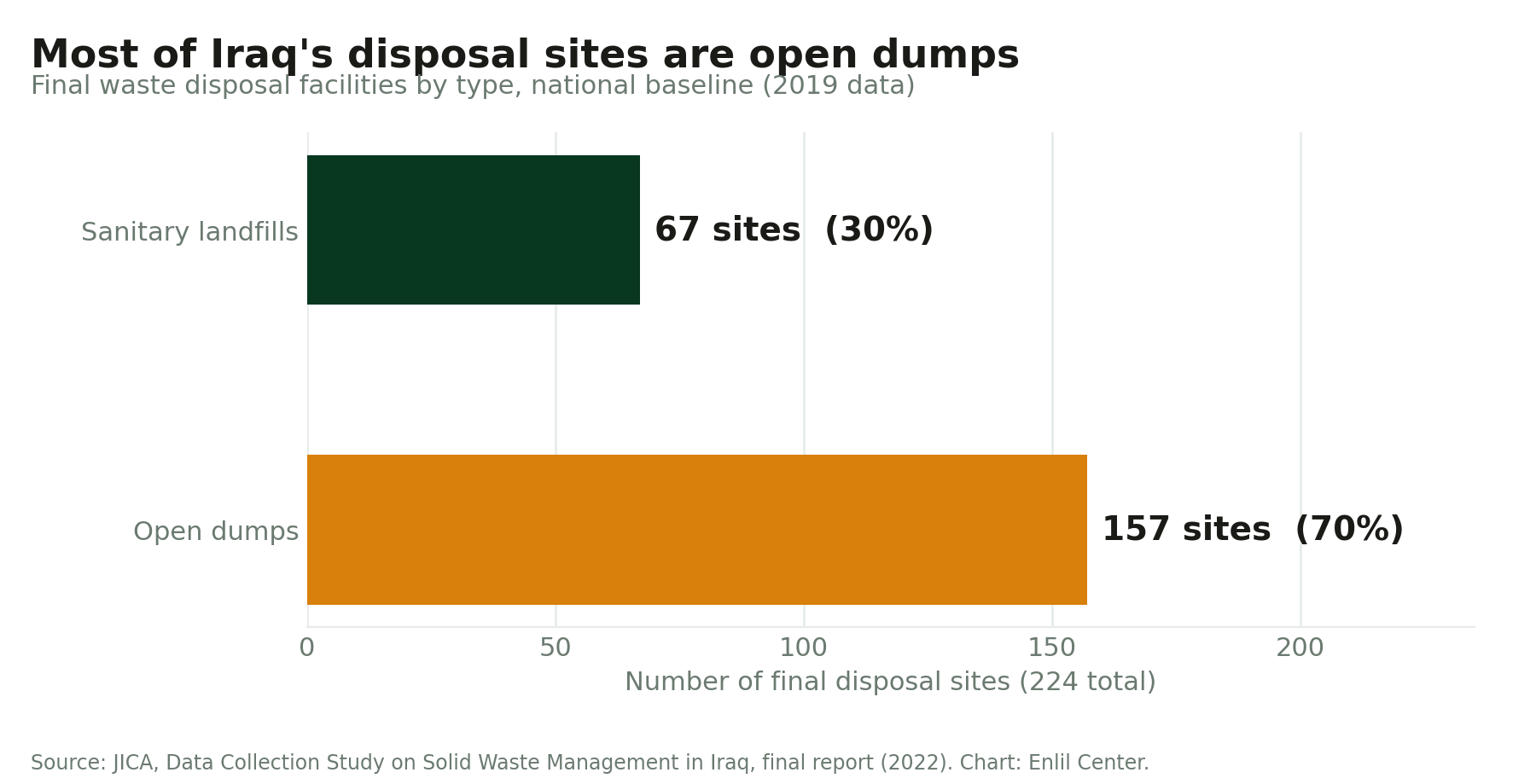
Caption: Of the 224 waste disposal sites in JICA's national baseline, seven in ten are uncontrolled open dumps. Source: JICA, Data Collection Study on Solid Waste Management in Iraq (2022; 2019 data).
Iraq's own 2025–2035 national strategy puts the combined financing need for water and waste management infrastructure at $31.9 billion, of which roughly $27.7 billion is expected to come from domestic public and private sources rather than international finance. That figure covers both sectors together — Enlil has not found a public breakdown isolating the waste-specific share — but even taken as a combined number it dwarfs what the state actually allocates. Iraq's 2023–2025 three-year budget gave the Ministry of Environment roughly $68 million a year — the first planned environmental budget line in the country's history — of which only about 48 percent was spent in 2023, almost all on salaries. The ministry's share of federal spending fell from 6.3 percent in 2016 to 0.08 percent in 2024. Spread over the strategy's ten years, the $31.9 billion need works out to roughly $2.9 billion a year: more than forty times the ministry's annual allocation. The gap, on any reasonable reading, is not marginal.
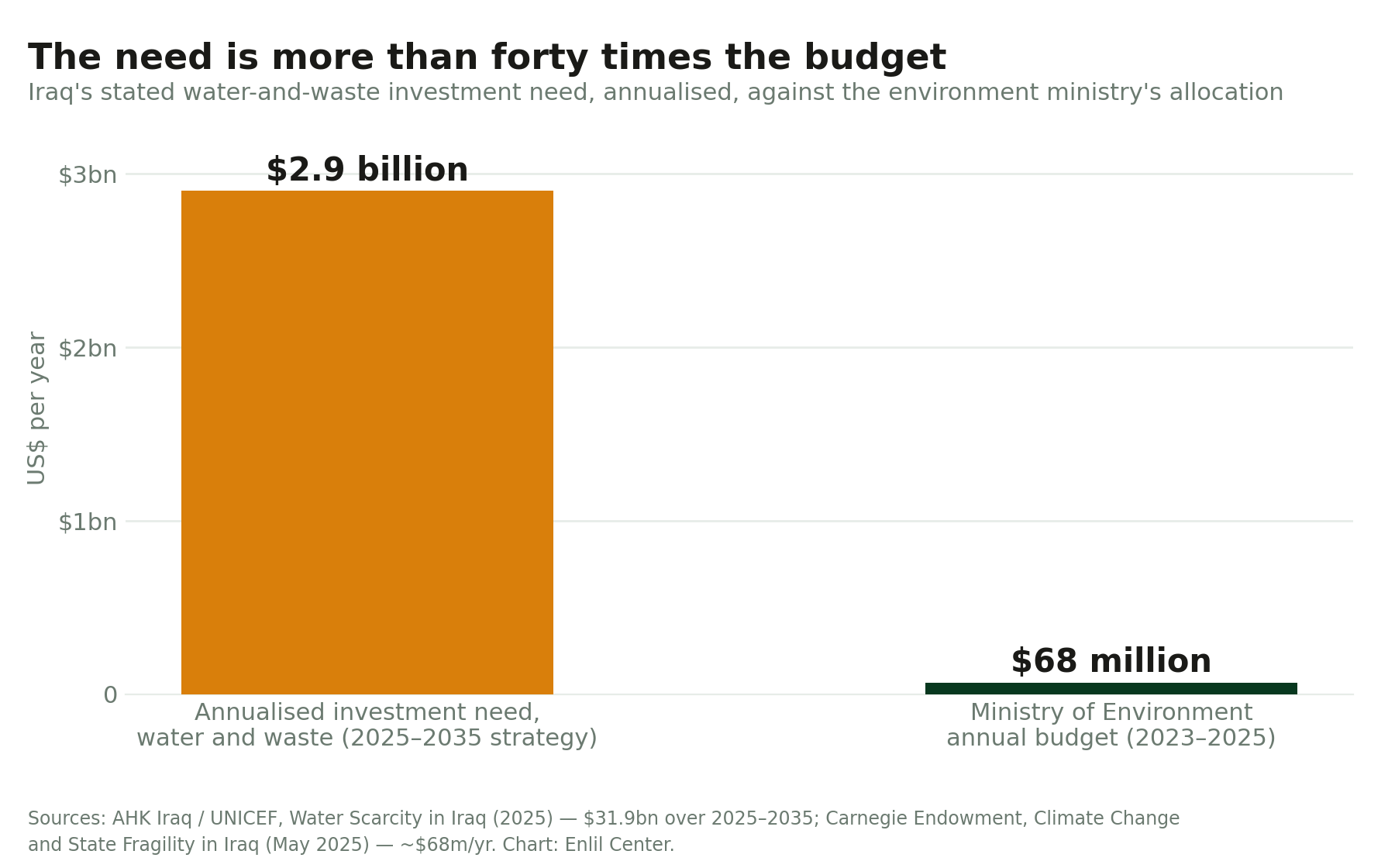
Caption: Iraq's own strategy implies about $2.9 billion a year of water-and-waste investment; the Ministry of Environment's annual allocation is about $68 million. Sources: AHK Iraq / UNICEF (2025); Carnegie Endowment (May 2025).
The climate dimension
Iraq's Paris Agreement commitments mention the waste sector as an emission source. Implementation has not followed. Open dumping and burning generate methane, particulate matter, volatile organic compounds, and dioxins. These compound Iraq's already significant climate liability. The country is among the most climate-vulnerable in the region, facing overlapping pressure from heat, water scarcity, and desertification, and its waste practices are making that liability worse.
The majority of Iraq's waste policies predate current climate commitments. Law No. 27 of 2009 on the Protection and Improvement of the Environment — Iraq's primary legal basis for waste regulation, which explicitly prohibits open burning — does not itself address emission targets, air quality standards linked to waste, or climate resilience framing, because it was written before those became the terms of the conversation. The sector is not integrated into the broader climate planning architecture.
The open burning problem
Open burning is how many Iraqis — communities, waste collectors, and even municipalities — manage waste when no alternative exists. Household waste burned in backyards or along roadsides is the most visible form. Informal landfills are sometimes lit to reduce volume or deter scavenging. A specific and underreported driver is the burning of cables and electronics by informal collectors to extract metal for resale, a practice that releases dioxins and heavy metals at concentrations far exceeding any regulatory limit, in areas where no monitoring infrastructure exists to measure it.
The drivers are structural, not behavioral. Collection coverage is insufficient in both urban peripheries and rural areas. Formal landfills in many governorates are either full, informally inaccessible to private operators, or simply too far from the collection points feeding them. Burning continues because the alternative — uncollected waste accumulating in streets and canals — is politically worse in the short term. Communities in these conditions do not choose open burning. They arrive at it.
Basra and Baghdad: the pattern in practice
Basra is the clearest case. Iraq's oil capital generates significant industrial and municipal waste volumes, and fire hotspots have repeatedly been reported clustering around the city's informal dumpsites, intensifying in summer months when heat accelerates decomposition and uncollected waste becomes intolerable at street level.
In November 2024, Reuters filmed drone footage over a landfill in Babylon governorate and interviewed residents, including one named Tarek Dhari, who described waste burning in the afternoon and the illnesses it causes locally. It is not an isolated incident so much as a pattern that repeats, under different names, across governorates.
Baghdad's own daily waste volume is harder to pin down precisely than the coverage around it implies — official per-city figures are not consistently published — but the scale is large enough that when the Council of Ministers approved a new waste-to-energy plant for the city in February 2025, the contract specified 3,000 tons of municipal solid waste a day as the plant's intake, sourced from Baghdad Municipality. The $497 million contract was awarded by the National Investment Commission in January 2025, approved by the Council of Ministers in February, and construction began in March 2025, with the Ministry of Electricity obliged to buy the plant's output up to an initial 100 MW. Set against even the lower 31,000-ton national estimate, one funded, under-construction plant covers under a tenth of the daily load — a genuine step, and also a measure of how far a single infrastructure project is from closing this gap.
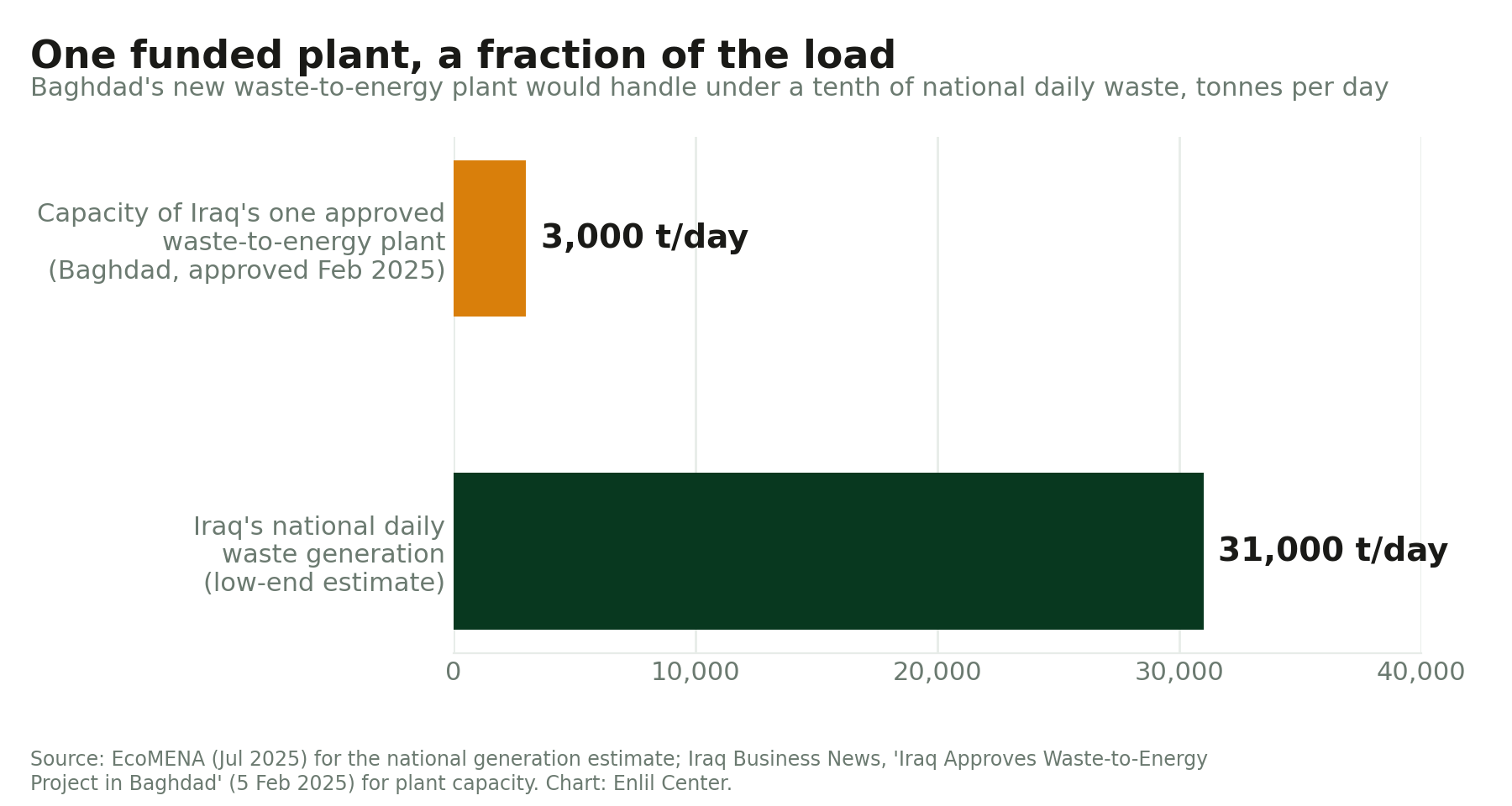
Caption: Baghdad's new waste-to-energy plant, approved in February 2025, would process under a tenth of Iraq's daily waste even on the low-end national estimate. Sources: EcoMENA (July 2025); Iraq Business News (5 February 2025).
Policy and legal architecture
Enforcement outside major urban centers is nearly absent. The fragmentation between ministries, municipalities, and donor programs means that even where laws exist and projects are funded, they often operate without coordination and without scaling.
International donor engagement has increased. The World Bank has funded pre-investment studies for landfill rehabilitation and closure, sanitary-landfill demonstration sites, an assessment of hospital waste handling in Baghdad, and preliminary designs for industrial waste treatment in Basra. JICA has supported baseline data collection on the national waste stream. UNDP has focused on climate-resilient waste management in vulnerable communities. Most of these interventions remain at the pilot or assessment stage.
What needs to happen
The recommendations below are not new to anyone working in this sector in Iraq. The problem is sequencing and political will, not information.
Iraq needs engineered regional landfills, with leachate management and methane capture, in every major governorate. This is the baseline. Without managed disposal infrastructure, enforcement of open burning prohibitions is not viable — governments cannot credibly penalize communities for burning when burning is the only option available to them.
Enforcement of open burning prohibitions needs to be funded and staffed, with fines linked to accessible alternatives, not imposed in a vacuum.
The Baghdad waste-to-energy plant approved in 2025 is the kind of project this sector needs more of, not fewer — Enlil expects its actual construction and operating record over the next two years to be a genuine test of whether Iraq can deliver capital-intensive waste infrastructure on schedule, not just approve it.
Recycling cooperatives and composting programs, supported through direct subsidy, can absorb portions of the waste stream while creating employment. Source separation protocols, starting with commercial and institutional generators, can reduce the complexity of downstream processing.
National waste policy needs to be rewritten with climate commitments embedded from the start, not added as afterthoughts. NDC alignment and SDG framing should shape the legislative revision.
Air quality monitoring in identified burning hotspots, using real-time data and community alert systems, is both technically feasible and politically necessary. Communities need to be able to see what they are breathing. That visibility changes what governments are willing to do.
Conclusion
Iraq is burning its waste. Not metaphorically, not occasionally. Daily, at scale, in every governorate, with consequences that accumulate in lungs, in water tables, and in the atmosphere.
The infrastructure and governance gaps that produce this are documentable, if not precisely quantified — Iraq's own institutions cannot yet agree on how much waste the country even generates. Addressing the combined water-and-waste infrastructure deficit is estimated at $31.9 billion over the 2025–2035 period. That figure is large but not unprecedented for a country with Iraq's oil revenues. What has been missing is the political will to treat waste as a priority sector and the institutional coherence to act across ministries, municipalities, and donor programs.
The fires are a symptom. The institutional fragmentation — including the fragmentation in the government's own data — is the condition. Addressing one without the other will not work.