
Summary
- COP29 closed in Baku on 24 November 2024 with a New Collective Quantified Goal (NCQG) on climate finance: developed countries agreed to lead mobilizing at least $300 billion a year for developing countries by 2035, inside a wider ambition of $1.3 trillion a year from all sources. It replaced a $100 billion annual goal set in 2009 that had run through 2025.
- Many developing-country negotiators called the number inadequate; UNFCCC's own Executive Secretary said the crisis required roughly $1.3 trillion a year, and India's delegation rejected the outcome outright on the floor.
- Iraq went into Baku holding two positions in tension: support for the Paris Agreement's goals, and resistance to any language that would require phasing out the oil exports that fund the great majority of government spending.
- During COP29, the Green Climate Fund's board confirmed a $39 million, six-year project with Iraq's government and the FAO to build climate resilience into agriculture in Karbala, Muthanna and Najaf — Iraq's concrete finance result from the conference, larger than earlier reporting suggested.
- One year on, Iraq's climate pledge has changed more than its oil dependence has: at COP30 in Belém in November 2025, Iraq submitted a new NDC (NDC 3.0) committing to a 22 percent emissions cut against business-as-usual by 2035 — up from 15 percent by 2030 in the pledge it carried into Baku — while oil rents were still worth 43 percent of GDP in the most recent year on record.
- Enlil reads the gap between the two trend lines as the actual story: Iraq's paper commitments are getting more ambitious under diplomatic pressure faster than its underlying economy is diversifying away from oil.
A finance goal that satisfied almost no one
The headline outcome of COP29 was the New Collective Quantified Goal on climate finance, agreed in the conference's final hours on 24 November 2024 after talks ran well past their scheduled close. It set a floor of at least $300 billion a year by 2035 for developed countries to help mobilize for developing countries, nested inside a broader, non-binding ambition to reach $1.3 trillion a year in total climate finance from all public and private sources by the same date. That floor replaces the $100 billion annual goal agreed in Copenhagen in 2009, which was meant to run from 2020 through 2025.
On paper, $300 billion is triple the old goal. In practice, negotiators from the countries the money is meant to help were unimpressed. UNFCCC Executive Secretary Simon Stiell, whose own institution helped broker the deal, said the scale of the crisis required closer to $1.3 trillion a year — the aspirational figure, not the guaranteed one — and called the agreement "an insurance policy for humanity, but only if premiums are paid in full, and on time." India's delegation rejected the text on the floor as it was being gaveled through, and UN Secretary-General António Guterres, while welcoming the deal, described it publicly as a foundation to build on rather than a solved problem. Enlil treats the $300 billion figure as the meaningful commitment and the $1.3 trillion figure as aspirational: the agreed text does not specify how much of either number is grants versus loans, or public versus private capital, which is precisely what recipient governments — Iraq among them — have to plan financing around in practice.
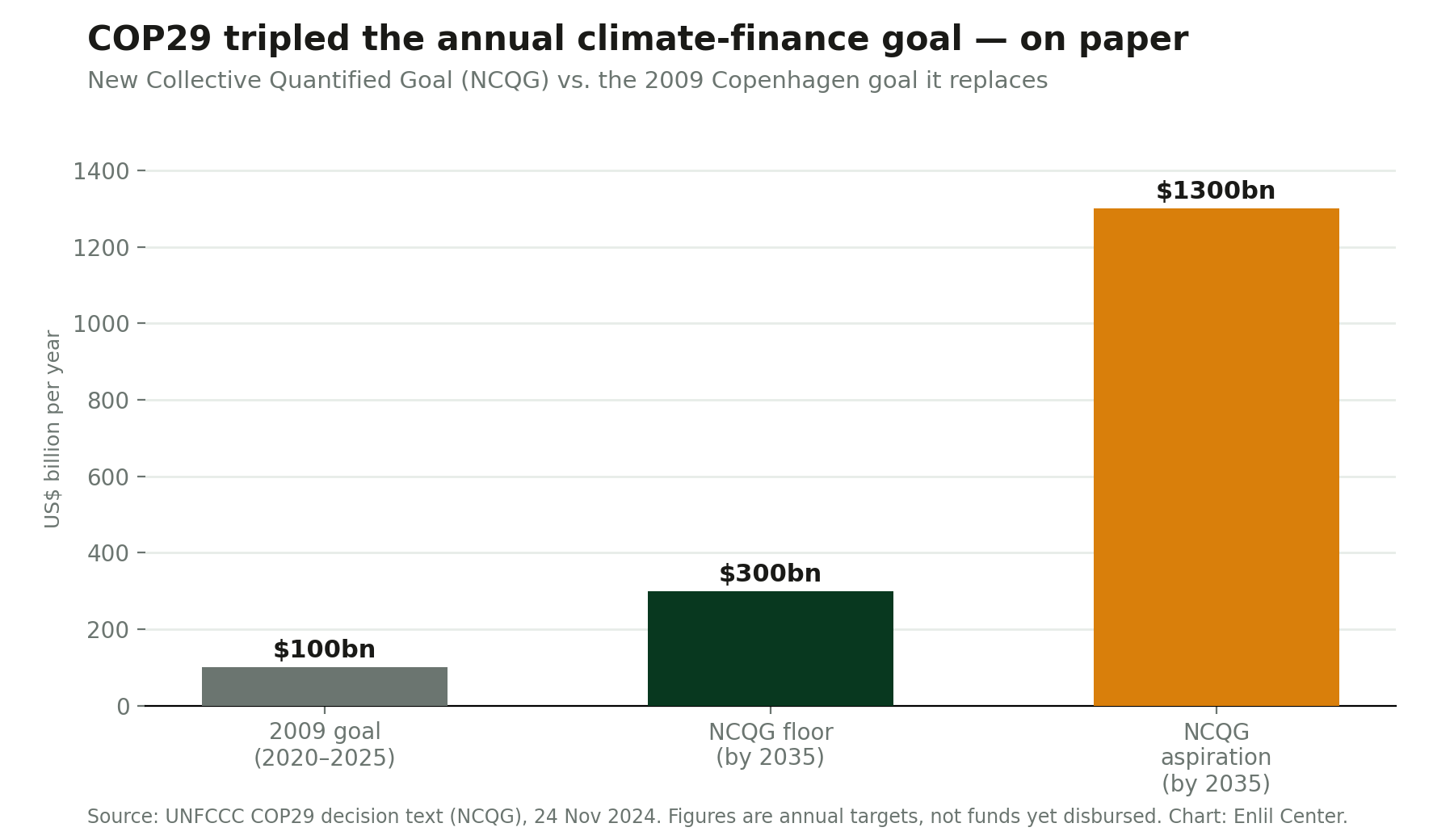
Caption: Figure 1. The New Collective Quantified Goal triples the floor of the old Copenhagen climate-finance commitment, to at least $300 billion a year by 2035, inside a wider $1.3 trillion aspiration for all sources combined. Source: UNFCCC COP29 decision text, 24 November 2024.
Iraq's position: support the goals, protect the revenue
Iraq attended COP29 carrying a structural contradiction that predates the conference and has not gone away since. It is OPEC's second-largest crude producer, and oil sales fund the large majority of the federal budget — a dependency the IMF has repeatedly flagged as Iraq's central fiscal vulnerability. President Abdul Latif Jamal Rashid told the conference that Iraq remained committed to international climate cooperation and environmental sustainability, while Iraqi officials resisted language elsewhere in the talks calling for a firm fossil-fuel phase-out timeline, arguing that oil exports remain the country's primary source of revenue for public services and reconstruction.
That position was not simply obstruction. Iraq's own updated NDC, submitted before COP29, already committed to a conditional 15 percent cut in emissions against business-as-usual by 2030 (versus a 13 percent target in its earlier pledge), alongside an unconditional target that had doubled from roughly 1 percent to 2 percent. The Ministry of Electricity had separately set an ambition of 12 gigawatts of renewable capacity by 2030 — about a third of planned power capacity — dependent on an estimated $100 billion in investment that Iraq does not have on hand domestically. The conditional structure of that pledge is the point: Iraq was telling COP29 explicitly that its climate ambition scales with the finance it receives, which is exactly the mechanism the NCQG negotiations were fighting over.
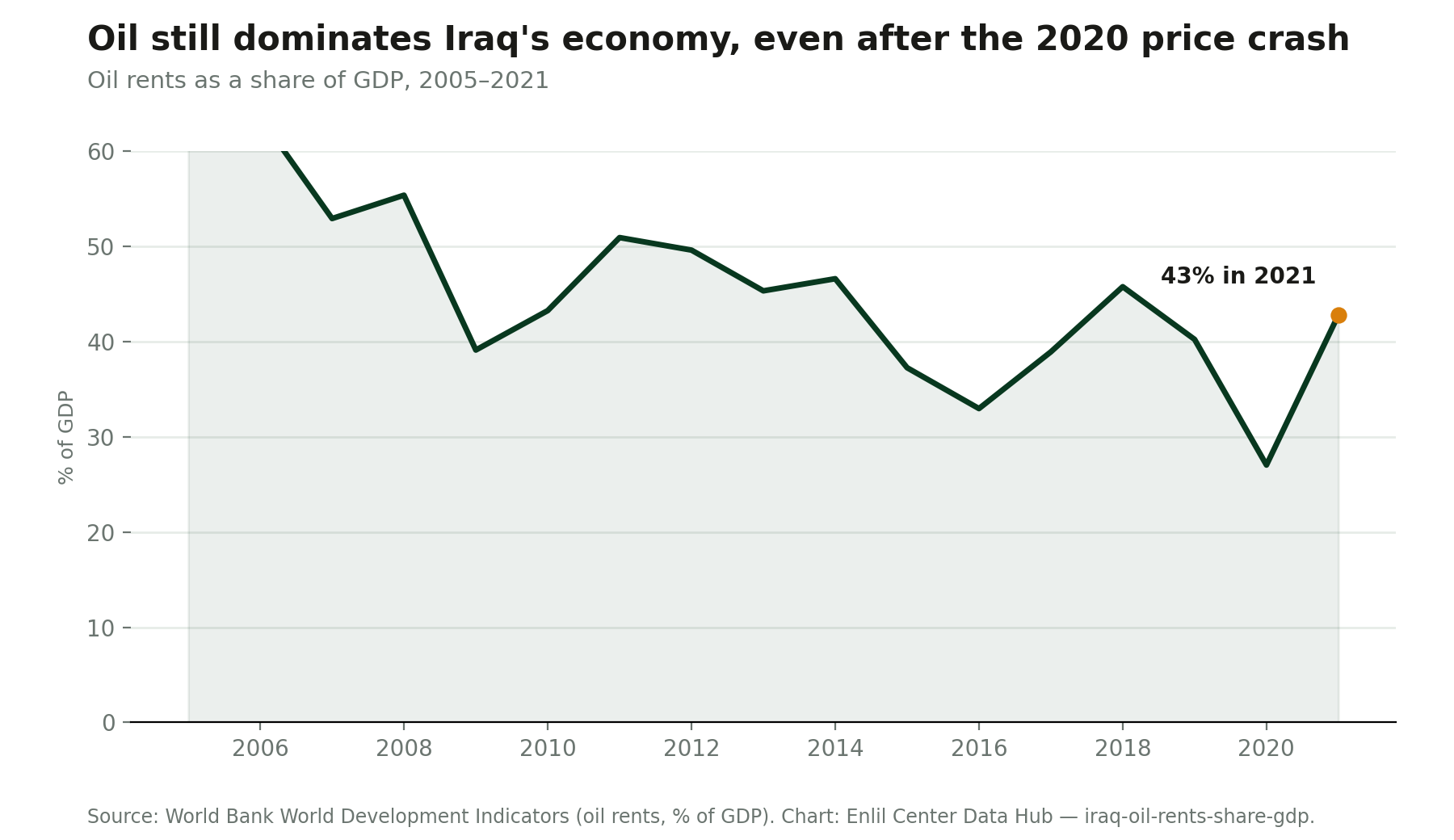
Caption: Figure 2. Oil rents fell sharply in the 2020 price crash but had recovered to 43 per cent of GDP by 2021, the latest year in the World Bank's series — the economic base against which Iraq's emissions pledges have to be read. Source: World Bank World Development Indicators, via Enlil Center Data Hub.
What Iraq actually got at Baku
Iraq's most concrete, verifiable result from COP29 was not a headline finance pledge but a specific project. The Green Climate Fund's board approved $39 million on 24 October 2024 for a six-year initiative — Strengthening Climate Resilience of Vulnerable Agriculture Livelihoods in Iraq's Rural Communities (SRVALI), led by the FAO with Iraq's government — targeting Karbala, Muthanna and Najaf governorates, where water scarcity is already undermining farming livelihoods. It was formally launched in coordination with FAO during the Baku conference. That figure is meaningfully larger than the $30 million initially reported around the conference and repeated in earlier Enlil coverage; Enlil has corrected it here against the Green Climate Fund's and FAO's own published project records.
Set against Iraq's own $100 billion estimate for a full renewable build-out, or against the emissions-cut commitments it has now made twice, $39 million for one rural-resilience project is a rounding error — useful, real, and far short of the scale the country's own pledges imply it needs.
One year later: a bigger pledge, on a faster clock
The clearest test of whether COP29 changed anything for Iraq is what happened at the next one. At COP30 in Belém in November 2025, Iraq submitted NDC 3.0, replacing the pledge it had carried into Baku. The new target is steeper and the deadline is closer: a 22 percent cut in emissions against business-as-usual by 2035, made up of a 5 percent unconditional commitment and a further 17 percent conditional on international support — up from the 2 percent unconditional and 15 percent conditional targets, against a 2030 deadline, that Iraq held during COP29. The new NDC also sets a renewable-energy share of 8.5 percent of the total energy mix by 2030 and estimates $72.2 billion in financing needed to deliver the full mitigation and adaptation package, alongside an estimated $5 billion a year in current economic losses from climate impacts.
Enlil reads the upgrade as real but not free-standing: Iraq raised its target within a year of Baku, which is faster movement than the country's actual energy mix has shown. The latest year of data in Iraq's own oil-rents figures — 43 percent of GDP in 2021, after a sharp 2020 dip tied to the pandemic oil-price crash and a partial recovery since — shows an economy still structured around the export that a serious mitigation pathway would need to shrink. Renewable electricity's share of total output remained under 4 percent as of the same year. A pledge can be revised in a single diplomatic season; a power grid and an export base cannot.
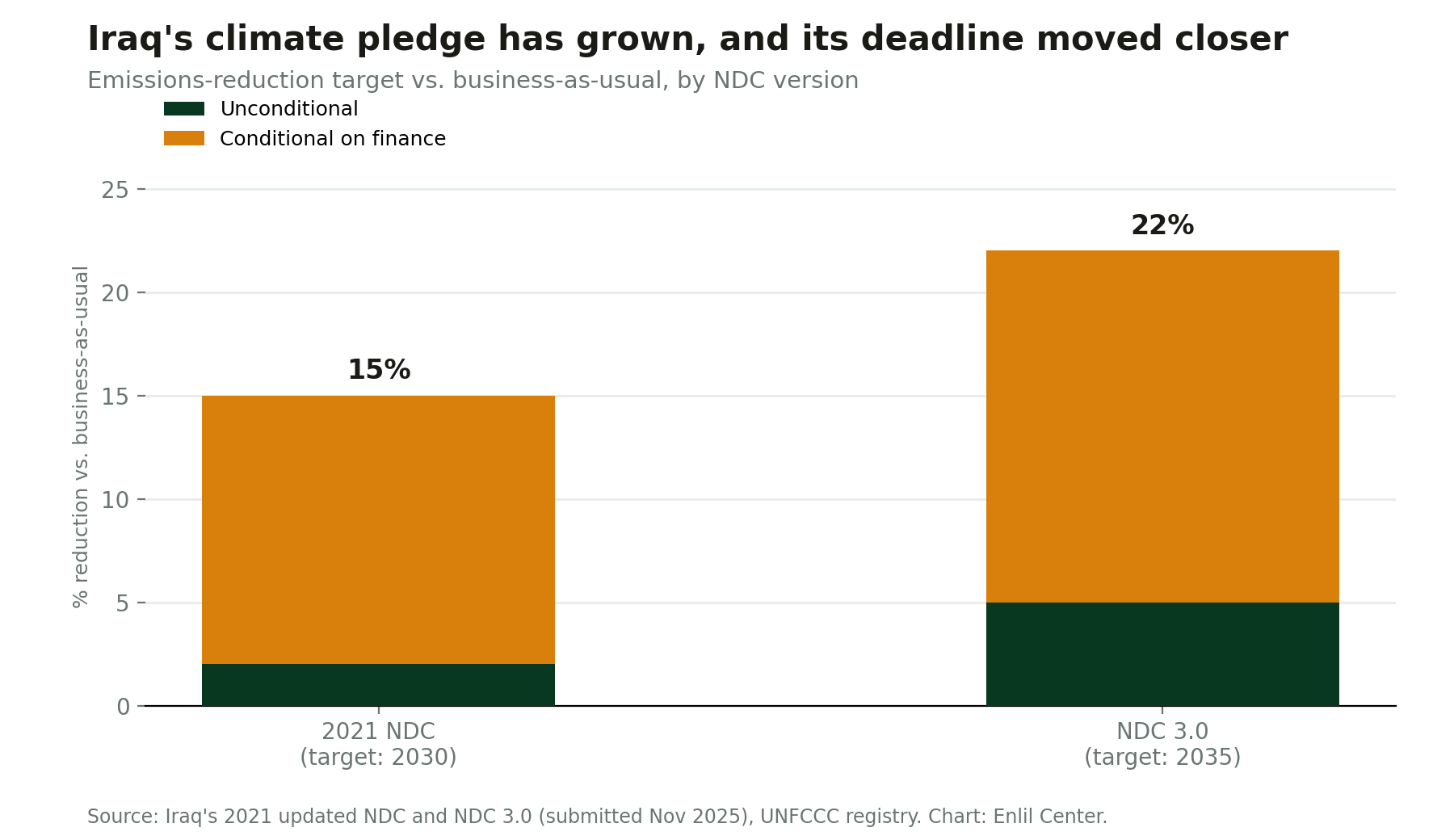
Caption: Figure 3. Iraq's pledge grew from 15 to 22 per cent between the NDC it held during COP29 and the one it submitted at COP30 a year later, but most of the increase is still conditional on international finance arriving. Source: Iraq's 2021 updated NDC and NDC 3.0 (submitted November 2025), UNFCCC registry.
What would make the next pledge different
Iraq's pattern across two COP cycles is consistent: arrive defending oil revenue, leave with a marginally larger conditional emissions target and one discrete, bankable project. That is not nothing — SRVALI is a real $39 million commitment reaching close to two million rural residents, and NDC 3.0's steeper target is a genuine diplomatic step relative to its predecessor. But the conditional share of both NDCs (17 of 22 percentage points in the newest version) means the bulk of Iraq's own climate ambition is explicitly contingent on finance flows that COP29's $300 billion goal does not guarantee will reach a mid-sized producer state ahead of larger claimants. Whether NDC 3.0 becomes more than a document depends on whether Iraq secures financing closer to its own $72.2 billion estimate than the $39 million it received at Baku — and on whether the oil-rents and renewable-share figures look different the next time Enlil checks them.