
Summary
- Iraq's state budget still depends on oil for the large majority of its revenue — a dependence that got measurably worse in real time while this argument was being tested: oil's share of the federal budget fell from around 91 percent in early 2025 to roughly 84 percent by mid-2026, not because Iraq diversified, but because a slump in oil prices and exports after the Iran-related disruptions of mid-2026 cut government income and forced a fiscal squeeze.
- Carbon markets, under Article 6 of the Paris Agreement, are one of the few mechanisms that could let Iraq turn emissions reductions into revenue. Iraq signed a climate and carbon-economics memorandum with the United Kingdom in January 2025, under which Iraq pledged to end gas flaring by 2028 and the two countries committed to a five-year roadmap on solar, gas switching and energy efficiency.
- The institution meant to run this system, the General Company for Carbon Economics (GCCE), is real — formed under the Ministry of Environment by a 2024 cabinet decision and formally launched at Iraq's first international carbon economics conference in Baghdad in May 2025. It still has no public national carbon registry and no functioning measurement, reporting and verification (MRV) system, which is what any credible credit depends on.
- The clearest concrete opportunity remains gas flaring. Iraq flares an estimated 17-18 billion cubic meters of gas a year and was the world's third-largest flaring country in 2025, behind only Russia and Iran. On 23 September 2026 — the week this piece was revised — the Ministry of Oil opened a new 30 million-cubic-foot-per-day gas processing unit at the East Baghdad South field, run by EBS Petroleum (the Iraq-registered arm of China's state-owned Zhenhua Oil) with Midland Oil Company, feeding Baghdad's Bismaya power station. It is a real, checkable example of the kind of project that could generate a verifiable carbon credit — and a reminder that Iraq is still building this capacity one unit at a time, not at the pace 500-plus emission sources would require.
- The risks are structural, not hypothetical: weak public financial oversight makes Iraq's carbon economy vulnerable to elite capture, and any land-based project (mangrove restoration, wetland credits) carries a real risk of sidelining the communities who depend on that land unless consent and impact-assessment rules are built in from the start.
An economy still built on one commodity
Iraq sits on one of the world's largest hydrocarbon reserves, and for decades that fact has been both the country's economic lifeline and its structural trap. The scale of that dependence is not abstract. Iraq's Ministry of Finance reported that oil and mineral-resource revenue made up 84 percent of federal budget income in the first five months of 2026, down from 91 percent over the same period in 2025 — not because non-oil revenue grew fast enough to matter, but because a fall in oil export income, worsened by the mid-2026 Iran-related disruption to regional trade, cut Iraq's overall revenue by roughly 27 percent year-on-year. Iraq posted a budget deficit of around $5 billion in the first four months of 2026 as a direct result. Enlil treats this as the sharpest illustration available of the argument this piece originally made in mid-2025: when oil prices or exports wobble, the Iraqi state's entire fiscal position wobbles with them, because nothing else is built to absorb the shock.
Carbon markets will not solve that on their own. But they are one of the few mechanisms that can simultaneously generate new revenue, incentivize emission reductions, and signal that Iraq is serious about its climate commitments. The question this piece asks is narrower and more testable: can Iraq build the institutional architecture needed to participate credibly, before the window closes.
What Article 6 actually offers Iraq
The Paris Agreement's Article 6 created the legal basis for countries to trade carbon credits internationally. Under Article 6.2, countries can exchange Internationally Transferred Mitigation Outcomes — verified units of emission reduction — with other nations. For Iraq, this matters because it creates a direct link between domestic climate action and external revenue.
The January 2025 memorandum of understanding between Iraq and the United Kingdom, signed by Deputy Prime Minister and Foreign Minister Fuad Hussein and UK Foreign Secretary David Lammy, set out more than a general intention. It committed both governments to a five-year roadmap on gas flaring reduction, energy efficiency and renewable power, and — a specific, checkable target the original version of this piece did not include — Iraq pledged to end gas flaring entirely by 2028, while the UK committed to its own clean-energy transition by 2030. An MOU is not the same as an operating carbon-credit economy, but a dated, named target is a stronger commitment than a general aspiration, and it gives Iraq's own government a deadline it will either meet or visibly miss.
The General Company for Carbon Economics, established under the Ministry of Environment following a 2024 cabinet decision, exists to bridge that gap. Its mandate covers registering carbon credits, overseeing mitigation projects, and developing measurement and reporting frameworks. It formally launched alongside Iraq's first international carbon economics conference in Baghdad in May 2025, bringing in participants from the Ministry of Oil, the Central Bank of Iraq, and international partners, and has since drawn project proposals from firms in the US, UK, Norway, China and India. On paper, it is well-positioned. In practice, it still operates without a public national carbon registry or a functioning MRV system — and that combination is what makes credible, internationally tradable carbon credit generation difficult right now, whatever interest exists on paper.
Governance, not opportunity, is the binding constraint
Iraq's challenge is not a lack of opportunity. It is a lack of institutional readiness.
A credible carbon credit requires three things: a verified baseline of emissions before a project starts, a measurement system that tracks reductions in real time, and independent third-party verification of the numbers. Iraq does not yet have these operating at scale. Baseline data across oil and gas, agriculture and waste is either outdated or fragmented across ministries that rarely coordinate with each other.
This matters beyond process. Without a working MRV system, Iraq cannot generate credits that meet international standards. Without internationally credible credits, it cannot attract the climate finance it needs. Without that finance, it cannot fund a transition away from the oil dependency that, as the budget numbers above show, is currently getting worse rather than better. Enlil treats this as a genuine cycle, and the entry point is governance, not market access.
Iraq's own just-transition framework correctly calls for a phased-down approach to fossil fuel dependence rather than an abrupt phase-out — the country's development needs make that the only realistic path. But phasing down requires a roadmap, and a roadmap requires data Iraq does not yet systematically collect. The absence of a national carbon registry is not a technical oversight. Enlil assesses it as a strategic liability that undercuts every other commitment layered on top of it.
Where the concrete wins already are
Despite the institutional gaps, Iraq has real, checkable starting points.
Gas flaring is the clearest one. Iraq flares an estimated 17-18 billion cubic meters of associated gas annually. According to the World Bank's Global Gas Flaring Tracker, Iraq was the world's third-largest flaring country in 2025, behind only Russia and Iran — together the three countries burned about 84 billion cubic meters, nearly half of everything flared globally that year. Each cubic meter flared is wasted revenue and an avoidable emission.
This is not a hypothetical fix. On 23 September 2026, Iraq's Ministry of Oil inaugurated a new gas processing unit at the East Baghdad South field with a capacity of 30 million standard cubic feet per day, built by EBS Petroleum — the Iraq-registered arm of China's state-owned Zhenhua Oil — in partnership with Midland Oil Company. The gas is piped directly to Baghdad's Bismaya power station via a line built by the State Company for Oil Projects. Minister of Oil Basim Muhammad Khudhair al-Abadi described it as part of a strategy to end flaring and convert associated gas into usable power. It is exactly the kind of intervention that could generate a verifiable, high-integrity carbon credit once Iraq's MRV system exists to certify it — and, at 30 million cubic feet a day against a national flaring volume in the billions of cubic meters, it is also a reminder of how much scaling remains before flaring reduction alone closes the gap.
Methane capture is closely related. Iraq joined the Global Methane Pledge, launched at COP26 and reinforced at COP28, committing to cut methane emissions 30 percent by 2030 against 2020 levels — part of a wider goal, tied to its Nationally Determined Contributions, of a 15 percent cut in overall greenhouse gas emissions by 2030 with international support. Gas leak detection systems are already being deployed at some oil extraction sites. This is ongoing activity, not aspiration — it could be generating credits today if the MRV infrastructure existed to verify it.
Land-based carbon sequestration is a different category of opportunity. Since 2023, the World Food Programme, Iraq's Ministry of Environment, the Basra local government and the University of Basra's Marine Science Centre have run a mangrove nursery in the tidal flats near Basra, with capacity to produce up to a million seedlings a year across a 400-hectare site, and an ambition to eventually restore up to 15,000 hectares of degraded coastline. Iraq's marshlands, once among the largest wetland systems in the world and now severely degraded, represent a carbon-sink restoration opportunity at meaningful scale — but restoration projects like this generate carbon credits only if they are measured and verified the same way an industrial project would be, which returns the argument to the same governance gap.
The risks a credible system has to design against
Any honest account of Iraq's carbon market potential has to engage with the country's institutional vulnerabilities directly, not around them.
Corruption is the most obvious risk. Carbon markets are globally susceptible to elite capture, speculative offsetting and greenwashing. In Iraq, where public financial management is weak and transparency mechanisms are limited, those risks are amplified, not reduced, by the same fiscal pressure documented above — a state short on oil revenue has a stronger incentive to treat a new carbon-credit revenue stream as a shortcut rather than build it properly. A scheme that becomes a channel for politically connected actors without delivering genuine emission reductions would damage Iraq's environmental credibility internationally and deepen public distrust domestically.
The answer is not to avoid carbon markets but to design accountability in from the start: third-party auditing, public disclosure of project registrations, and independent validation of MRV data are not optional extras if Iraq's credits are to carry weight in international markets.
Community displacement is a second, related risk. Carbon offset projects have a documented global history of prioritizing land-use changes that generate credits while dispossessing the communities who depend on that land. Any Iraqi framework needs enforceable safeguards against forced displacement, real community consent mechanisms, and accessible routes to redress. Enlil expects an Environmental and Social Impact Assessment to function as a legal requirement for every project entering the carbon registry, not a donor-requested courtesy — a distinction that will matter most for exactly the kind of marshland and mangrove projects described above, where the people living on that land are rarely the ones designing the credit scheme.
What sequencing would actually look like
Iraq does not need a perfect system before entering carbon markets. It needs a credible one, built in a sequence that matches its actual institutional capacity.
That means, in order: first, a legal framework — a carbon credit law defining ownership, trading rights and liability. Second, the registry itself — a national carbon tracking system recording every project, credit issued and transaction. Third, working MRV — sector-specific measurement and reporting protocols, starting with oil and gas, where data infrastructure already exists in some form. Fourth, piloting before scaling — three to five high-integrity projects across different credit types (gas flaring reduction, methane capture, ecosystem restoration) to generate proof of concept before Iraq enters international trading mechanisms at scale.
Iraq's window to position itself in global carbon markets is narrowing as the international climate finance architecture matures. Countries that build credible governance frameworks early gain a structural advantage over those that arrive late with improvised systems. Iraq has the environmental assets, a stated policy ambition, and now a specific, dated commitment — ending flaring by 2028 — against which its own progress can be measured. Enlil assesses that whether Iraq meets that 2028 deadline, not the MOUs and conferences that preceded it, is the test that will actually determine whether this became a functioning system or another announcement layered on top of the last one.
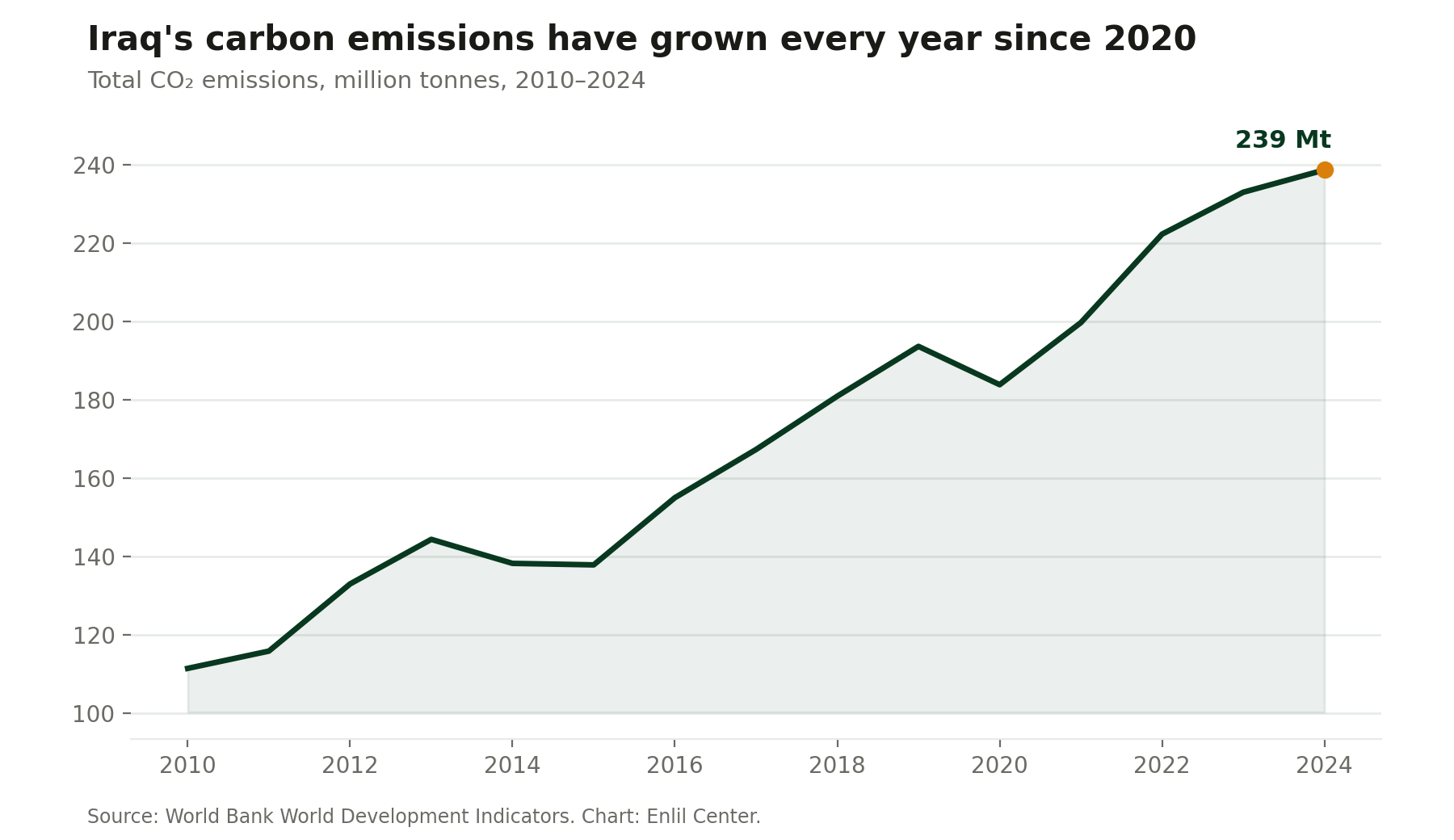
Caption: Iraq's carbon emissions have risen almost every year since 2010, reaching an estimated 239 million tonnes in 2024 — the backdrop against which any credible carbon-credit system has to operate. Source: World Bank World Development Indicators.
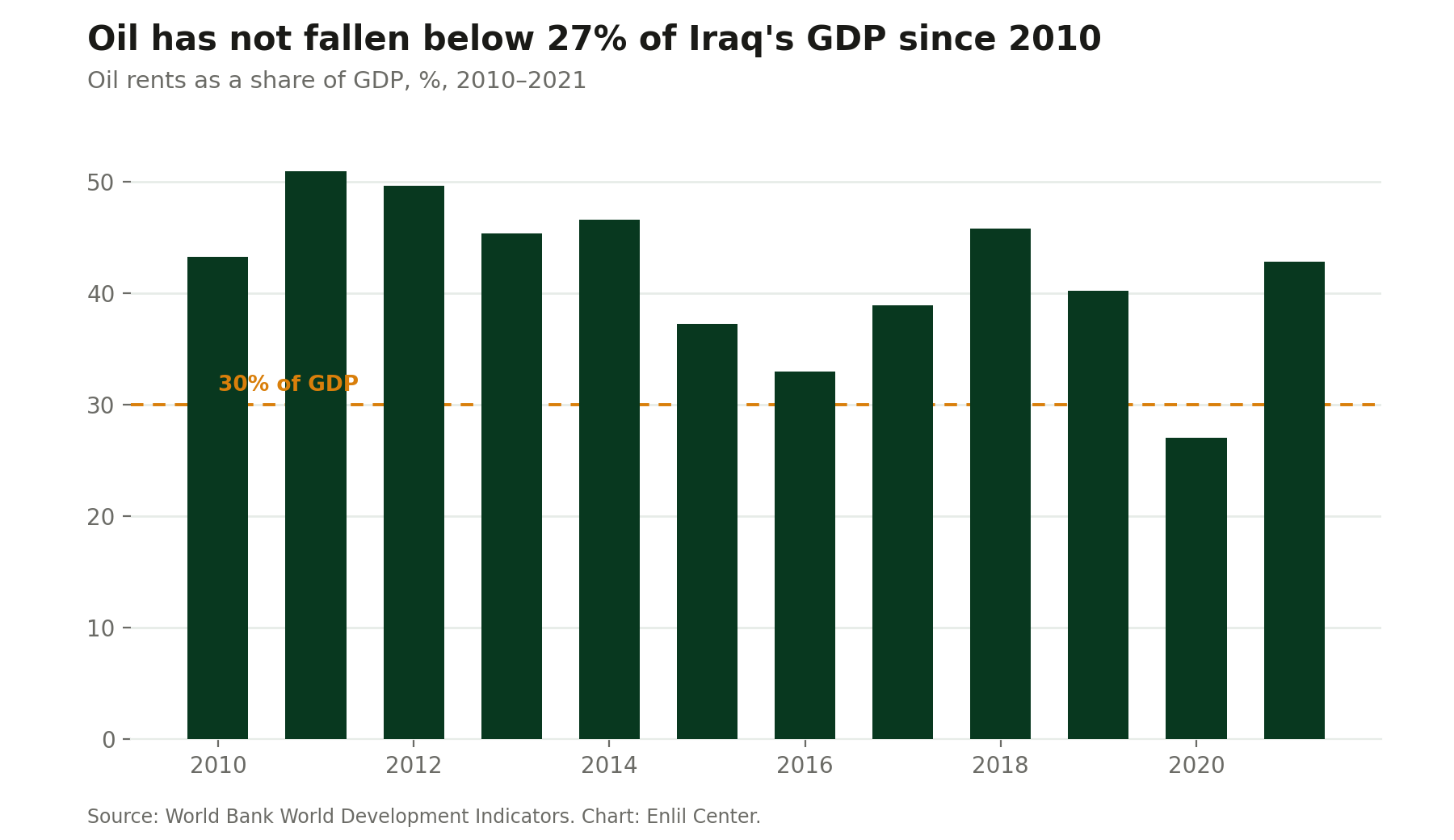
Caption: Oil rents have not fallen below 27 percent of Iraq's GDP in any year since 2010 — the structural dependence that makes carbon-market revenue, and economic diversification generally, a fiscal necessity rather than an option. Source: World Bank World Development Indicators.
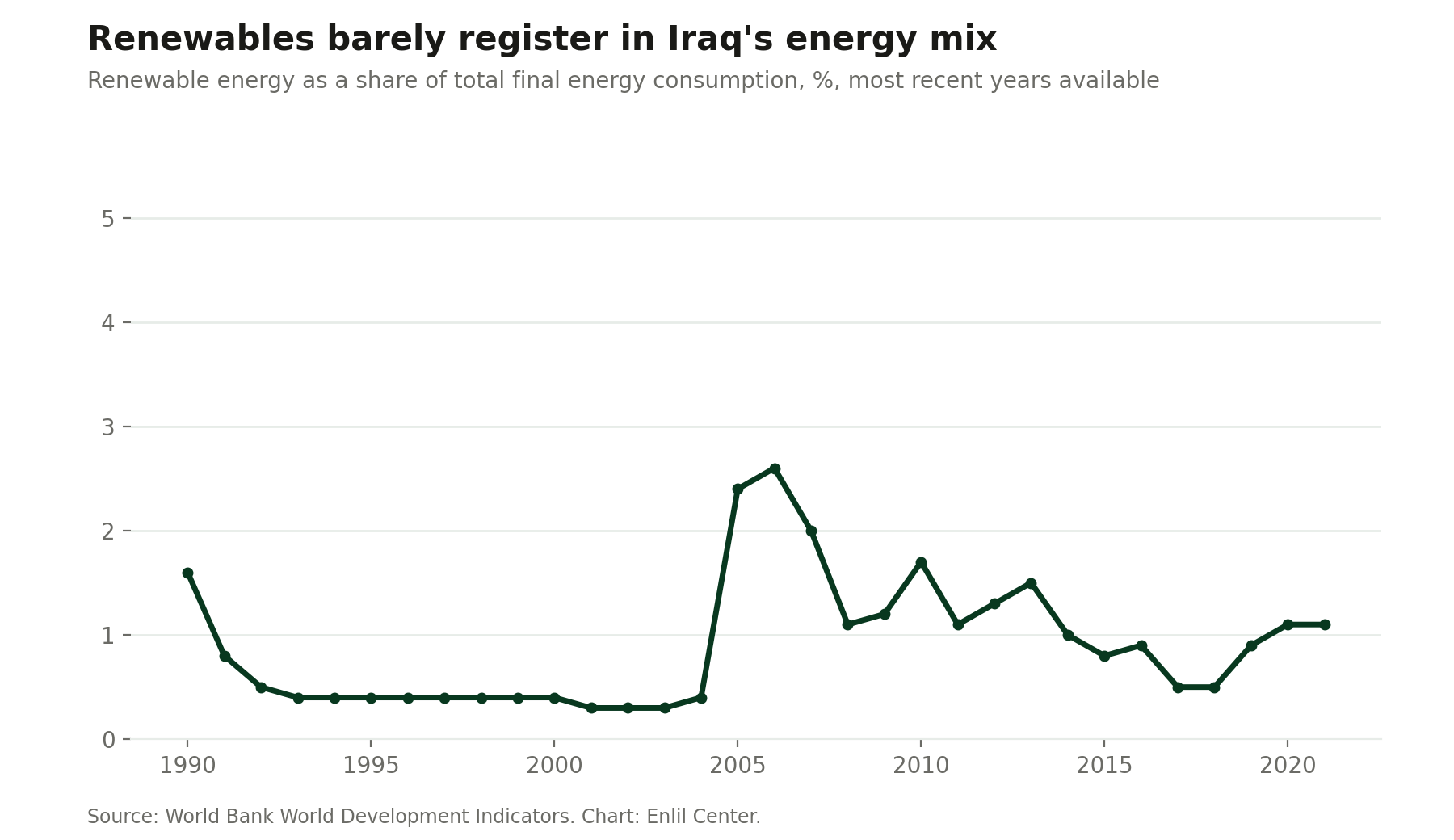
Caption: Renewable energy has never exceeded about 2.6 percent of Iraq's total final energy consumption in the three decades of available data — showing how little of Iraq's energy mix has shifted even as flaring and emissions have grown. Source: World Bank World Development Indicators.