
Summary
- The UN climate conference, COP31, runs in Antalya from 9 to 20 November 2026. Türkiye hosts it and Australia leads the negotiations. Iraq's delegation is headed by the Minister of Environment, Srwa Abdulwahid, and includes the Kurdistan Region. Its stated priorities are water security, adaptation and climate finance.
- Iraq arrives with a new climate plan, its NDC 3.0, submitted to the UN on 13 November 2025 and launched nationally on 8 October 2026. It promises to cut emissions by up to 5% below a projected baseline by 2035 on its own, and by 22% with international support. Even the supported path leaves emissions higher in 2035 than in 2020. The plan costs US$72.2 billion, of which at least US$51 billion is conditional on outside finance.
- Iraq also arrives without a national adaptation plan. The process started in 2020 with Green Climate Fund money; 81 developing countries have now submitted one, including Jordan, Lebanon, Morocco and Palestine. Iraq has not.
- The money available is far smaller than the need. The Green Climate Fund has approved US$49.5 million for two projects in Iraq and disbursed about US$1.6 million. The new loss and damage fund has US$342 million for its first round worldwide against US$2.8 billion in requests, and has approved no grants yet. In Antalya the real fight is over a new item on tripling adaptation finance by 2035.
- Enlil assesses that Iraq should expect no new money in Antalya itself. What it can gain is position: support for a tripling target with a clear baseline, a dust-storm alliance with its neighbours, and credibility on gas flaring, where World Bank satellite data show Iraq still flared 24.1 bcm in 2025, the third-largest volume in the world.
What COP31 is, and who runs it
COP31 is the 31st Conference of the Parties to the UN climate convention. It is also the meeting of the Paris Agreement parties, where most of the decisions that matter are taken. It opens in Antalya on 9 November and closes on 20 November, with a leaders' summit on 11 and 12 November and the ministerial segment from 17 to 19 November.
The arrangement is unusual. Türkiye hosts the conference, and Türkiye's Murat Kurum is COP31 President. Australia's climate minister, Chris Bowen, is "President of Negotiations" and steers the formal talks. Türkiye runs a voluntary Action Agenda with ten themes, among them clean energy and electrification, zero waste and methane reduction, climate-resilient cities and food security. The presidencies call this a "COP of Implementation": fewer new promises, more delivery on the ones made in Baku and Belém.
For Iraq, two things are different this year. It no longer chairs the Group of 77 and China, the bloc of developing countries it led through 2025 and on whose behalf it spoke at COP30 in Belém. The chair has passed to Uruguay, so Iraq will negotiate as a member of the G77 and the Arab Group rather than as the voice of either. And the government has changed. A new cabinet took office in 2026, and the Environment Minister who leads the delegation took office with it.
Who is going, and what they say they want
The Ministry of Environment says the minister "will head the Iraqi negotiating delegation" and that the delegation's messages centre on "water security, adaptation and climate finance". The President of the Republic received the delegation and its steering committee in July. The minister chairs the Permanent National Committee on Climate Change, which has met on both the NDC and COP31 preparations, and on 21 October she met the Kurdistan Regional Government's members of the delegation to build "a unified national position".
At the 37th session of the Council of Arab Ministers Responsible for the Environment in Cairo on 1 October, where she offered to host the next session in Baghdad, she called for a coordinated Arab position for COP31 on climate finance, adaptation, loss and damage and technology transfer. On 31 October she said that in Antalya Iraq intends to meet neighbouring countries and Egypt "to announce an alliance to confront dust storms" and to sign memorandums of understanding. That is the most concrete deliverable Iraq has announced.
What Iraq brings: the NDC 3.0 in numbers
A nationally determined contribution, or NDC, is each country's climate plan under the Paris Agreement. Iraq's first, submitted in October 2021, promised an unconditional cut of 1 to 2% below business as usual by 2030. The NDC 3.0 raises that to 3% by 2030 and adds two targets for 2035: up to 5% unconditional and up to 17% conditional on international support, a total of 22%.
The targets are cuts against a projection, not against today's emissions. The NDC puts Iraq's emissions at around 198 million tonnes of CO2-equivalent in 2020, rising to around 300 million tonnes by 2035 if nothing changes. On Enlil's arithmetic, the 5% target means about 285 million tonnes in 2035 and the full 22% means about 234 million. Both are higher than 2020. Iraq's plan slows growth; it does not yet promise a fall.
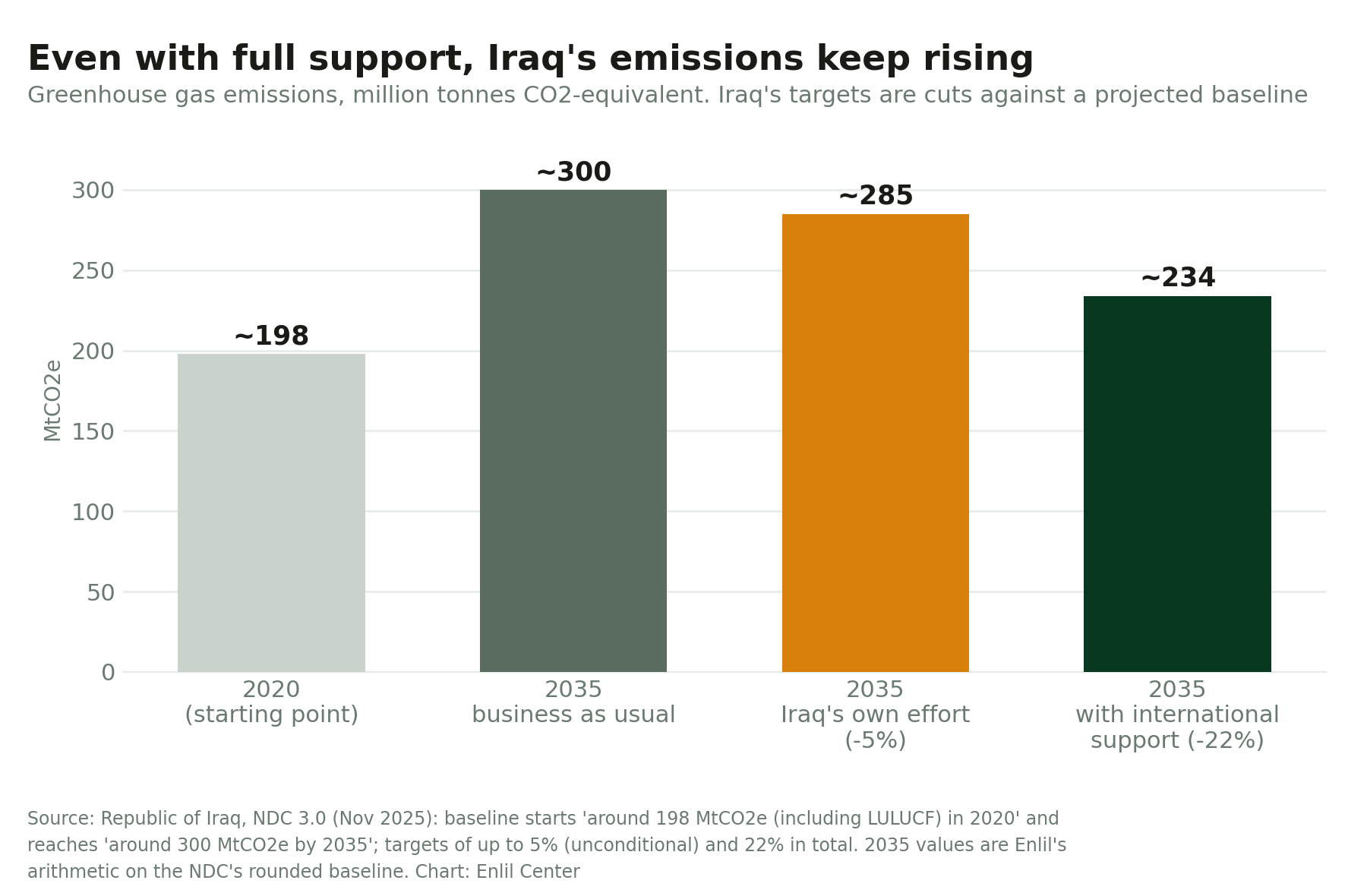
Caption: Iraq's targets are cuts against a projected baseline of around 300 MtCO2e in 2035. 2035 values are Enlil's arithmetic on the NDC's rounded baseline. Source: Republic of Iraq, NDC 3.0. Chart: Enlil Center.
The plan rests on four pathways: cutting electricity network losses, switching power plants from heavy fuel oil and diesel to gas and converting about 9 GW of single-cycle plants to combined cycle by 2030, capturing associated gas with "a goal reaching zero flaring by 2030 at latest", and raising renewables to 8.5% of generation by 2030. On adaptation it lists measures for water, agriculture, special ecosystems such as the marshes, and health. It also has a loss and damage section, which estimates the economic cost of climate impacts in Iraq at around US$5 billion a year, led by about US$1.1 billion in agricultural losses.
Then comes the price. The NDC's cost table adds up to US$72.2 billion: US$28 billion for mitigation, US$28 billion for adaptation, US$5 billion for loss and damage and US$5.6 billion each for technology transfer and capacity building. Iraq commits about US$9.2 billion from its own effort. At least US$51 billion is explicitly conditional on international support. Water adaptation alone is costed at US$11.8 billion and agriculture at US$8.35 billion. For scale, the NDC itself gives Iraq's 2024 GDP as US$272 billion.
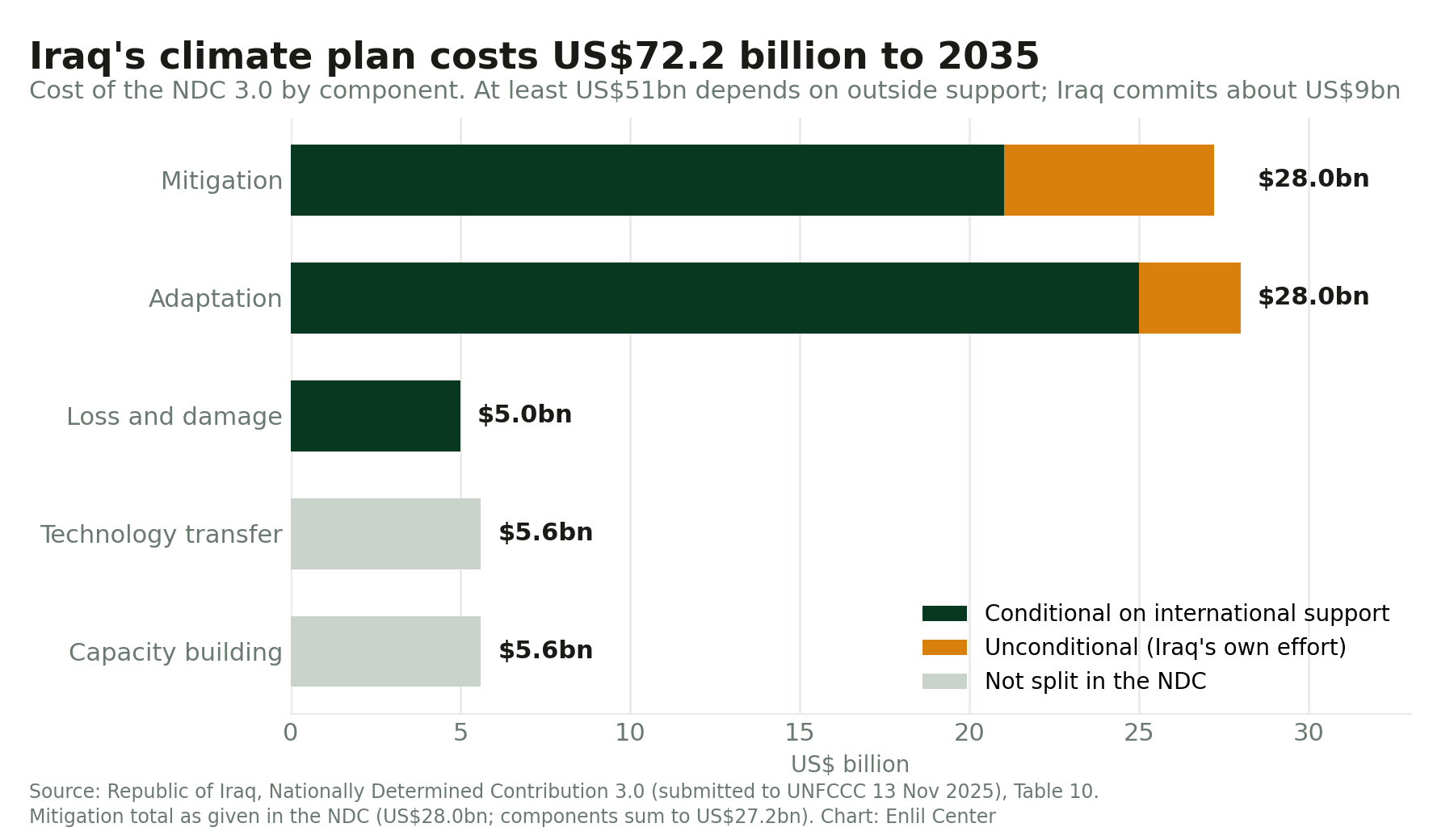
Caption: NDC 3.0 cost by component: at least US$51 billion is conditional on international support; Iraq commits about US$9 billion. Source: Republic of Iraq, NDC 3.0, Table 10. Chart: Enlil Center.
One caution about the baseline. The figures above are Iraq's own. Its national inventory, reported to the UN in its first Biennial Transparency Report in September 2025, puts 2021 emissions at 203.7 million tonnes of CO2-equivalent, excluding land use. International estimates are much higher. Climate Watch, the emissions database maintained by the World Resources Institute, puts Iraq at 299 million tonnes for 2021 and 335 million for 2023.
Most of the gap lies in one category: "fugitive" emissions from oil and gas, meaning gas that is flared, vented or leaked at oil fields and processing plants. Iraq's inventory counts about 24 million tonnes from this source in 2021. Climate Watch counts about 93 million. The difference comes from the data each relies on. Iraq's report says it applied the simplest IPCC method, "Tier 1", with global default emission factors, "in view of the capacity of Iraq" and the limited data available, and it estimated flaring and venting from the total volume of oil produced, as recorded in the UN energy balance. Climate Watch takes its energy and oil-and-gas figures from the International Energy Agency (IEA). For methane, the IEA builds emission intensities from places where emissions have been measured, including by satellite, and applies them "to production and consumption data on a country-by-country basis". It warns that where measurements are scarce, as in Iraq, "uncertainty is even higher". Neither figure is a direct measurement. A simple cross-check shows why the national figure looks low: on Enlil's arithmetic, burning the 24 bcm of gas the World Bank's satellites recorded in 2025 releases in the order of 45 million tonnes of CO2, nearly twice what the national inventory counts for all fugitive emissions, before any leaked methane is added.
This matters for the NDC because its targets are percentages of a baseline. A baseline that undercounts flaring and methane makes each percentage point smaller in tonnes. Iraq's report itself notes that default factors "may not fully reflect national or local conditions". Moving to higher-tier methods for oil and gas, using measured volumes of flared and vented gas, would make Iraq's plan more credible and its targets easier to finance.
What Iraq does not bring
A national adaptation plan. National adaptation plans set out how a country will adapt to climate impacts and are the main document funders look for when financing adaptation. Iraq launched its NAP process with UNEP in September 2020, funded by a US$2.6 million Green Climate Fund readiness grant. In April 2025 its steering committee met in Erbil and agreed to align the plan with the NDC so that both could be announced at COP30. The NDC was submitted; the NAP was not. The UN's NAP Central registry, last updated on 7 October 2026, lists 81 plans from developing countries, including Jordan, Lebanon, Morocco and Palestine. Iraq is not among them, and the Ministry of Environment's own climate page says work to complete it is still under way.
This matters more than it seems. The NDC asks for US$25 billion in conditional adaptation finance. A country that asks for adaptation money without a submitted adaptation plan is asking funders to finance projects that have not been prioritised in the document they read first. Enlil assesses that finishing and submitting the NAP is the single most useful thing Iraq can do for its own adaptation finance, and that it costs nothing at the negotiating table.
A climate law. Iraq has a General Company for Carbon Economics, set up by Cabinet decision in 2023 to develop a national carbon market, and the NDC says Iraq intends to use the Paris Agreement's carbon market mechanisms. But there is no climate change law, and the Ministry of Environment says it is still developing a new Environmental Protection and Improvement Law. Carbon markets need clear rules on who can authorise and sell emission reductions.
What Iraq does bring, to its credit, is its first Biennial Transparency Report, submitted in September 2025, with a full greenhouse gas inventory for 2020 and 2021.
The money: what is on offer and what Iraq has received
There are three kinds of money under discussion in Antalya.
The overall finance goal. At COP29 in Baku, countries agreed a new goal of at least US$300 billion a year by 2035 for developing countries, with developed countries taking the lead, and a wider ambition of US$1.3 trillion from all sources. At COP30 in Belém the cover decision, the "Global Mutirão", only "takes note" of the roadmap to US$1.3 trillion and set up a two-year work programme on climate finance. No new money will be pledged against this goal in Antalya.
Adaptation finance. The Belém decision "calls for efforts to at least triple adaptation finance by 2035", but it sets no baseline year, which leaves the target hard to measure. On 26 October, at the African Group's request, a new item was added to the Antalya agenda: "Tripling of adaptation finance: implementation of paragraph 53 of decision 1/CMA.7." This is where Iraq's interests are most directly at stake. A tripling measured from a clear baseline, with a share reserved for grants, would matter far more to a water-stressed country than any statement on the headline goal.
Loss and damage. The Fund for responding to Loss and Damage opened its first call for funding requests at COP30. According to the Fund's report to COP31, its first round now has US$342 million available, against requests of US$2.8 billion from 119 countries. Of US$822.7 million pledged, US$486 million had been received. No grants have yet been approved; the first portfolio goes to the Fund's Board in December. Iraq's NDC counts US$5 billion of loss and damage need. Even a successful application would cover a small fraction of that.
Against the US$72.2 billion plan, the record of the dedicated climate funds in Iraq is modest. The Green Climate Fund has approved two projects: a US$29.3 million FAO project to strengthen the climate resilience of vulnerable farming livelihoods, approved in October 2024, of which about US$1.6 million had been disbursed by June 2025; and a US$20.2 million WFP project for food-insecure households in southern Iraq, approved in October 2025 and effective from September 2026. It has also approved US$5.2 million in readiness grants. The Adaptation Fund's only Iraq project, a US$10 million IFAD agriculture programme approved in 2018, has received US$6.1 million and is due to finish in 2027. The larger flows come through the World Bank and bilateral donors, mostly as loans for electricity, transport and water, such as the proposed US$600 million healthy rivers project, which is still in the pipeline and not yet approved.
Enlil assesses that Antalya can do little to close the gap between the NDC's request and what the climate funds deliver. The gap will close at home, through projects prepared to the standard the funds require, a submitted NAP, and institutions able to spend what is approved.
The host is upstream
Both the Tigris and the Euphrates rise in Türkiye, and Iraq's NDC says plainly that dams and irrigation projects in neighbouring countries add "transboundary pressures" to Iraq's water crisis. Among its adaptation options it lists the need to "renegotiate water agreements on transboundary rivers considering climate change context".
The two governments are already in a water process outside the climate talks. A framework cooperation agreement on water entered into force in September 2024, and in November 2025 the foreign ministers signed its implementing financing mechanism in Baghdad. In July 2026 the Iraqi Cabinet activated the mechanism from 1 September 2026, and in September it capped the crude oil supplied to the Turkish side to fund it at no more than 33,000 barrels a day in a first phase. On 17 October the Prime Minister told Türkiye's foreign minister that Iraq wants a "comprehensive agreement in the field of water".
Neither government has linked this to COP31, and the UN climate talks are not a forum for river-sharing agreements. But Antalya puts Iraq's Environment Minister in Türkiye's own conference, at a time when water is the first priority she has named. Enlil assesses that Iraq's realistic aim is visibility: to make the climate case for transboundary water cooperation in public, in the host country, and to use the Belém adaptation indicators, the first of which on water is "level of water stress", as a shared language.
Flaring: the credibility test
Gas flaring is where Iraq's climate story and its energy story meet, and where its claims are easiest to check. The NDC says Iraq has made progress "by eliminating gas flaring" and reports that the share of gas burned fell from 33% in 2022 to 26% in 2025. In May 2026 the outgoing Prime Minister said gas utilisation had risen to 74% from 52%. At COP30, Iraq's then minister told the conference routine flaring would stop by 2028; the NDC says 2030.
The World Bank's satellite estimates show the volume burned has hardly changed. Iraq flared 23.8 bcm in 2020 and 24.1 bcm in 2025, third in the world after Russia and Iran. The World Bank's 2026 tracker notes that Iraq flared four times as much gas as it imported in 2025, "even after significant efforts in recent years". The two accounts can both be true: Iraq is capturing a larger share of a growing volume of associated gas, so the amount burned stays flat.
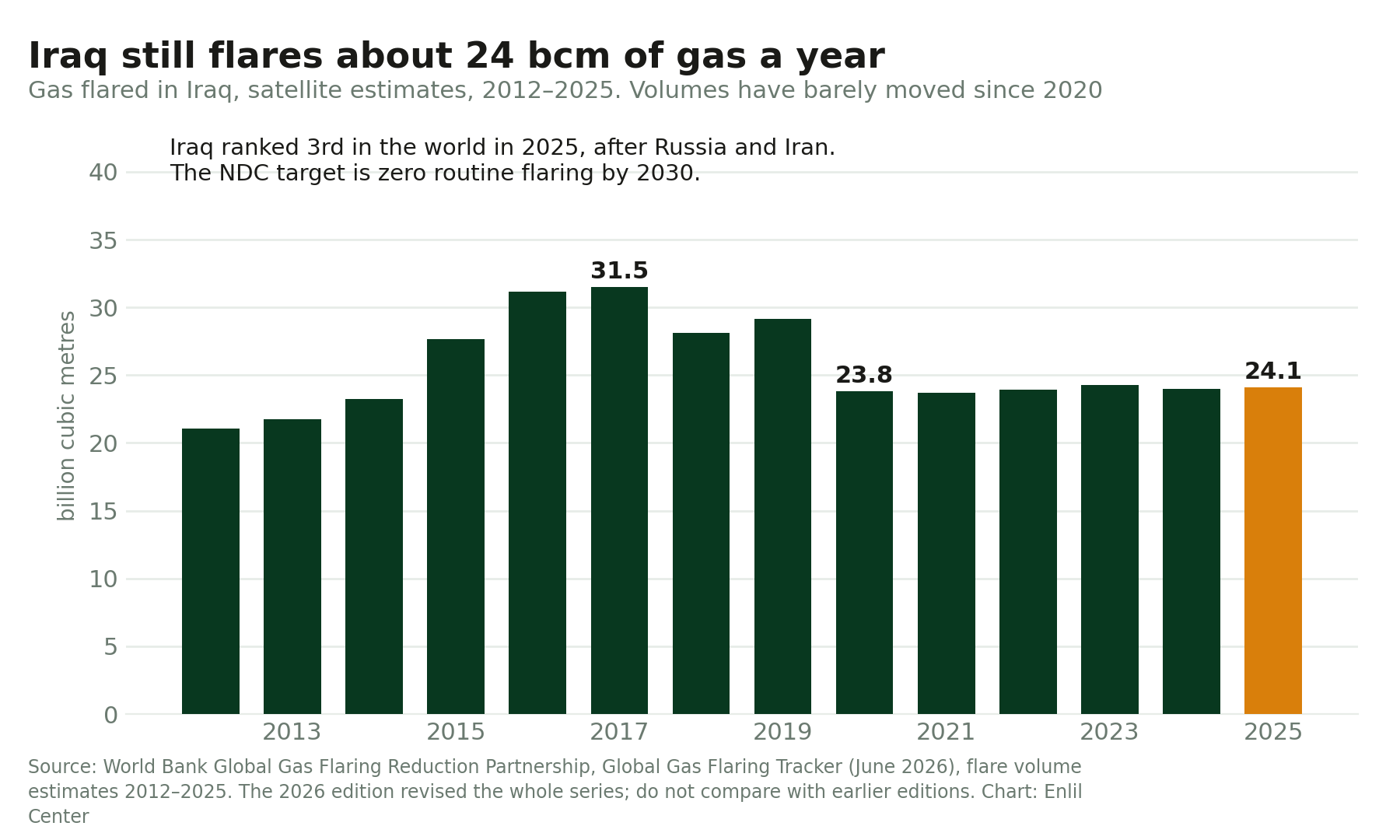
Caption: Satellite estimates of gas flared in Iraq, 2012–2025. Source: World Bank GGFR, Global Gas Flaring Tracker, June 2026. Chart: Enlil Center.
Methane is not a negotiating item in Antalya; it sits in the presidency's voluntary Action Agenda under zero waste and methane reduction. But it is the area where outside investors, buyers and partners will judge Iraq's numbers. Enlil assesses that a clear, dated flaring target with annual public reporting in the same units the World Bank uses would do more for Iraq's credibility in Antalya than any new pledge.
What to expect, and what to watch
Enlil expects COP31 to settle rules and processes and to bring few new pledges. For Iraq, five outcomes are worth watching between 9 and 20 November:
- Tripling adaptation finance. Whether the new agenda item produces a baseline year and a delivery plan, or is pushed to 2027. This is Iraq's most important negotiating interest.
- The just transition mechanism. Belém agreed to create one but left its design to later talks, which have not concluded. For an oil-dependent economy, how the mechanism treats fossil-fuel producers matters.
- The mitigation work programme. Parties must decide whether it continues. Its outcome will shape the pressure on oil producers in the next round of NDCs.
- Loss and damage. Whether the Fund's December approvals include countries like Iraq, and whether new pledges follow.
- Iraq's own deliverables. The dust-storm alliance with neighbours and Egypt, any memorandums signed, and any statement on the national adaptation plan or a flaring timetable.
Enlil will review these on 20 November, when the conference closes, against what Iraq said it wanted going in.