
Summary
- In 2022, Iraq's annual freshwater withdrawals reached 120 per cent of its internal renewable water resources — the rainfall and river flow generated within its own territory. The balance is met by inflows from Turkey, Syria and Iran that are not governed by any binding allocation agreement.
- Internal renewable freshwater per person has fallen from roughly 4,900 cubic metres in 1961 to 799 cubic metres in 2022, crossing the 1,000 cubic metre threshold conventionally used to define water scarcity around 2013.
- Agriculture accounts for approximately 73 per cent of withdrawals, overwhelmingly through flood irrigation. Demand-side reform therefore offers Iraq more leverage than any plausible improvement in upstream releases.
- Enlil Center identifies four priorities: institutionalised technical water diplomacy; volumetric pricing of irrigation water paired with subsidised efficiency; reduction of urban network losses ahead of new storage; and a statutory ecological flow for the southern marshes.
The balance sheet
The clearest measure of Iraq's water position is the ratio of what the country uses to what it generates. World Bank data, drawing on FAO AQUASTAT, put annual freshwater withdrawals at 120.5 per cent of internal renewable resources in 2022 (Figure 1). A ratio above 100 per cent is only possible because Iraq draws on water that originates elsewhere: the Euphrates enters from Syria after passing through Turkey; the Tigris enters directly from Turkey and is joined by tributaries rising in Iran. FAO's AQUASTAT puts Iraq's dependency ratio — the share of its renewable water that originates outside the country — at 61 per cent; for the Euphrates alone the figure approaches total dependence.
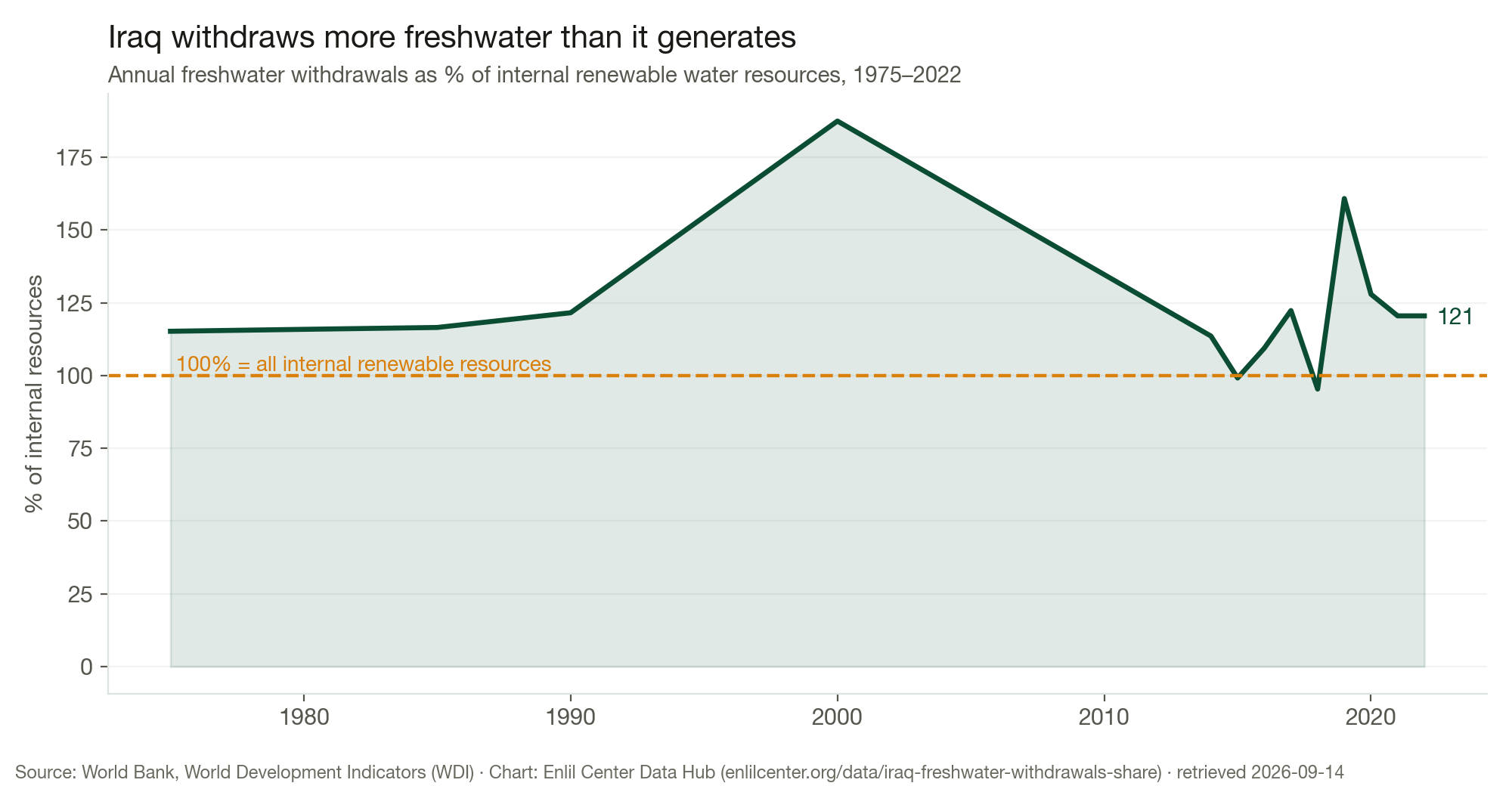
Caption: Figure 1. Annual freshwater withdrawals as a share of Iraq's internal renewable resources reached 120 per cent in 2022. Source: World Bank WDI (FAO AQUASTAT), via Enlil Center Data Hub.
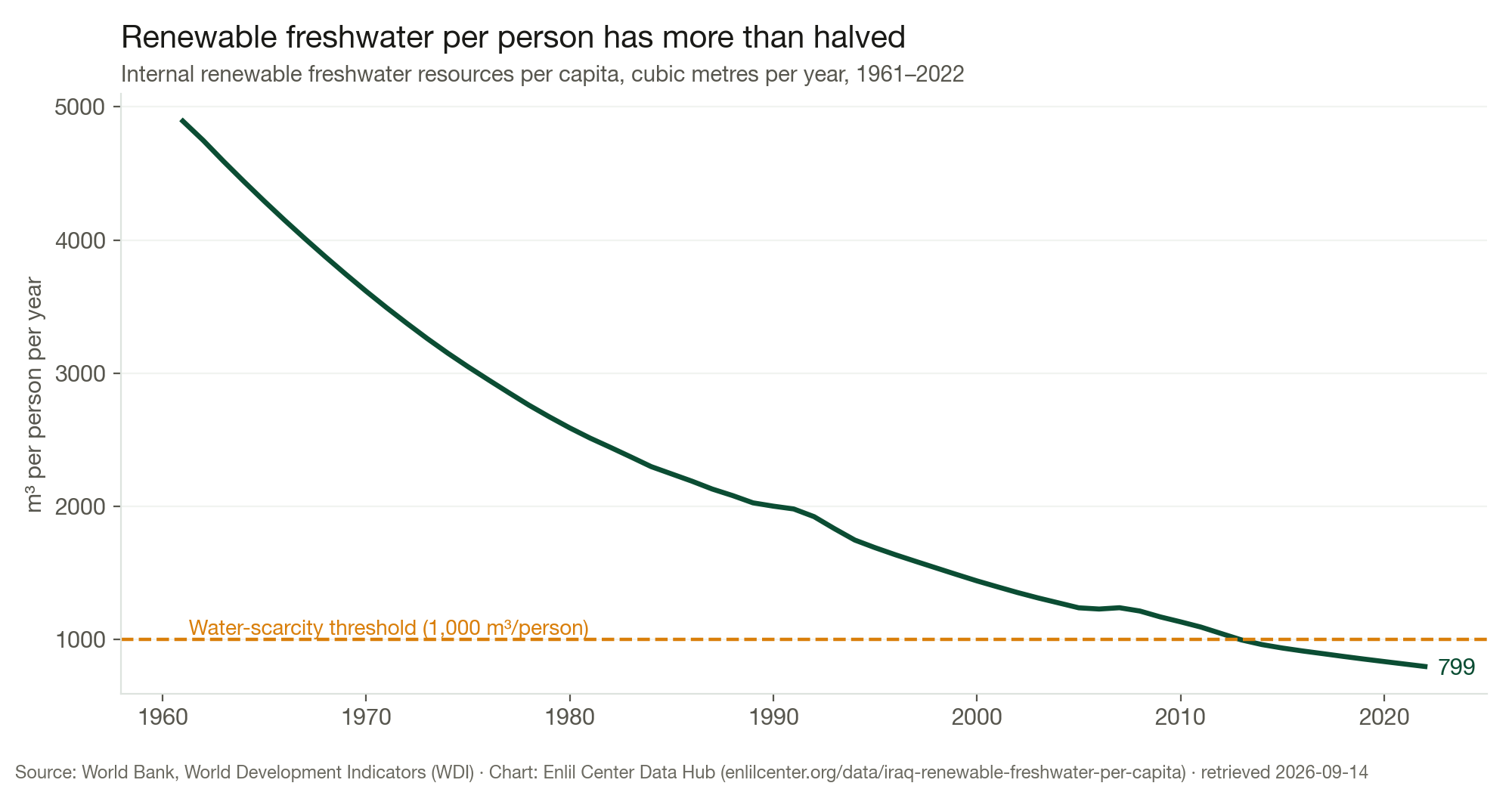
Caption: Figure 2. Internal renewable freshwater per person fell below the 1,000 m³ scarcity threshold around 2013 and stood at 799 m³ in 2022. Source: World Bank WDI, via Enlil Center Data Hub.
That dependence is not new. What has changed is the combination of demographic growth at home and storage capacity abroad. Iraq's population has risen from approximately 17 million in 1990 to 47 million in 2025, while the volume of water generated within the country has, by definition, not grown at all. The result is visible in the per-capita series (Figure 2): internal renewable freshwater per person has more than halved since the early 1990s and now stands below the 1,000 cubic metre benchmark that the water-resources literature treats as the threshold of scarcity. On current demographic trends — an increase of roughly one million people a year — the figure will continue to decline irrespective of rainfall in any given year.
Upstream control
Iraq's supply is determined to a large degree by infrastructure it does not operate. Turkey's Southeastern Anatolia Project (GAP) comprises more than twenty dams on the two rivers and their tributaries; the Ilisu Dam on the Tigris, one of the largest, began impounding water in 2019. Iran has diverted or dammed tributaries, including the Sirwan (Diyala) and the Karun, that historically fed Iraq's eastern and southern basins.
None of this is governed by an enforceable water-sharing treaty. The 1987 Turkey–Syria protocol and the 1990 Syria–Iraq arrangement set indicative flow figures for the Euphrates that have never been formalised into binding allocations, and the successive memoranda of understanding signed with Ankara since 2009 establish cooperation mechanisms rather than entitlements. In practice, the volume of water reaching Iraq reflects decisions taken in Turkey and Iran about their own hydropower, irrigation and reservoir management — decisions of which Iraq is informed rather than in which it participates.
Climate as an amplifier
Climate change does not create Iraq's water deficit, but it compounds every element of it. Long-run average precipitation is approximately 216 millimetres a year, concentrated in the north and north-east; the central and southern plains, where most of the population and irrigated agriculture are located, depend almost entirely on the rivers. The drought of 2021–2023 was among the most severe in four decades. In August 2023 the Ministry of Water Resources described national reserves as the lowest in its recorded history; by May 2025 they stood at roughly 10 billion cubic metres — about half the volume the ministry considers necessary at the start of summer, and the lowest level in 80 years — with the ministry stating that Iraq was receiving less than 40 per cent of its expected share of Tigris and Euphrates flows.
Rising temperatures act on both sides of the ledger. Summer maxima now routinely exceed 50°C in Basra and Nasiriyah, increasing evaporative losses from open reservoirs and canals and raising irrigation requirements per hectare. Lower river flows in turn allow seawater to move further up the Shatt al-Arab, an intrusion that has rendered Basra's municipal supply intermittently saline since 2018. The United Nations has characterised Iraq as among the five countries most vulnerable to climate change; water is the principal channel through which that vulnerability is realised.
The demand side
If external inflows constitute the supply problem, agriculture constitutes the demand problem. Approximately 73 per cent of Iraq's freshwater withdrawals are allocated to agriculture (Figure 3), predominantly through surface flood irrigation of wheat, barley, rice and dates on land that has been cultivated by broadly the same methods for generations. Flood irrigation is inefficient on two counts: a substantial share of applied water is lost to evaporation, and repeated application without adequate drainage progressively salinises the soil. In the southern governorates, salinisation has already removed significant areas from production.
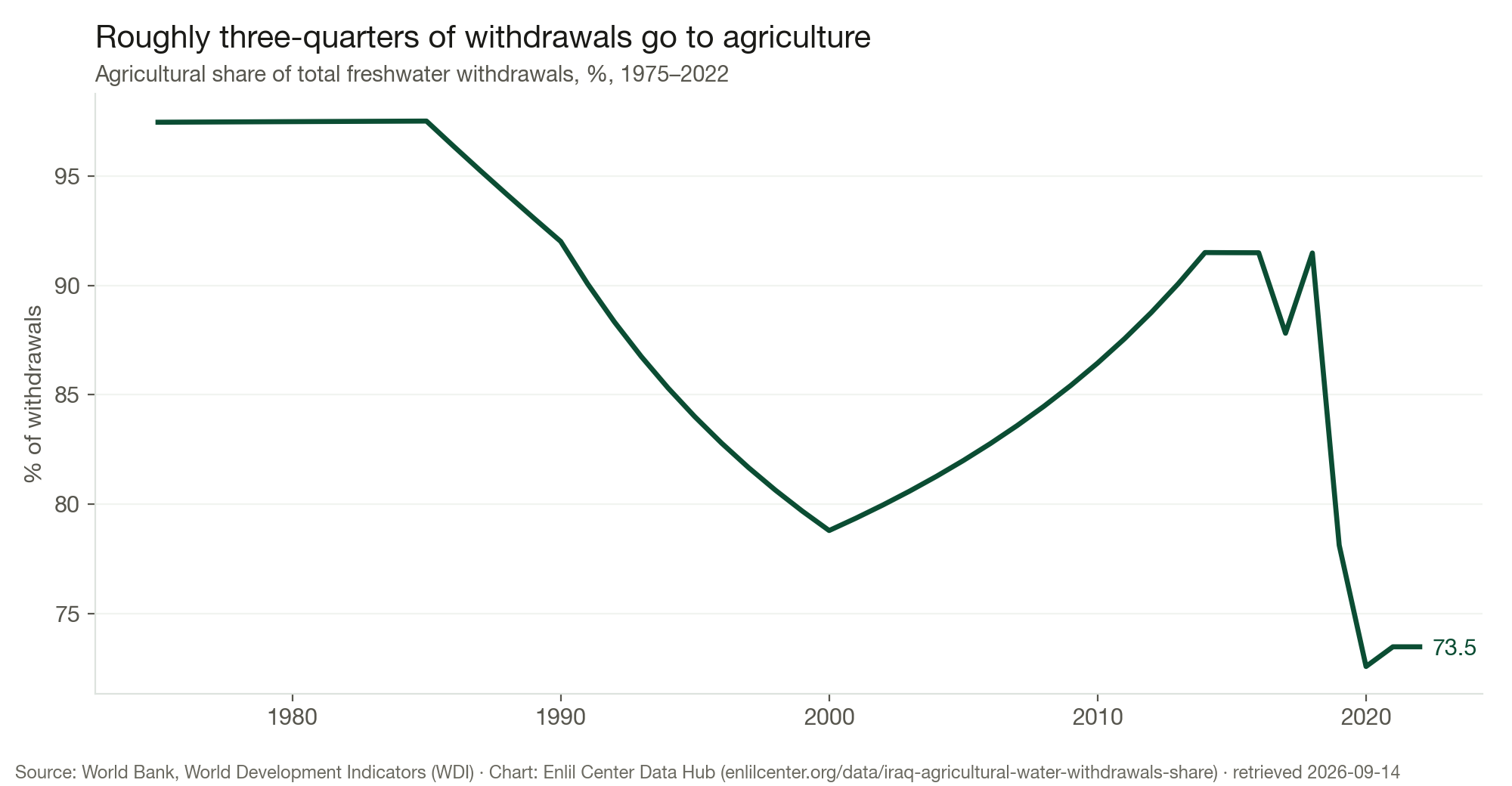
Caption: Figure 3. Agriculture accounts for roughly 73 per cent of Iraq's freshwater withdrawals. Source: World Bank WDI, via Enlil Center Data Hub.
This is where the arithmetic becomes decisive. Even under an optimistic scenario for upstream releases, Iraq would continue to apply the majority of its water to fields at efficiencies that no water-scarce country can sustain. Comparable economies — Jordan, Morocco, Israel — irrigate with a fraction of the water per unit of output. The relevant technologies (drip and sprinkler systems, laser land-levelling, salinity-tolerant crop selection) are mature. What has been absent in Iraq is a price signal, since irrigation water is supplied at effectively zero cost, and an agricultural extension service with the reach to support smallholder adoption.
Cities and networks
The country is also urbanising rapidly. Roughly 70 per cent of Iraqis now live in urban areas (Figure 4), up from around two-thirds a decade earlier. Municipal demand is a smaller volume than irrigation but a politically far more sensitive one. The Basra water crisis of 2018, in which at least 118,000 people were hospitalised after consuming contaminated supply, demonstrated the consequences of failure at the municipal scale. Non-revenue water — treated water lost to leakage and illegal connections before it reaches a metered consumer — is estimated by the World Bank at around 60 per cent nationally, against a global average of roughly 35 per cent, with individual governorates losing 40 per cent or more of treated supply along the network. Reducing those losses is the single measure most fully within Iraq's own control.
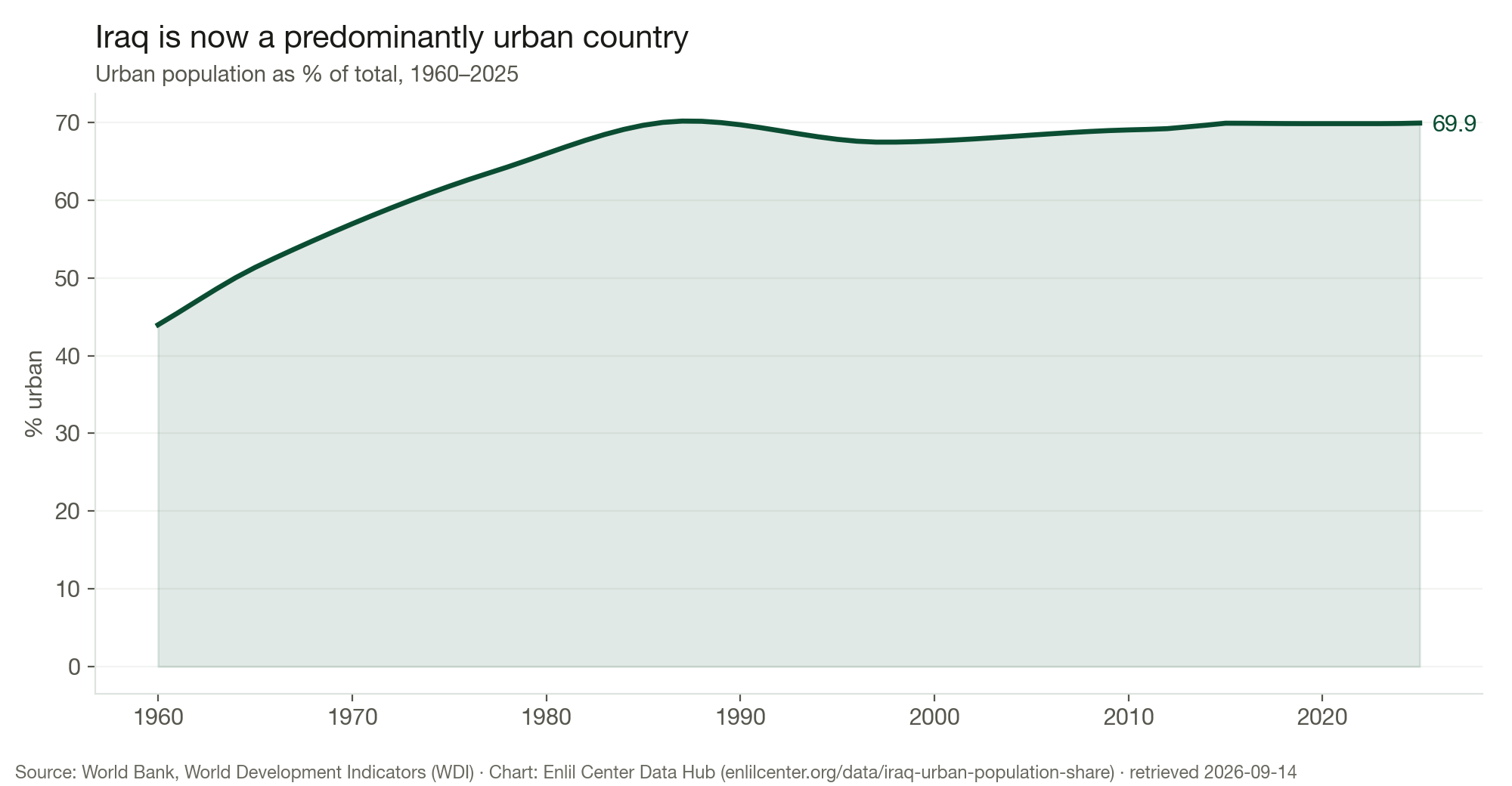
Caption: Figure 4. About 70 per cent of Iraqis now live in urban areas. Source: World Bank WDI (UN Population Division), via Enlil Center Data Hub.
Policy priorities
There is a temptation to frame Iraq's water challenge as a diplomatic problem alone — to seek a treaty with Turkey and to stop there. Enlil Center's reading of the evidence is that four measures need to advance together.
1. Institutionalise water diplomacy. Iraq requires a standing, technically staffed water diplomacy unit equipped with independent hydrological monitoring, rather than ad hoc ministerial delegations. Turkey has proved more receptive to discussions framed around joint monitoring, data exchange and drought protocols than to negotiations over rights; a permanent technical channel is the precondition for either.
2. Price irrigation water and finance efficiency. A modest volumetric charge on irrigation water, paired with subsidised conversion to drip and sprinkler systems, has reduced agricultural withdrawals substantially elsewhere in the region. The response of Iraqi producers to the guaranteed wheat price in recent seasons indicates that farmers do respond to incentives when the state offers them consistently.
3. Reduce network losses before adding storage. Bringing non-revenue water down from around 60 per cent towards the global average would deliver more usable supply to Iraq's cities than any realistic increase in upstream releases, at lower cost and without dependence on any external party.
4. Give the marshes a statutory flow. The southern marshes moderate floods, recharge groundwater and act as a buffer against seawater intrusion. A minimum ecological flow should be written into the national water budget as a fixed allocation, not treated as a residual to be negotiated away in dry years.
None of these measures is rapid. All are less costly than the alternative: a country approaching 50 million people that depends permanently on water it neither generates nor controls.
The data series cited in this analysis — freshwater withdrawals, per-capita resources, agricultural water use, urban population and precipitation — are published on the Enlil Center Data Hub with their sources and are available for download.
Methodological note
Figures are drawn from the World Bank's World Development Indicators (FAO AQUASTAT and UN Population Division source data), retrieved 14 September 2026. Per-capita values refer to internal renewable resources only and exclude transboundary inflows; the withdrawal ratio can therefore exceed 100 per cent. External dependence is FAO AQUASTAT's dependency ratio (61 per cent, 2022); network-loss and reserve figures are taken from World Bank and Ministry of Water Resources statements as reported, and should be read as indicative.