
Summary
- On 20 October 2026 Iraq's Cabinet scrapped customs duties on imported solar energy systems. The step is smaller than it sounds: duties and taxes on panels, inverters, cables and batteries had already been cut from 33% to 5% in February. On Enlil's model, removing the last 5% takes about US$120 off a typical US$4,500 home system.
- Households did not wait for either cut. China, which supplied 99.6% of Iraq's panel imports, shipped US$180.5 million of solar modules to Iraq in 2025, twelve times the 2022 value, and US$171.9 million of lithium-ion batteries. Enlil estimates the 2025 panels alone at about 1.9 GW. IRENA's official count of all solar installed in Iraq at the end of 2025 is 63.6 MW.
- Iraqis buy solar to escape the neighbourhood generator, not the grid. The first 1,500 kWh of household power cost 10 dinars per kWh, against the Ministry of Electricity's own cost of 120 dinars. A generator ampere in Baghdad costs 15,000 dinars a month, which Enlil puts at roughly 400 dinars per kWh actually used. A home system costs about 130 dinars per kWh over its life and repays itself in about six years.
- That is why the 40-article grid-connection rules now at the State Council matter more than the duty cut. If exported power is credited at the household's own tariff, almost every household earns 10 dinars per kWh and has no reason to register. The few who gain are the largest consumers. For the state, a rooftop kWh saves fuel only when the grid has power to spare. In today's shortage it mostly passes power on to the next neighbourhood, so the credit rate decides whether the ministry gains or loses.
- Enlil recommends five clauses: register every system and publish the count; credit exports at the ministry's average billed revenue per kWh, about 44 dinars, against bills only; require certified inverters that disconnect when the grid goes down; keep approval simple, with a size cap per subscriber; and guarantee the terms for a fixed period, which is where Pakistan's scheme went wrong.
A duty cut that came after the boom
The Cabinet's 24th regular session on 20 October approved "zeroing the customs duties imposed on imported solar energy systems", to support the private sector and encourage citizens to adopt renewable energy. The Ministry of Electricity says the minister requested it on 23 September.
The decision finishes a job begun earlier in the year. On 22 February the Director General of Customs said the rate on solar cells, lithium batteries, inverters and cables was 5% for each item. Five days later the head of the National Team for Renewable Energy and Energy Efficiency Projects, Nasir Karim Qasim, said the government had cut customs and tax charges on the main parts of solar systems "from 33% to only 5%", and that a technical proposal to remove the rest was under study. October's decision is that proposal.
On Enlil's model, the final five points are worth about US$120 on a US$4,500 system with 5 kW of panels and 10 kWh of storage. That assumes imported equipment makes up just over half of the installed price, with the rest going on installation, wiring, frames and margins. It is welcome, but it will not change many household decisions. The bigger February cut did not create Iraq's rooftop market either. The market was already there.
A boom the statistics cannot see
Iraq publishes no count of rooftop solar systems. The federal Ministry of Electricity has given no national figure for household installations, and the International Renewable Energy Agency (IRENA), which compiles national statistics, records Iraq's total installed solar capacity at 63.6 MW at the end of 2025. Its off-grid figure has not changed since 2022.
Trade data tell a different story. China reports its exports to the UN Comtrade database by product. Its shipments of solar modules to Iraq rose from US$15.0 million in 2022 and US$16.2 million in 2023 to US$45.6 million in 2024 and US$180.5 million in 2025. Lithium-ion batteries followed the same path, from US$12.3 million to US$171.9 million (Figure 1). Data from all reporting countries put China's share of Iraq's 2025 panel imports at 99.6%.
China reported 3.42 million modules weighing 101,494 tonnes for 2025, about 30 kg each, which is the weight of a standard panel of around 550 W. On that basis Enlil estimates the 2025 shipments at about 1.9 GW, or roughly US$0.10 per watt at China's border. Two caveats apply. Some of these panels went to farms, businesses and government buildings, not homes. And a module count is not an installation count. Even so, the order of magnitude is clear: one year of imports is about thirty times what the official statistics record for the whole country.
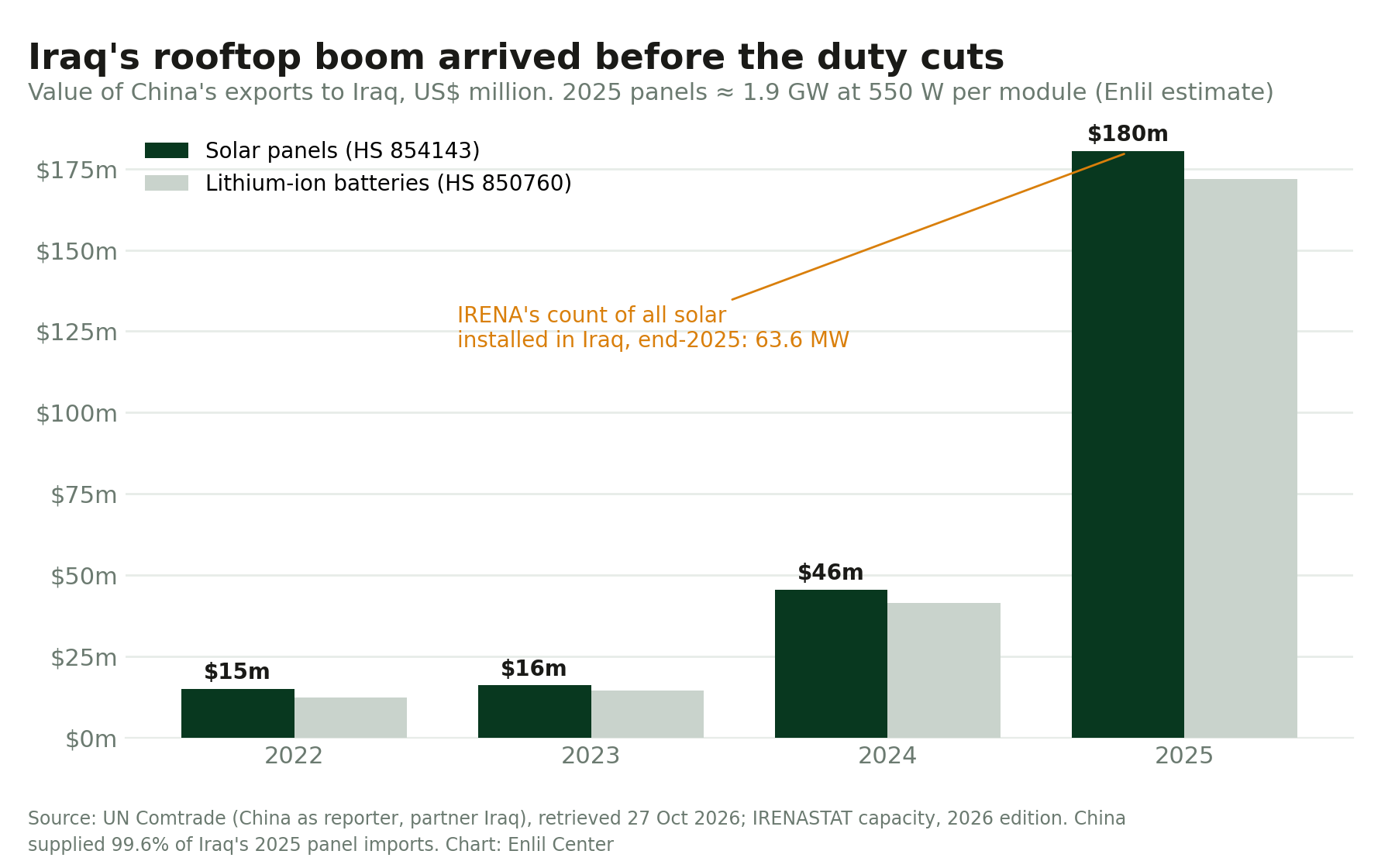
Caption: Iraq's rooftop boom arrived before the duty cuts. Value of China's exports of solar panels (HS 854143) and lithium-ion batteries (HS 850760) to Iraq, 2022–2025. Source: UN Comtrade; IRENASTAT. Chart: Enlil Center.
The boom therefore came while duties were still high, and it was matched almost dollar for dollar by batteries. Households are not buying panels to cut a power bill. They are buying power for the hours when the grid is off.
Why households buy: the generator, not the grid
The grid is cheap when it works. The residential tariff that the Ministry of Electricity lists as in force in its 2025 statistical report charges 10 dinars per kWh for the first 1,500 kWh, then 35, 80 and 120 dinars for higher bands. The ministry's 2025 figures imply that the average residential subscriber uses about 842 kWh a month, which keeps the typical household in the first band. At that rate a month's grid power costs about 8,400 dinars, under six dollars.
The grid does not work enough of the time. The ministry's 2025 statistical report puts Baghdad's average demand at 7,210 MW against 4,493 MW supplied, so about 38% of demand went unmet. The neighbourhood generator fills the gap. On 2 October the Baghdad Governorate Council set the price of a 24-hour generator ampere, which runs whenever the grid is off, at 15,000 dinars a month.
An ampere is a subscription to capacity, not to energy. If one ampere is available during the 38% of hours when the grid is off, and a household draws on average 60% of it, the subscription delivers about 38 kWh a month. That is roughly 400 dinars per kWh, forty times the grid's first-band tariff. The utilisation figure is Enlil's assumption, and it is the single input that moves the result most.
Against those two prices, a rooftop system sits in between. Enlil's model uses yields from the EU's PVGIS service (1,644 kWh per installed kW a year in Baghdad, 1,655 in Basra, 1,566 in Erbil), cuts them by 8% for dust, and spreads a US$4,500 installed cost, the middle of a US$3,000–6,000 range since Iraq publishes no official system price, plus one battery replacement over 15 years at a 10% discount rate. The result is about 130 dinars per kWh. That is about a third of the generator's cost, thirteen times the first-band tariff, and close to what the minister said a kWh costs the state to deliver: 120 dinars, of which the government pays 90 (Figure 2).
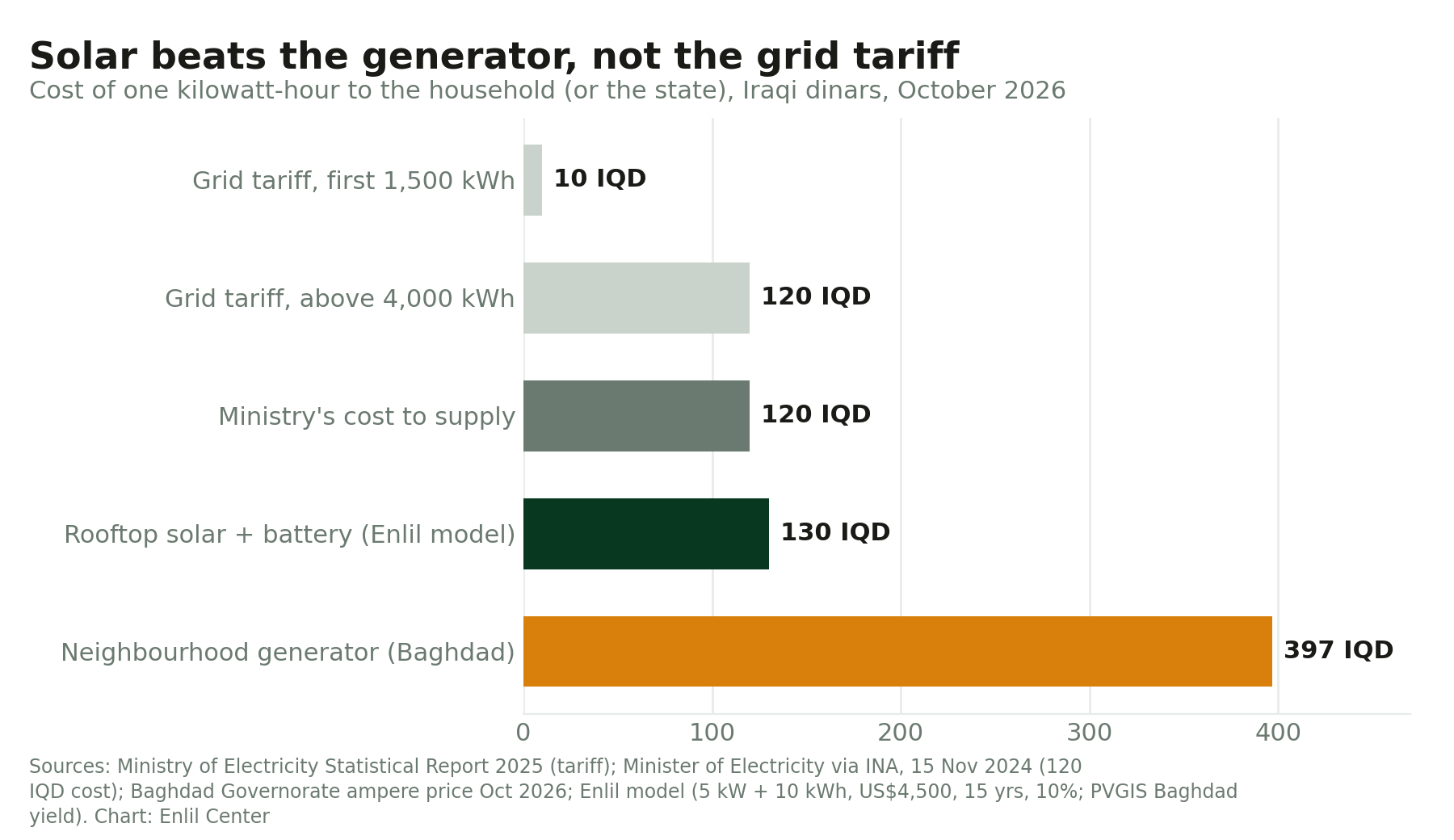
Caption: Solar beats the generator, not the grid tariff. Cost of one kWh, Iraqi dinars, October 2026. Sources: Ministry of Electricity Statistical Report 2025; Minister of Electricity via INA; Baghdad Governorate Council; Enlil model. Chart: Enlil Center.
Measured against the generator bill it replaces, the base-case system repays itself in about six years (5.8). The range is wide: under four years if the system costs US$3,000 or a household uses most of the amperes it pays for, about eight and a half if ampere prices fall back to 10,000 dinars or the household draws only 40% of its amperes (Figure 3). Solar yield and dust matter far less. The economics turn on generator prices and system costs, not on sunshine, which Iraq has in abundance.
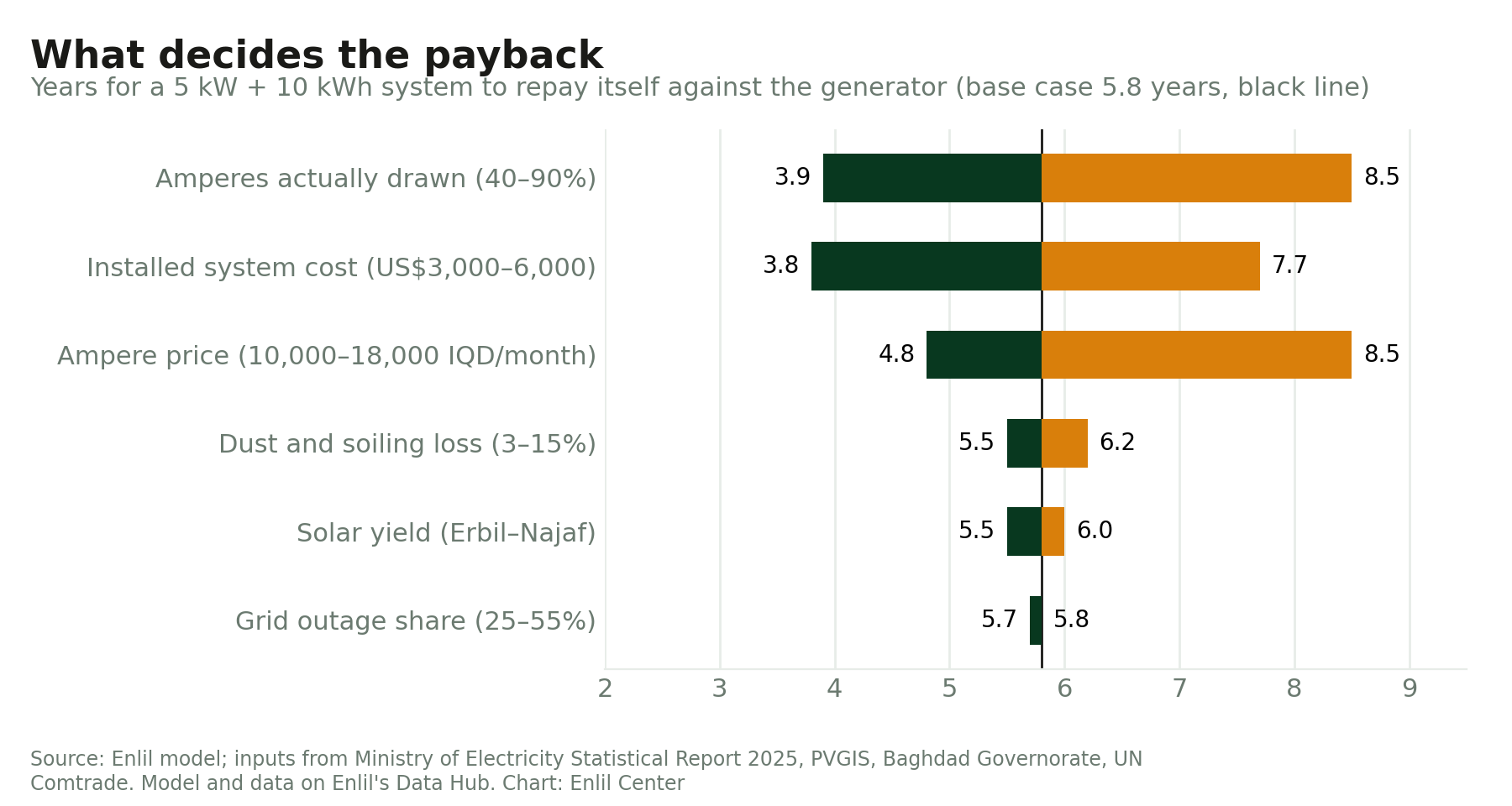
Caption: What decides the payback. Years for a 5 kW + 10 kWh system to repay itself against the generator, varying one input at a time. Source: Enlil model. Chart: Enlil Center.
What the 40 articles have to decide
The ministry says it has drafted instructions of 40 articles that would let citizens connect their solar systems to the national grid through smart meters, with bills reflecting the energy exchanged, and has sent them to the State Council for legal drafting. The text has not been published. Its core choice is how to value a kWh a household sends into the grid.
The simplest design is net metering, where exported kWh cancel imported kWh one for one. For a household in the first band, each exported kWh is then worth 10 dinars. A system producing about 7,500 kWh a year would earn at most about US$50 a year from the grid, not enough to justify a meter, a registration or an inspection. Net metering at the tariff rewards only the largest consumers, whose top kWh cost 80 or 120 dinars. That is the same group that already receives most of the electricity subsidy: a 2023 World Bank study found that 50.9% of it went to the richest fifth of households.
The state's arithmetic depends on the grid. The ministry billed 43.8 dinars for each kWh it sold in 2025 and collected 71% of that, while 52% of the energy it distributed was lost before it was paid for. When the grid has power to spare, a kWh a household produces for itself costs the ministry at most the 7 dinars it would have collected at the first-band tariff, and saves it up to 120 dinars of supply cost. Iraq's grid rarely has power to spare. When it meets only part of demand, the power stations run flat out regardless, so a rooftop kWh saves no fuel. It passes power on to the next neighbourhood in the load-shedding schedule, which pays for it at its own tariff. The gain is then fewer outage hours for other households, not a saving for the treasury, and the credit rate decides whether the ministry breaks even.
Two technical points need writing into the rules. The first is safety. Iraq's grid goes down for hours every day, so an inverter that keeps exporting into a dead line puts repair crews at risk; inverters must disconnect automatically when the grid fails. The second is quality. Enlil found no published Iraqi standard for solar panels or inverters. Earlier government programmes left the specification to the ministry when financing a system, and the Central Bank's solar loan scheme, launched with about 1 trillion dinars in 2021, had lent only about 6 billion dinars by February 2026, according to its initiatives director.
What others have learned
Lebanon is the closest parallel: a country where a failing utility pushed households towards generators and then panels. Its official energy conservation centre counts 1,081 MW of decentralised solar at the end of 2023, up from 92 MW in 2020. That capacity supplied 15% of Lebanon's electricity in 2023, and 96% of residential capacity installed since 2021 includes batteries. The country's 2025–2030 renewable energy plan notes that annual renewal of net-metering contracts added uncertainty and made the scheme less attractive.
Pakistan shows the risk of changing the terms after the fact. In February 2026 its regulator replaced net metering with net billing, cutting the price paid for exported power from 26 to 11 rupees per unit and limiting new contracts to five years. The Prime Minister ordered a review petition within days. Jordan, by contrast, had 696 MW connected under net metering and 383 MW under wheeling by 2022, under published rules from its regulator.
Five clauses for the State Council
Enlil Center recommends that the instructions include the following.
- Registration and a public count. Every connected system is registered, and the ministry publishes the number and capacity each quarter by governorate. Iraq cannot plan around 2 GW of panels it does not know exist.
- Export credit at the ministry's average billed revenue, against bills only. Credit exported kWh at a published rate equal to what the ministry bills on average for each kWh it sells, 43.8 dinars in 2025, set off against the household's own bills and never paid in cash. That is more than four times the first-band rate, enough to give households a reason to register, while the ministry bills the same power to the next consumer at about the same average rate. A credit at the full 120-dinar cost of supply would make sense only for power that lets the ministry burn less fuel, which a grid that meets only part of demand rarely does.
- Certified inverters with automatic disconnection. Publish a list of approved inverter types that disconnect when the grid goes down, together with a minimum standard for panels and batteries.
- Simple approval with a size cap. Approve systems up to a cap linked to the subscriber's connection, without a site visit below that cap, and fit the smart meter at the ministry's cost, recovered from the savings.
- Guaranteed terms. Fix the credit rate and contract terms for at least seven years for every system connected under these rules. Pakistan's experience shows how quickly trust goes when terms change midway.
What would show this is wrong
The data behind Enlil's model are published on the Enlil Data Hub, and every input and assumption is stated in this analysis, so the numbers can be checked and rerun. Two tests will come from outside. If the duty cut is as marginal as this analysis suggests, Iraq's 2026 solar imports in the Comtrade data will track summer outages and generator prices rather than jump after October. And if the rules credit exports at the tariff band, Enlil expects registered systems a year after the rules take effect to be a small fraction of what the import data show. Either result would be visible in public data.