
Summary
- On Thursday, 24 September 2026, Iraq's parliament voted to approve the recommendations of a special committee (Parliamentary Order No. 63) that investigated pollution in the Tigris and Euphrates rivers. Environment Minister Sarwa Abdulwahid declared a state of environmental emergency and announced a platform for reporting and tracking pollution violations, new water-quality monitoring stations, and a one-year government action plan.
- This is not Iraq's first response to the same rivers this year — it may be at least the fourth. Maysan governorate, one of the three areas behind this month's worst test results, had already declared and then lifted its own local state of emergency over Tigris pollution, ending it around 27 April 2026. Days before that, a different environment minister told the public the wider Tigris-Diyala pollution episode had been "contained." In May, parliament formed a separate special committee, told affected governorates they could sue polluters, and set a six-month deadline for "urgent solutions" to the pollution file — a deadline that does not expire until November, meaning Thursday's vote arrived before its own predecessor's deadline had even run out. In between, a civil-society watchdog publicly asked parliament to convene an urgent session on the crisis in mid-June — three months before it did.
- The numbers behind these declarations are large by any measure. Government testing reviewed by parliament this month found water failed safety standards in 100 percent of samples in Maysan, 99 percent in Muthanna, and 97 percent in Basra. Roughly six million cubic meters of untreated sewage, medical and industrial waste enter the rivers every day, from more than 500 identifiable sources — many of them state institutions, including hospitals, refineries, and Baghdad's own municipal sewage network.
- Treatment capacity has not kept pace with any of this. Most of Iraq's water-purification plants have already outlived their 25-year design life. Of 17 small wastewater-treatment units built nationwide, only five are running, and a newly funded Baghdad treatment plant backed by Japanese and World Bank financing has no public construction timeline.
- The ministry's June reassurance sat alongside its own admission that most sewage goes untreated. In June, it told Iraqis that treated household water was safe — while conceding, in the same statement, that up to 70 percent of sewage in some provinces receives incomplete or no treatment before reaching the rivers.
- Whether Thursday's declaration breaks the pattern depends on one thing none of the earlier responses delivered: enforcement that reaches inside the state's own institutions, not just a new announcement layered on top of the last one.
An emergency declared on a Thursday
Iraq's parliament received the report of the Order 63 committee on Wednesday, 23 September, one of four items on that day's agenda alongside a laboratory technicians' bill and an employee-leave law. The committee had been tasked with identifying the causes of pollution in the Tigris and Euphrates, naming the parties responsible, and reviewing what had already been done to limit the damage. A day later, on Thursday, parliament voted to approve its recommendations, and Environment Minister Sarwa Abdulwahid — in the post since mid-May — declared a state of environmental emergency. “Environmental conditions have reached a stage that requires exceptional measures,” she said. The government's response includes a platform for documenting pollution violations and identifying their sources, new water-quality monitoring stations modeled on Iraq's existing air-quality network, and what officials describe as a one-year government action plan.
That declaration is a real step: a named minister, a dated vote, and at least two concrete deliverables — a public violations platform and physical monitoring stations — that can be checked later against whether they actually exist. But the emergency itself is not a new discovery, and it is not even the first time this year that the word “emergency” has been formally applied to this same pollution.
The times before this one
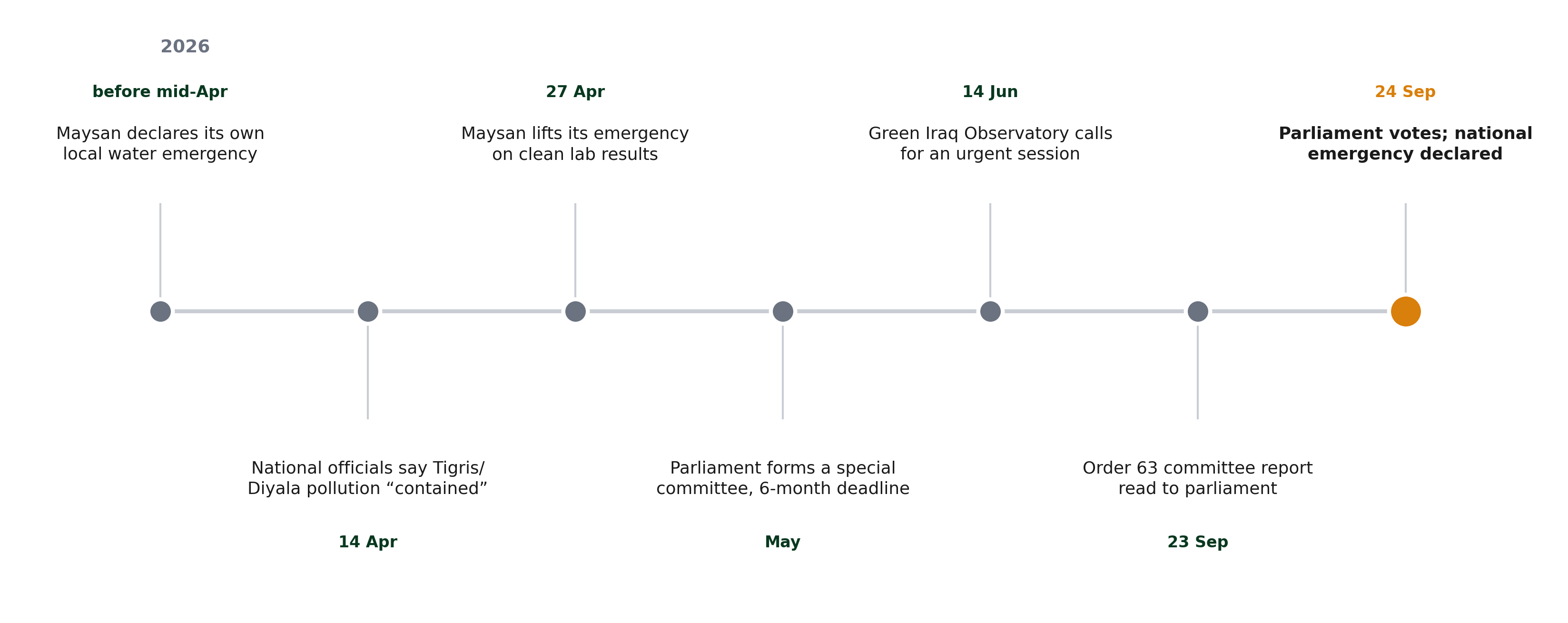
Caption: Iraq's responses to Tigris/Euphrates pollution across 2026, before this week's national emergency declaration. Source: Enlil Center, compiled from Shafaqna Iraq, Al-Mada, +964 Media, Kitabat, Kurdistan24 and 964media reporting (see Sources).
At some point before mid-April, Maysan governorate — one of the three governorates behind this month's 100/99/97 percent test-failure results — declared its own local state of emergency over Tigris pollution and shut down its water projects as a precaution. On 14 April, national officials said the wider episode had been contained: a sewage leak from the Rustumiya drainage system into the Diyala River, combined with heavy sediment carried by floodwater into the Tigris, had produced a visible crisis around Baghdad — fish die-offs on floating farms, and water tankers dispatched to supply residents in al-Mada'in and Basmaya after local supplies were fouled. The environment minister at the time, Halo al-Askari, announced that ministries and municipalities “were able to contain the phenomenon.” The water resources minister at the same briefing, Aoun Diab, added a warning that proved prescient: “dredging does not fundamentally solve the problem if the sources of pollution are not stopped.” Around two weeks later, on 27 April, Maysan lifted its own emergency, saying laboratory tests had confirmed the water was clean enough to resume normal supply.
Three weeks after that, in May, parliament acted again — forming a separate special committee to track pollution in the Diyala and Tigris rivers, directing the governorates affected to pursue lawsuits against polluters, and opening coordination with the United Nations on the environmental damage. One deputy on the committee demanded “urgent solutions” to the pollution file within six months, a deadline that runs to November 2026 and has not yet lapsed — meaning Thursday's vote, and the emergency it declared, landed on top of a still-open commitment from the government's previous attempt at the same problem, not after it. In between, on 14 June, the environmental watchdog Green Iraq Observatory publicly called on parliament to convene an urgent session on the crisis — three months before Order 63's report was actually read into the record.
None of this means Thursday's declaration is empty. Governments across the world routinely need more than one attempt to act on slow-moving environmental damage, and a monitoring platform and physical testing stations are a more concrete, checkable commitment than a governorate's decision to reopen its water projects once lab results looked acceptable. But a pattern of a local emergency being declared and lifted, a national “contained” claim, a committee with a deadline still running, and a civil-society call for urgency that took three months to reach the parliamentary floor — all before this week's national emergency — is itself information about how much capacity moved between each of those moments, and how much still has to. The most direct evidence for that is Maysan itself: the same governorate that lifted its own emergency in April on the strength of clean lab results is, five months later, the governorate whose water failed 100 percent of this month's tests.
What the rivers actually carry
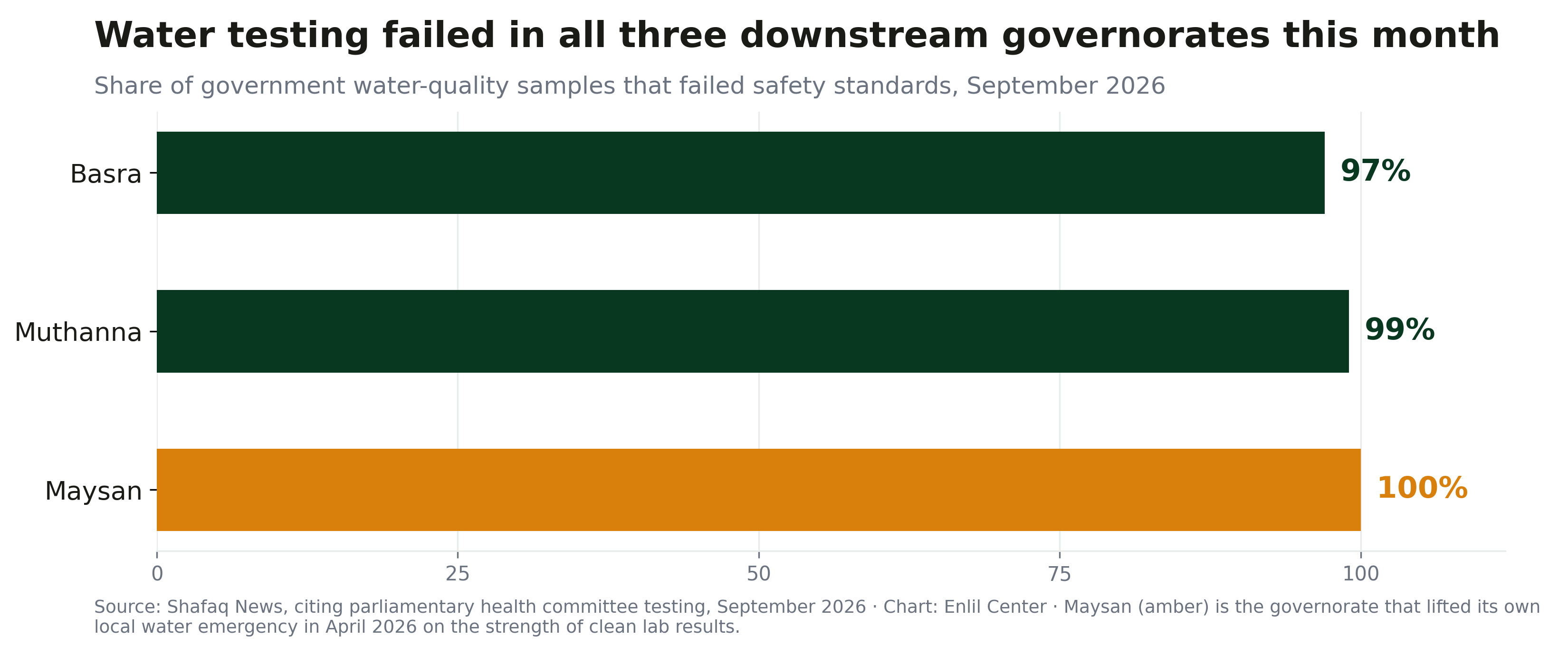
Caption: Government water-quality testing failed in all three downstream governorates this month. Maysan (amber), at 100%, is the governorate that lifted its own local water emergency in April 2026 on the strength of clean lab results. Source: Shafaq News, citing parliamentary health committee testing.
The scale behind this year's run of local, national, and parliamentary responses is not something officials are inventing. Government testing reviewed by a parliamentary health committee this month found that treated water failed safety standards in 100 percent of samples taken in Maysan province, 99 percent in Muthanna, and 97 percent in Basra — the three governorates furthest downstream on the Tigris-Euphrates system, where whatever enters the rivers upstream ends up concentrated. Enlil treats a 100 percent failure rate with some caution, since it likely reflects a specific set of official testing parameters rather than a literal claim that no household tap in Maysan produces potable water. But even a more conservative reading is consistent with Iraq's own longer-run data: World Bank figures put 98 percent of Iraqis as having at least “basic” drinking water and sanitation access, but only about 60 percent have water and about 51 percent have sanitation that meets the stricter WHO/UNICEF standard of being safely managed — free of contamination and reliably available. Iraq built the pipes and the toilets. It did not build the treatment behind them, at the end of a system now receiving an estimated six million cubic meters of untreated sewage, medical waste, and industrial wastewater every day.
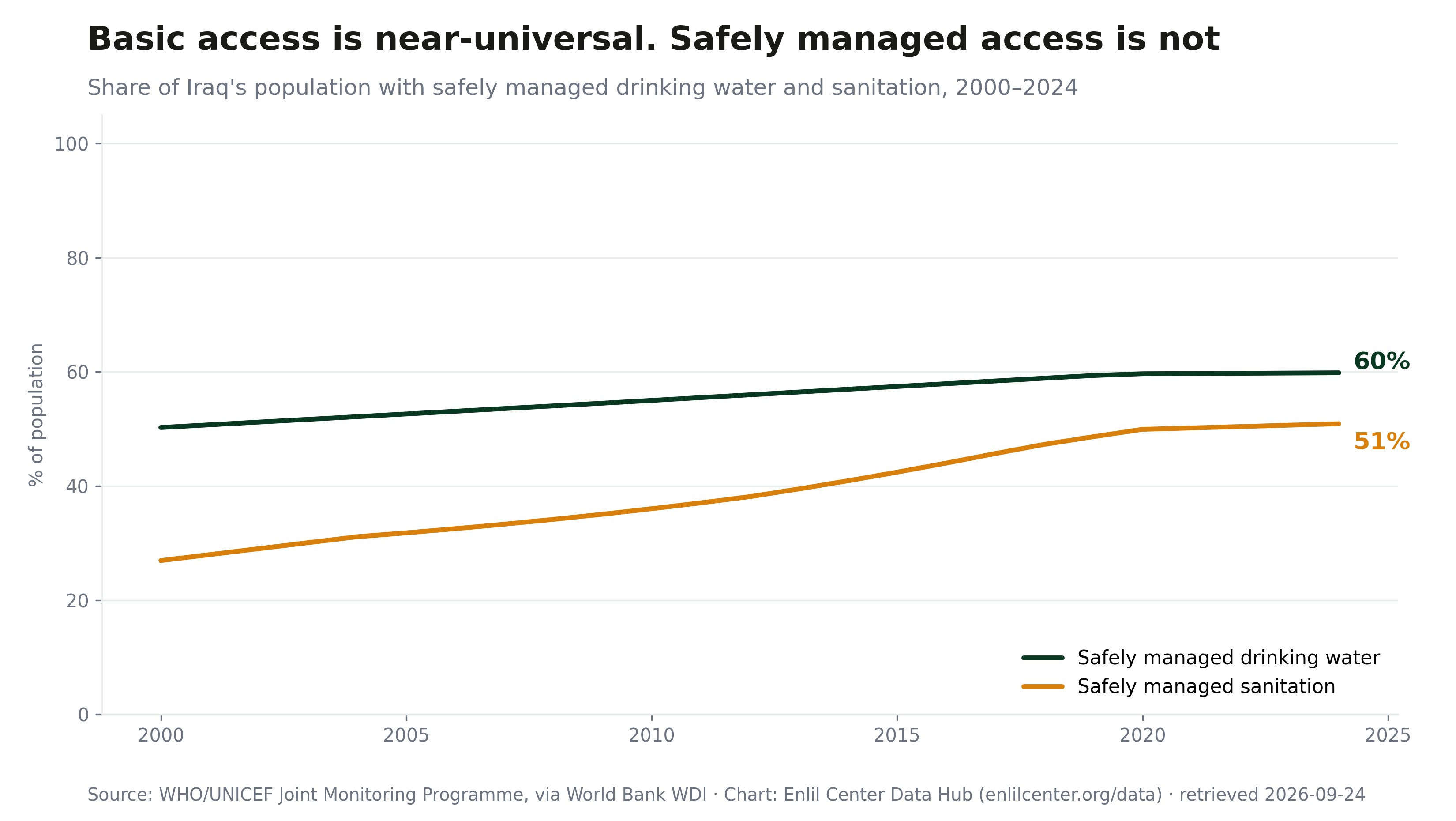
Caption: Basic access to drinking water and sanitation is close to universal in Iraq. The stricter, safely-managed standard is not. Source: WHO/UNICEF Joint Monitoring Programme, via World Bank WDI. Chart: Enlil Center Data Hub.
That volume comes from a source problem too distributed for any single fix. An Al Jazeera investigation in June counted more than 500 identifiable pollution sources discharging into the Tigris and Euphrates between Iraq's northern border and Basra: raw sewage, tannery and industrial effluent, petroleum derivatives, and untreated medical waste. A large share of the named sources are not rogue private actors but the state's own institutions — Baghdad's municipal sewage network, hospitals, and the oil and industrial ministries all appear on the list. A separate parliamentary review this year documented 24 polluted discharge points inside Baghdad alone, including hospital, refinery, and power-station waste, and flagged the Diyala River — already contaminated further upstream — as a concentrator that periodically flushes accumulated sewage and industrial waste toward the Tigris. Iraqi reporting has linked that mechanism to the crisis's most visible symptom: in April, roughly 300 tons of fish died within about two hours in Wasit, and a separate, later incident killed more than 1,000 tons, shutting down downstream water-treatment intakes entirely.
Capacity that has not kept pace
The infrastructure meant to intercept this volume has aged faster than it has been replaced. Iraq's Green Observatory has found that most water-purification plants nationwide have already exceeded their 25-year design life, a problem most acute in Babylon, Wasit, Anbar, and Salah al-Din. A separate audit of Basra's own treatment plants found that most lack the integrated laboratories needed to test their own output. Where newer capacity exists, it runs far behind demand: Al Jazeera's investigation found 17 small-capacity wastewater-treatment units installed nationally, of which only five are operational — against the 500-plus discharge points documented in the same reporting. A newly funded 300-billion-dinar (roughly $230 million) treatment plant for Baghdad, backed by Japanese and World Bank financing, has no publicly disclosed construction timeline. Five working units against 500 active sources, feeding a system whose existing plants are already past their engineered lifespan, describes a capital-construction gap measured in years — not a shortfall that a one-year action plan, on its own, is built to close.
What the ministry's own numbers concede
The public argument over how bad the underlying picture is has itself become a recurring feature of this crisis. When similar unfit-water findings circulated in June, the Ministry of Environment publicly maintained that treated household water was safe, citing daily testing across 73 monitoring stations nationwide — while conceding, in the same statement, that roughly 45 percent of Baghdad's sewage and up to 70 percent in other provinces receives incomplete or no treatment before reaching the rivers, which the ministry itself called the biggest challenge to water quality. That concession sits closer to this month's testing data than the reassurance delivered alongside it. Separately, political rhetoric around the crisis has reached for comparisons the evidence does not support: statements this month asserted that water pollution kills or sickens Iraqis at a rate comparable to the country's cumulative terrorism toll, citing rising cancer and kidney-failure cases without an underlying epidemiological study to support the comparison. Enlil treats that comparison as political rhetoric rather than a verified statistic — but notes that no ministry has published the systematic health-outcomes study that would settle the question either way, a gap that leaves the state managing a disputed public-health hazard it has not actually measured.
What would make this one different
Thursday's declaration is more specific than April's “contained” or May's committee: a named platform for tracking violations, physical water-quality stations, and a one-year plan with a minister's name attached to it. Each of those is a claim that can be checked later, which is itself progress over an assurance that a problem has already been handled. What is not yet confirmed is whether the two other measures reportedly on the table before Thursday's vote — a campaign led by the prime minister's office and amendments to the environmental protection law imposing harsher penalties — were formally adopted alongside the emergency declaration, or remain, like May's lawsuits directive, an instruction that governorates and ministries are free to not fully act on.
The test this time is narrower than the declaration itself invites: whether the coming year compels Iraq's own ministries, hospitals, and municipal utilities — named in the government's own data as major sources of the discharge — to fund treatment capacity on a timeline that matches 500 active outlets, succeeding where a governorate's emergency, a national containment claim, and a committee with a still-running deadline have not. A platform that documents violations only has force if violations documented against a state hospital or a state refinery are followed up the same way a violation against a private tannery would be. In Enlil's assessment, that is the ministry's structural position rather than a failing of will: the Ministry of Environment is the regulator, but the largest dischargers in the government's own data are sibling ministries and municipal utilities, over which it has in practice held far less enforcement leverage than over a private firm. Read that way, Thursday's declaration is less a promise by the ministry than a request for authority it has not previously had, and the harsher-penalty amendments still awaiting confirmation are the part that would actually answer it. Iraq will know by November, when the May committee's own deadline runs out, whether Thursday's emergency was the moment Maysan's water stopped failing its tests, or simply the next name given to the same unresolved file.