
Summary
- This analysis was published on 6 April 2026, at the peak of uncertainty in the Iran-Israel-US war that began on 28 February 2026 with the killing of Iran's Supreme Leader Ali Khamenei in US-Israeli strikes. It is updated here with what is now verifiable about what actually happened next.
- Brent crude traded near $108–111 a barrel on 6 April, up roughly 50 percent on pre-war levels, driven by geopolitical risk rather than a genuine supply shortfall. Prices have stayed volatile but have not delivered the catastrophic spike some scenarios warned of — trading roughly $100–113 a barrel through September.
- The real shock landed on physical export volumes, not primarily on price. Iraq's southern, seaborne crude exports — the routes that pass through the Strait of Hormuz — collapsed from a pre-war run rate of over 3 million barrels a day to roughly 100,000 barrels a day in May, the low point, before recovering through the year. Iraq's northern export route via the Kirkuk-Ceyhan pipeline into Turkey kept moving throughout, which meant Iraq's total national export volume fell by less than the seaborne collapse alone suggests — but still fell hard, to a combined national average of roughly 530,000 barrels a day across May and June against a pre-war total above 3.3 million.
- Iraq's overland export corridor through the Al-Waleed crossing into Syria was real and did move oil, but at a scale — tens of thousands of tonnes a month — that never came close to substituting for the lost seaborne trade of over three million barrels a day.
- The fiscal damage was severe: Iraq's oil export revenue fell to roughly $18.7 billion for the first half of 2026, against roughly $85 billion for all of 2025. The budget deficit tripled from about $5 billion at the end of April to about $16 billion at the end of June, public debt hit a record, and the government warned it might struggle to pay civil servants on time.
- Exports have since recovered substantially — to roughly 1.4 million barrels a day in July and around 2 million barrels a day in August — but remained, seven months into the crisis, well below the pre-war baseline of about 3.5 million barrels a day.
What this piece originally captured
This analysis was first published on 6 April 2026, in the middle of an active war. Israel and the United States had opened the conflict on 28 February with strikes that killed Iran's Supreme Leader, Ali Khamenei — an event the original version of this piece did not mention, focused as it was on the oil-market mechanics of the days immediately around publication. Iran's Assembly of Experts installed his son, Mojtaba Khamenei, as successor. By early April, Brent crude was trading near $108–111 a barrel, up roughly 50 percent from pre-war levels, and diplomats from Pakistan, Egypt and Turkey were pressing for a ceasefire against a deadline set by President Trump. That diplomacy did produce something: the United States and Iran reached an initial ceasefire on 7–8 April, one day after this piece was first published. It did not hold in the form expected — by 13 April the US had imposed a naval blockade on Iran after a round of talks in Islamabad collapsed, and the conflict continued in phases for months afterward, including a June memorandum of understanding that broke down again in July when Iranian forces struck commercial vessels.
The shock that mattered was to volume, not just price
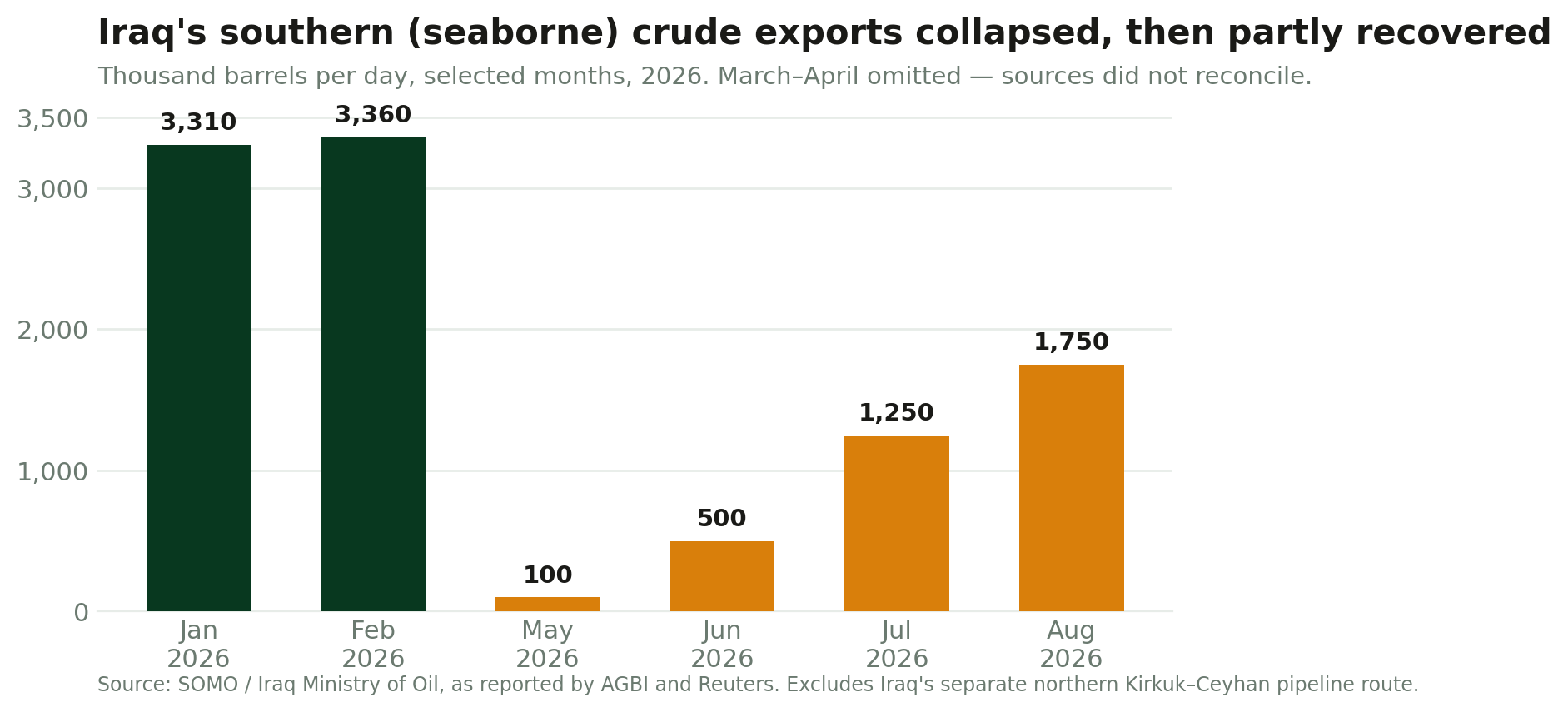
Caption: Iraq's southern, seaborne (Basrah) crude oil exports by month, 2026 — the route most directly exposed to the Strait of Hormuz. Iraq's separate northern export route via the Kirkuk-Ceyhan pipeline continued operating and is not included in this chart. Source: SOMO/Iraq Ministry of Oil data as reported by AGBI, Reuters, Shafaq News, Iraqi News and Arab News/The New Arab.
The original piece framed the risk mainly in terms of oil prices — how far Brent might spike if the Strait of Hormuz closed. That framing undersold what actually happened to Iraq specifically. Prices rose but did not spike catastrophically: Brent has traded in a roughly $100–113 a barrel range into September, well short of the 80 percent surge one scenario in the original analysis flagged as a low-probability tail risk. What collapsed instead was the physical volume of oil Iraq could move through the Gulf. Iraq's southern, seaborne exports fell from a pre-war run rate above 3 million barrels a day to roughly 100,000 barrels a day at the May low, before recovering in stages — to about 500,000 in June, over 1.25 million in July, and toward 2 million by late summer. Iraq's northern route through the Kirkuk-Ceyhan pipeline into Turkey kept moving throughout the crisis and was not shut down the same way, which is why Iraq's combined national total never fell as far as the seaborne figures alone suggest: the government's own reporting puts combined exports at roughly 530,000 barrels a day across May and June, against a pre-war national total above 3.3 million. Either way the country lost the large majority of its normal export capacity for months.
The overland corridor was real, but its scale was always modest
In response to the Gulf disruption, Iraq reopened the Al-Waleed border crossing into Syria at the end of March, restarting an overland export route that had been closed for more than a decade. Anbar Governorate spokesperson Muayyad al-Dulaimi described the operational parameters at the time:
"Iraq requires between 300 and 500 tankers daily to facilitate the export of approximately 100,000 barrels of heavy crude oil per day, as part of ongoing export operations."
That corridor was genuine and it moved real cargo — Iraq's state oil marketer, SOMO, signed contracts to move roughly 650,000 metric tonnes of fuel oil a month through it between April and June. But set against a seaborne export capacity of well over three million barrels a day, an overland route measured in the tens of thousands of tonnes was always going to be a partial mitigation, not a substitute. Enlil's original framing of this corridor as "a model of operational resilience" that "helps safeguard fiscal revenue" did not hold up against what the fiscal data shows happened next, and that framing is corrected here rather than repeated.
What the resilience story missed: the fiscal collapse
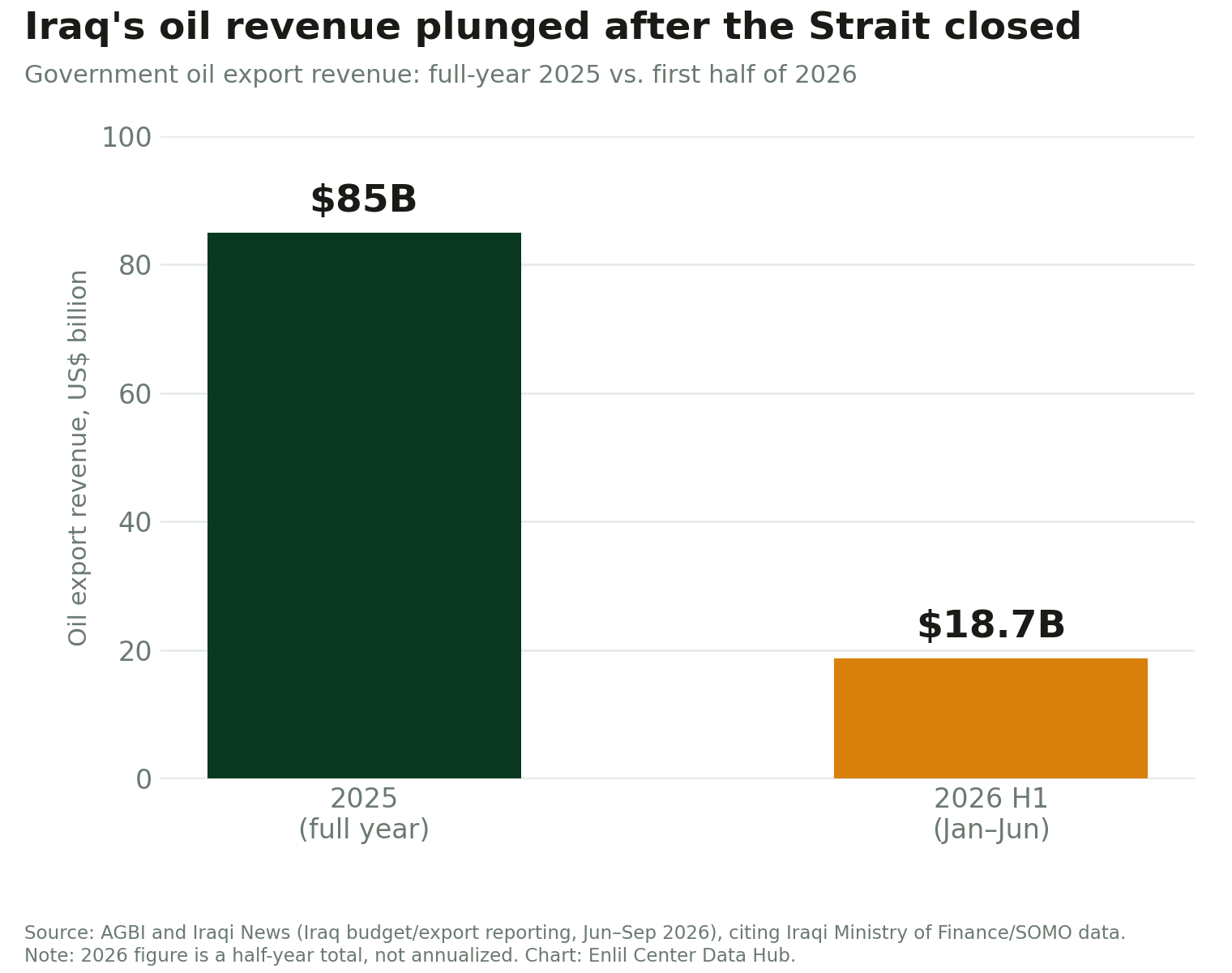
Caption: Iraq's government oil export revenue, full-year 2025 compared with the first half of 2026. Source: AGBI reporting on Iraq's budget deficit, citing Ministry of Finance data.
Oil accounts for the great majority of Iraqi government revenue, so the export collapse translated directly into a fiscal crisis. Government oil export revenue fell to roughly $18.7 billion for the first half of 2026, against roughly $85 billion for the whole of 2025 — a run rate collapse of nearly two-thirds. Iraq's budget deficit more than tripled in two months, from about $5 billion at the end of April to about $16 billion at the end of June, and independent estimates from the IMF and World Bank put the full-year deficit on track for 8 to 11 percent of GDP. Baghdad turned to domestic borrowing to cover the gap, pushing public debt to a record high of roughly $79 billion by the end of May, and by mid-year the government was warning that it might not be able to pay civil-servant salaries on schedule. None of this appeared in the original 6 April analysis, which was written before most of it had happened — but it is the part of the story that actually determined how the crisis affected ordinary Iraqis.
Where things stand now
Seven months into the war, the picture is one of partial, uneven recovery rather than either resolution or renewed catastrophe. Exports have climbed back toward 2 million barrels a day, the highest since the crisis began, as shipping through the Strait has partly resumed even without a full political settlement. Brent has settled into a wide but not extreme trading range. Tanker attacks and strikes have continued in bursts — including strikes on tankers in the Strait of Hormuz in late September — and Iran has said it is willing to fully reopen the Strait if the United States eases its naval pressure and blockade. Enlil treats the current state as a fragile equilibrium rather than a resolution: exports remain well below pre-war levels, the fiscal damage already done will constrain Iraqi government spending well into 2027 regardless of what happens next, and the tanker war has shown it can resume on short notice.
Sources: Wikipedia and Britannica summaries of the 2026 Iran war and Strait of Hormuz crisis; Al Jazeera; Shafaq News; Iraqi News; Arab News/The New Arab; AGBI; Enab Baladi; Rudaw; original Bloomberg Economics reporting (February–April 2026), as available at time of original publication.