
Climate Mobility Integration into Iraq's National Adaptation Plan (NAP)
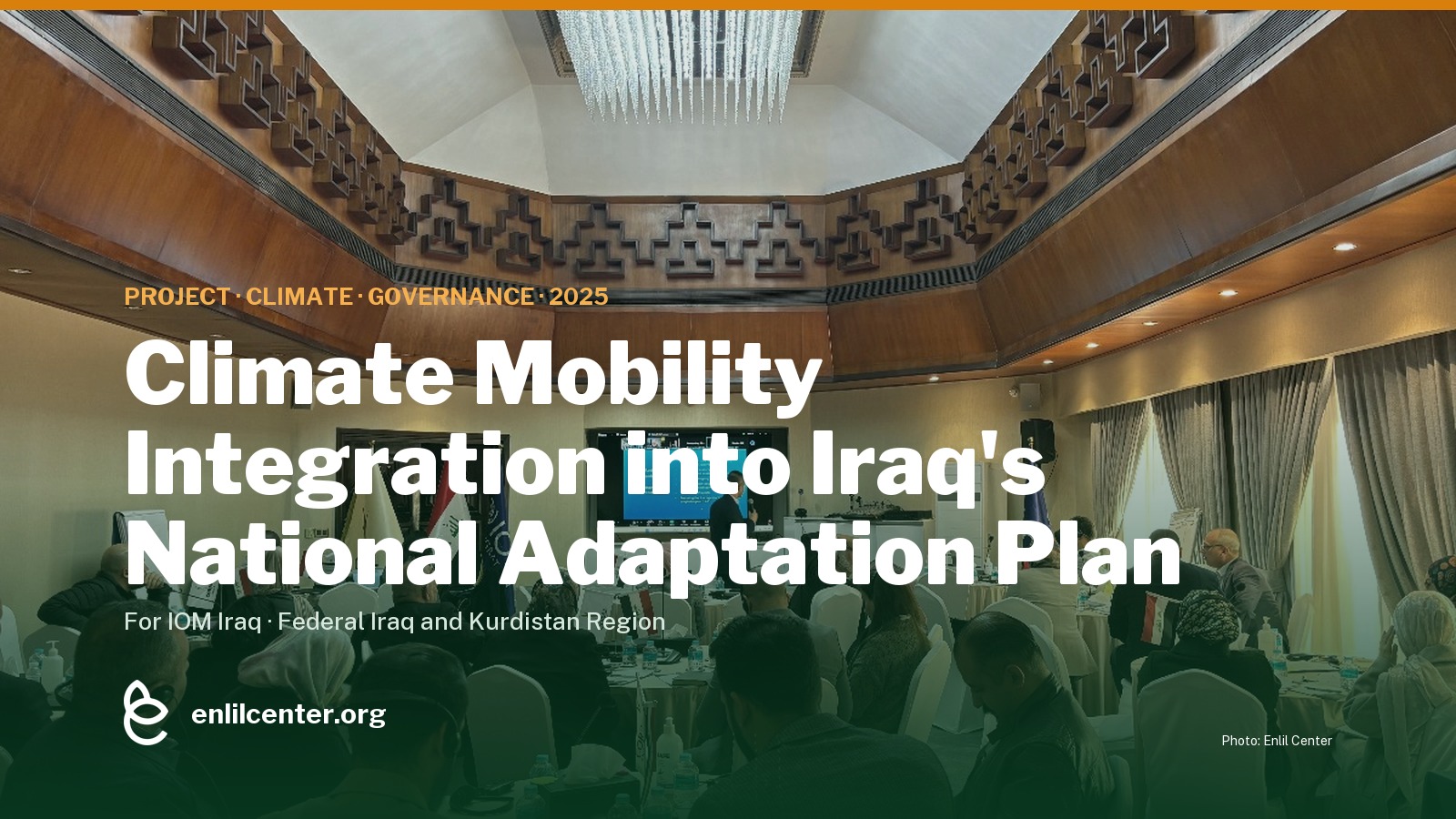
Enlil Center led the field research and technical writing for the Climate Mobility Chapter of Iraq's National Adaptation Plan for IOM Iraq — interviews, focus groups and field visits across Federal Iraq and the Kurdistan Region, now part of Iraq's UNFCCC submission.
Abstract
- Iraq is among the countries most exposed to climate change, and its people are already moving because of it: IOM recorded more than 140,000 Iraqis displaced by drought, water scarcity, salinity and land degradation across 12 governorates in March 2024, rising to about 186,000 by September 2025.
- Commissioned by IOM Iraq, Enlil Center led the field research and technical writing for the Climate Mobility Chapter of Iraq's National Adaptation Plan (NAP) — the country's formal adaptation strategy under the UNFCCC.
- The evidence base was built in the field: key-informant interviews with officials, community leaders, humanitarian practitioners and displaced people; focus-group discussions; and visits to communities in Federal Iraq and the Kurdistan Region living with drought, flooding and agricultural collapse.
- The chapter was incorporated into Iraq's NAP submission, placing testimony from climate-affected Iraqis inside the national policy document that will guide adaptation planning and finance requests.
Overview
Iraq is one of the world's most climate-vulnerable countries — a place where water scarcity, extreme heat, desertification and recurrent flooding are not projections but daily realities that shape where people live, how they earn a living and whether they can stay. As those pressures intensify they push people to move: within communities, across governorates, and sometimes out of the country. A National Adaptation Plan that ignored that movement would be planning for a population that no longer exists.
Commissioned by the International Organization for Migration (IOM) Iraq, Enlil Center led the field research and technical writing for the Climate Mobility Chapter of Iraq's NAP, the foundational adaptation document Iraq submits to the United Nations Framework Convention on Climate Change. The project put the voices of climate-affected Iraqis at the centre of national policy.
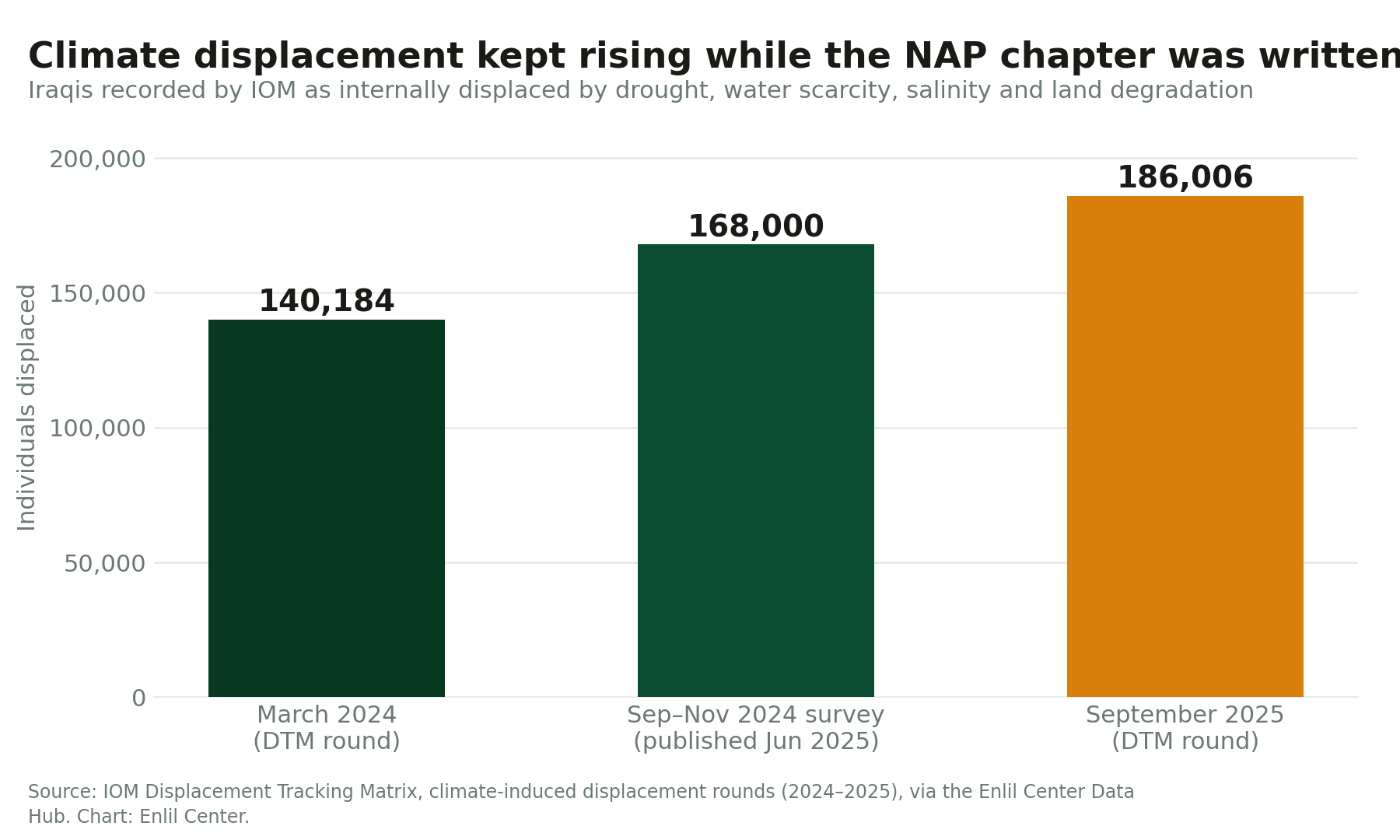
Caption: The scale the chapter was written against: IOM's count of Iraqis displaced by climate factors rose by roughly a third between March 2024 and September 2025. Source: IOM Displacement Tracking Matrix, via the Enlil Center Data Hub.
What we did
Enlil Center's team deployed across governorates in both Federal Iraq and the Kurdistan Region, conducting field visits to communities already living with the consequences of climate change. The methodology combined structured qualitative research with direct community engagement: key-informant interviews with local officials, community leaders, humanitarian practitioners and displaced individuals; focus-group discussions capturing perspectives on climate-driven displacement, migration decisions and livelihood disruption; and field visits to areas affected by drought, flooding, land degradation and agricultural collapse. The data fed directly into a technical chapter authored by Enlil Center's researchers — an evidence-based analysis of how climate change is reshaping human mobility in Iraq.
Policy impact
The chapter was formally incorporated into Iraq's NAP submission to the UNFCCC. The testimonies of farmers who abandoned drought-stricken land, families displaced by flooding and workers who lost climate-dependent livelihoods are now embedded in Iraq's national climate policy framework, informing adaptation planning at the highest level. For a country navigating development and climate crises at once, having locally grounded, independently produced evidence in its official submission is a step toward more responsive climate governance — and a stronger basis for the adaptation finance the NAP is meant to unlock.
Our role
This project reflects what Enlil Center was built to do: rigorous, field-driven research as an independent Iraqi institution — not a subcontractor working from a distance, but a team embedded in the same country, speaking the same languages and understanding the same context as the communities it documents. Working under IOM's mandate, Enlil operated to international research standards while bringing local knowledge no external team could replicate.
About the NAP process
A National Adaptation Plan is a country's long-term strategy for reducing vulnerability to climate impacts and integrating resilience into development planning. Established under the UNFCCC, the process requires countries to identify priority adaptation needs and present evidence-based measures. Iraq launched its NAP process in 2020 with UNEP support. Enlil tracks the drivers behind the chapter — freshwater per person, rainfall and displacement — in the Data Hub series linked below.
Video
Downloads
Data behind this project
Series from the Enlil Data Hub — each chart is downloadable with its source.
Sources & citations
This project could not be found. Back to Projects