
Recommendations on Policy and Legislation to Stop Open Burning of Waste in Iraq
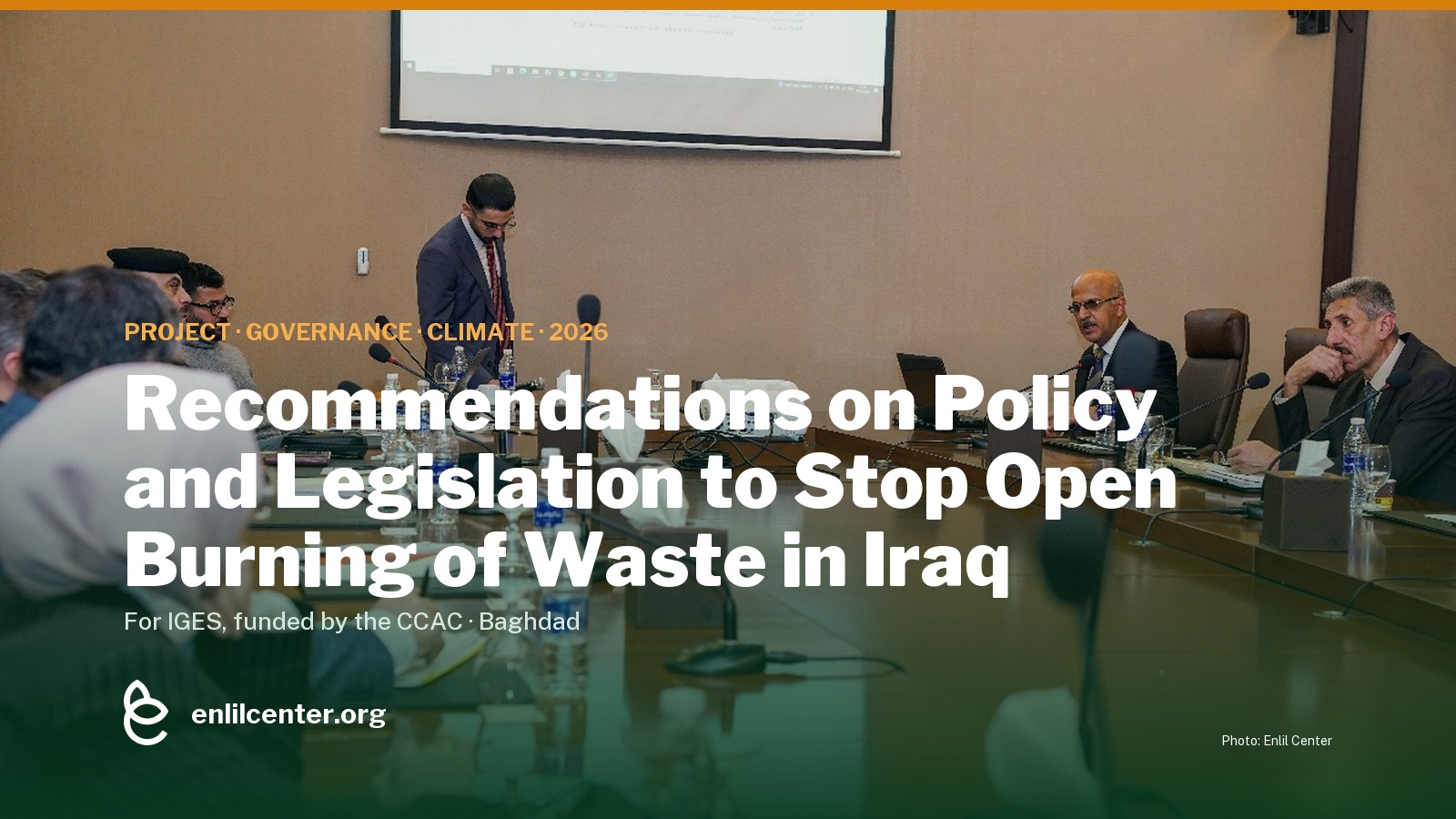
Enlil Center is the national partner to IGES and the Climate and Clean Air Coalition on policy and legislative recommendations to end open waste burning in Iraq — stakeholder consultations, governance analysis and a proposed Iraq Waste Framework reviewed with the Ministry of Environment.
Abstract
- Open burning is Iraq's default waste disposal method: of the 224 disposal sites in JICA's national baseline, 157 are uncontrolled open dumps, and the state's own estimates of how much waste the country produces range from roughly 11 to 40 million tonnes a year.
- Commissioned by the Institute for Global Environmental Strategies (IGES) and funded by the Climate and Clean Air Coalition (CCAC), Enlil Center is the national consultancy partner for the project Recommendations on Policy and Legislation to Stop Open Burning of Waste in Iraq.
- Enlil designed and ran two focus-group discussions with ministries, municipalities and the private sector, analysed the institutional overlaps, financing gaps and enforcement weaknesses that drive open burning, and contributed the national context to the recommendations.
- The recommendations — a proposed Iraq Waste Framework, institutional responsibilities, municipal regulations, disposal-site management and costed short-term actions — were reviewed with Ministry of Environment officials in January 2026 and are positioned to inform amendments to the Environmental Protection Law and the forthcoming national Waste Management Law.
Overview
Open burning of waste releases black carbon, methane, dioxins and fine particulates — the pollutants behind Iraq's persistently high PM2.5 exposure and a direct contributor to climate change. It persists not because communities choose it but because the alternatives are missing: collection reaches about six in ten Iraqis nationally, most disposal sites are open dumps, and Law No. 27 of 2009 prohibits open burning without giving municipalities the means to stop it.
Through this IGES-led, CCAC-funded initiative, Iraq is receiving targeted technical assistance to develop evidence-based policy and legislative measures that eliminate open burning while strengthening the waste-management system underneath it. Enlil Center serves as the national consultancy partner, working with the Ministry of Environment and the international consultant team.
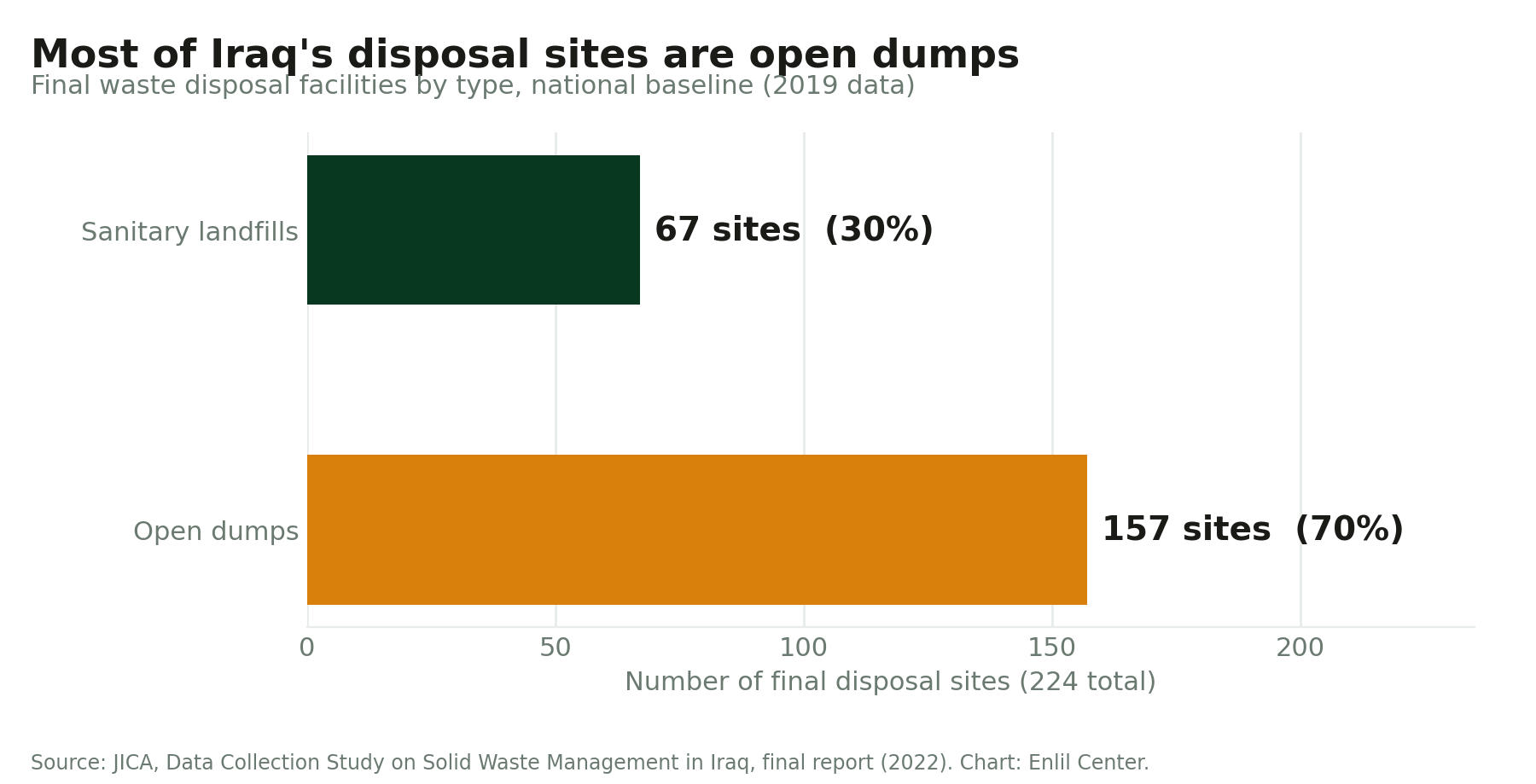
Caption: The starting point: seven in ten of Iraq's disposal sites are uncontrolled open dumps. Source: JICA, Data Collection Study on Solid Waste Management in Iraq (2022; 2019 data).
What we did
Enlil led all national-level coordination and stakeholder engagement. The team designed and organised two focus-group discussions with key stakeholders from ministries, municipalities and the private sector, handling participant selection, logistics and full documentation — participant lists, answer forms and detailed FGD reports. It conducted field-level analysis of current waste practices, identifying the institutional overlaps between the Ministry of Environment and the Ministry of Construction, Housing, Municipalities and Public Works, the financing gaps at municipal level, and the enforcement weaknesses that leave open burning unpunished. And it contributed national context and policy insight to the recommendations themselves, including a proposed national waste framework, institutional reforms, municipal regulations, disposal-site management and costed short-term actions.
Policy impact
The recommendations were presented and discussed in a high-level review meeting with Ministry of Environment officials and other stakeholders in January 2026. The final document gives Iraq a roadmap — a proposed Iraq Waste Framework, institutional responsibilities, financing mechanisms and a phased implementation plan — to move from open burning to managed disposal. They are positioned to inform updates to the Environmental Protection Law and the national Waste Management Law now in preparation. Enlil's own analysis of the governance failures behind open burning is published in the Articles section.
Our role
Enlil did not act as a logistics provider. It brought a working understanding of Iraq's governance structures, municipal realities and stakeholder dynamics to make sure the recommendations are practical, implementable and aligned with Iraq's climate and environmental commitments.
About the project
The Climate and Clean Air Coalition supports countries in reducing short-lived climate pollutants such as black carbon and methane, of which open waste burning is a major source. IGES leads the CCAC's work on regional roadmaps and city pilots to end open burning; the Iraq recommendations sit within that programme. The air-quality and urbanisation series behind the problem are linked below in the Data Hub.
Video
Downloads
Data behind this project
Series from the Enlil Data Hub — each chart is downloadable with its source.
Sources & citations
This project could not be found. Back to Projects