
Renewable Energy Assessment for Public Infrastructure in Anbar Governorate
Under GIZ's ARILA programme, Enlil Center supported a renewable-energy assessment for public buildings in Ramadi, Fallujah and Heet — field demand assessment, feasibility and SWOT analysis, and a roadmap for solar and hybrid systems on Anbar's critical infrastructure.
Abstract
- Anbar's public buildings — municipal offices, schools, clinics and water-treatment plants — still depend on an unreliable grid and expensive diesel generators, years into reconstruction. Iraq's installed solar capacity was 63.6 MW in 2025 against a 12,000 MW target for 2030.
- Commissioned by WEE Pros GmbH under GIZ's Assisting Reconstruction and Improving Livelihoods in Anbar (ARILA) programme, Enlil Center supported a technical assessment of renewable-energy options for public-service buildings in Ramadi, Fallujah and Heet.
- Enlil's energy expert joined the in-country mission, assessed energy demand at priority buildings and existing installations, and contributed to a feasibility study and SWOT analysis covering technical and financial viability, market availability, tariffs and regulation, security and do-no-harm considerations, and capacity needs.
- The assessment gives GIZ ARILA and Anbar's authorities an evidence-based roadmap for solar and hybrid systems on critical infrastructure, financing models and the regulatory adjustments needed to scale them.
Overview
Iraq's conflict-affected governorates face chronic electricity shortages that undermine basic public services. In Anbar, where reconstruction is ongoing, many municipal buildings, schools, health facilities and water-treatment plants rely on grid power that arrives for a few hours a day and on diesel generators that cost more than the services they keep running. Solar and hybrid systems are the obvious alternative: the governorate has strong solar resources, and daytime demand from public buildings matches solar output.
Commissioned by WEE Pros GmbH under GIZ's ARILA programme, Enlil Center supported a strategic assessment of the potential to expand renewable energy for public administration and service buildings, focused on the conflict-affected districts of Ramadi, Fallujah and Heet. The assignment analysed current energy-use patterns, reviewed existing renewable installations and explored grid-connected and off-grid solar and hybrid options to improve supply reliability and cut operating costs.
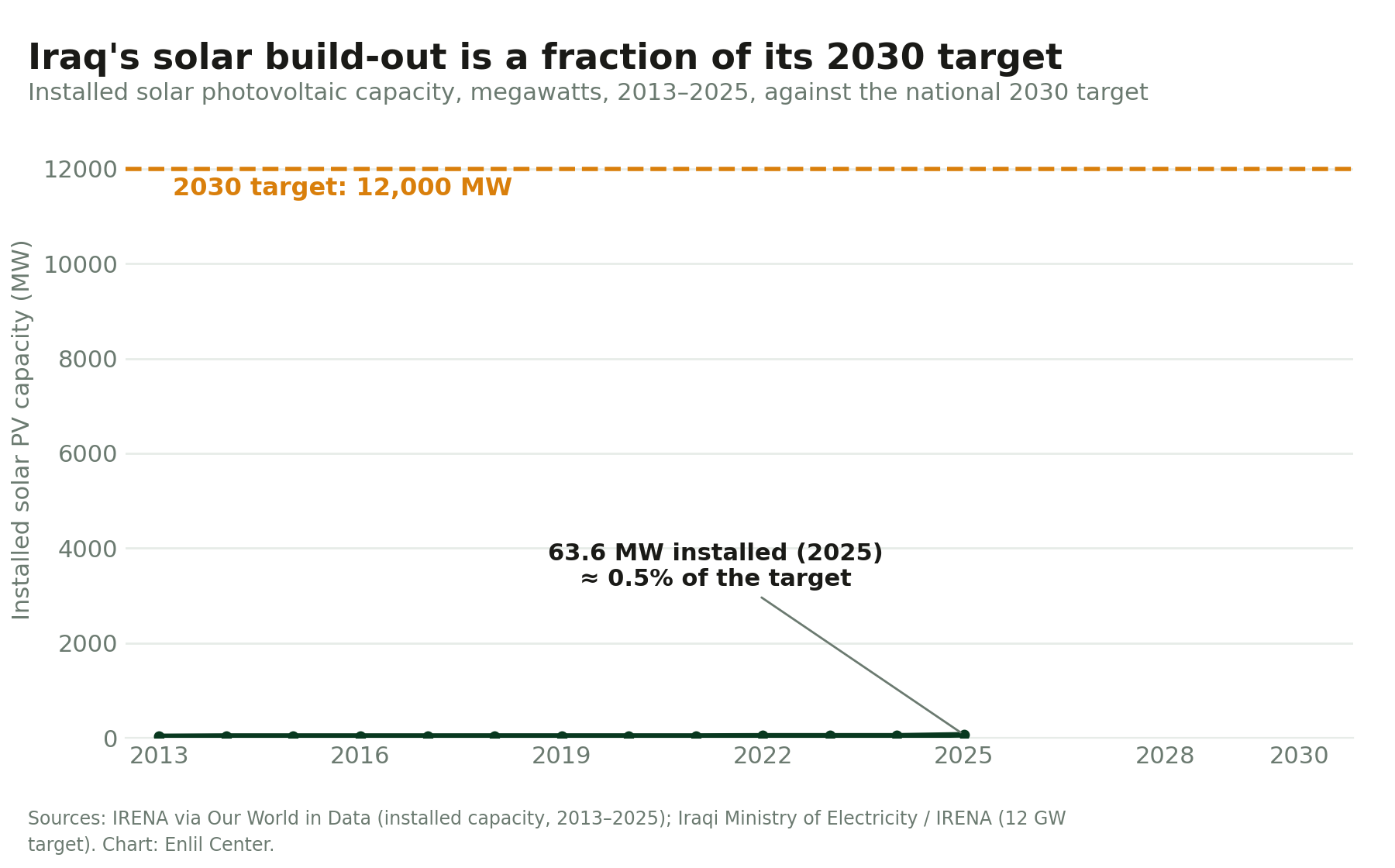
Caption: The national context for Anbar's public-building solar: Iraq had installed about 0.5 percent of its 2030 solar target by 2025. Sources: IRENA via Our World in Data; Iraqi Ministry of Electricity.
What we did
Enlil, through its energy expert Othman Kareem, provided targeted technical support to the international project team: participating in the in-country mission in Baghdad and Anbar, including field visits to assess demand at priority public buildings and existing renewable installations; supporting the team leader in preparing and reporting the mission, including stakeholder mapping and coordination; contributing technical inputs and national context in discussions with local authorities, electricity utilities, private suppliers and development partners; and assisting in the feasibility study and SWOT analysis covering technical and financial viability, market availability of technologies and services, regulatory and tariff frameworks, security, do-no-harm principles and capacity-building needs.
Project impact
The assessment delivered a practical roadmap for scaling renewable energy in Anbar's public sector: evidence-based recommendations on suitable solar and hybrid solutions for critical infrastructure, potential financing models, and the regulatory and institutional adjustments required. The findings are expected to inform future investment decisions, strengthen local ownership of green reconstruction and attract further donor and private-sector funding for renewable projects across the governorate.
Our role
Enlil brought a working understanding of Iraq's energy sector, Anbar's post-conflict realities, the regulatory environment and local stakeholder dynamics, so that the recommendations are practical and implementable rather than imported.
About the project
GIZ's ARILA programme supports the stabilisation and reconstruction of Anbar Governorate after years of conflict, with reliable and sustainable energy for public services as a core component. Through this consultancy with WEE Pros GmbH, Enlil contributed Iraqi expertise to integrating renewable energy into Anbar's reconstruction strategy — reducing diesel dependency, lowering emissions and making essential infrastructure more resilient. The national electricity series behind the problem are linked below in the Data Hub.
Video
Downloads
Data behind this project
Series from the Enlil Data Hub — each chart is downloadable with its source.
Sources & citations
This project could not be found. Back to Projects