
Summary
- By early 2026, Iraq was generating about 29 GW against a baseline demand of roughly 40 GW. Forecasters later revised the summer peak-demand estimate upward to a record 62 GW — implying a shortfall of up to 32 GW, larger than the roughly 26 GW gap officially projected back in June.
- The immediate trigger was the collapse of Iranian gas imports, which Iraq had relied on for 30-40% of its electricity generation. After Washington ended Baghdad's sanctions waiver in March 2025 and US-Israeli strikes hit Iran's South Pars field in March 2026, flows fell to 15-20 million cubic meters a day against the roughly 50 million Iraq needs.
- Two self-inflicted problems compound the geopolitics: electricity is sold far below cost, so the ministry recovers only about a tenth of what it spends; and Iraq flared an estimated 18.2 billion cubic meters of gas in 2024 — the world's third-largest flaring total, enough to power a significant share of the exact shortfall it is trying to plug with imports.
- The crisis is not theoretical: the Ministry of Electricity reported a nationwide "total blackout" on 4 March 2026, traced to a sudden loss of gas supply at the Rumaila plant in Basra — a preview, before the heat had even arrived, of how little margin the grid has left.
- The long-promised Gulf Cooperation Council power link, meant to bring Iraq its first cross-border electricity supply, missed its original April 2026 start date and has slipped to "the end of August at the earliest" — after the peak-demand weeks it was meant to relieve.
- The most credible progress is domestic and specific: the Karbala solar plant's first 22 MW phase went live in September 2025 and a further phase entered trial operation in March 2026 — but Iraq's total installed solar capacity was still just 63.6 MW as of 2025, against a government target of 12,000 MW by 2030.
A grid built on borrowed gas
There is no shortage of irony in Iraq's electricity crisis. The country sits on some of the planet's largest hydrocarbon reserves, yet for more than three decades it has struggled to deliver reliable power to its homes and businesses. As temperatures climb back above 50°C in the summer of 2026, that failure is once again becoming a daily emergency — and on the ministry's own forecast, a more severe one than the year before.
By the start of 2026, Iraq was generating about 29 gigawatts (GW) of electricity against a baseline national demand of roughly 40 GW. Iraq's Ministry of Electricity hoped to reach around 30 GW of supply during the summer peak, but industry trackers revised the expected peak demand upward through the spring — from an initial estimate near 55 GW to a record 62 GW, some 15% above the previous year's own record of 54 GW. That left a shortfall of up to roughly 32 GW: larger, not smaller, than officials had been projecting only months earlier.
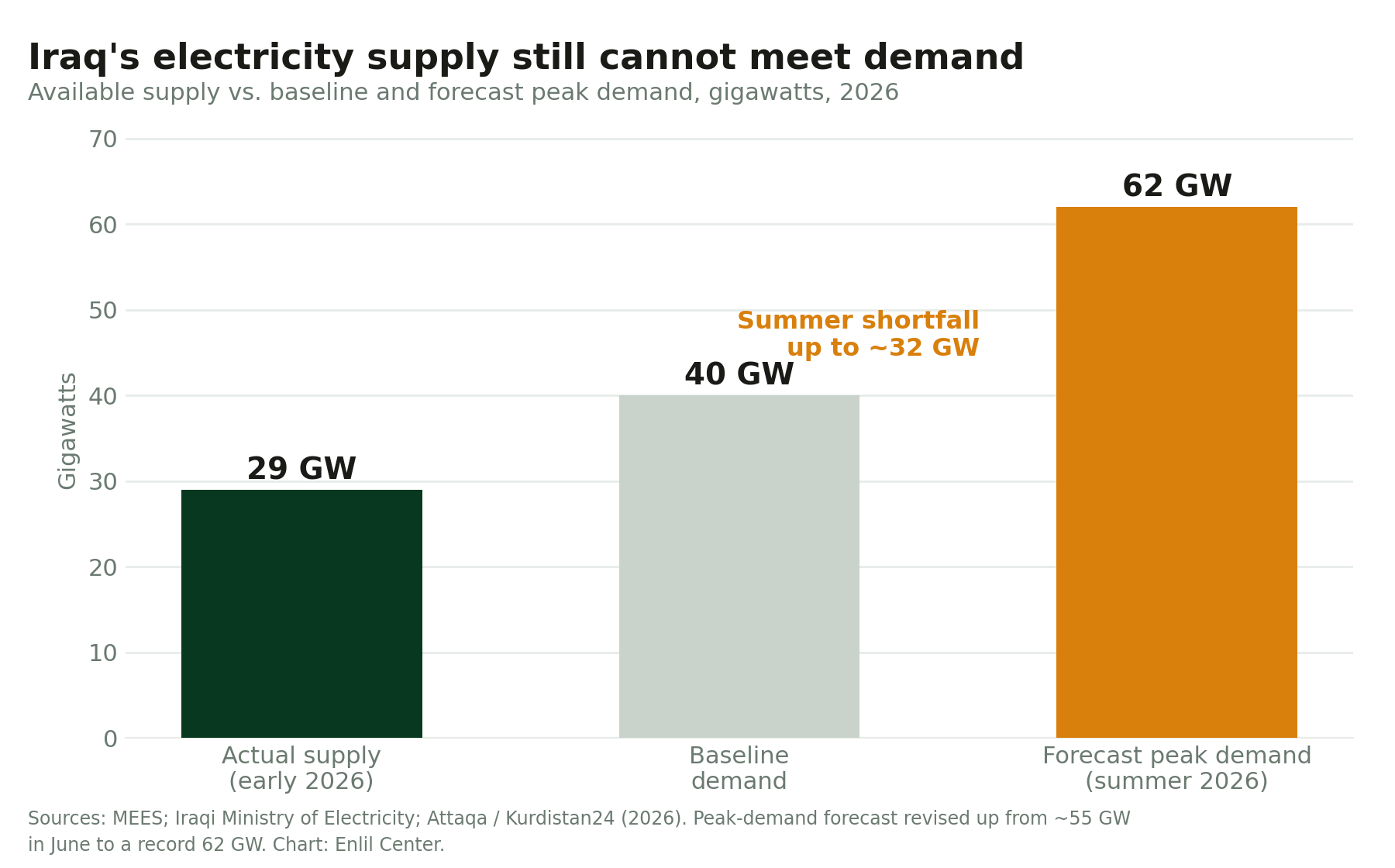
Caption: Iraq's own demand forecast worsened through the spring of 2026, widening the summer supply gap to as much as 32 GW. Sources: MEES; Iraqi Ministry of Electricity; Attaqa / Kurdistan24.
The numbers translated directly into hardship. Supply hours collapsed across the country: reporting from Attaqa and Kurdistan24 in May described Najaf sliding from two-hours-on, two-hours-off to as little as two-on, six-off within ten days, Hilla dropping to one hour on and three off, and even Basra — the oil capital — running on rationed schedules. Public protests, a fixture of Iraqi summers, were already building by late May, weeks before the peak.
The immediate trigger is gas — specifically Iranian gas. Before the latest regional escalation, Iraq relied on imports from Iran to generate roughly 30-40% of its electricity. That dependence proved dangerously fragile. In March 2025, Washington ended the sanctions waiver that allowed Baghdad to buy Iranian energy. Then, after US-Israeli strikes on Iran's South Pars field in March 2026, flows fell sharply. Iranian gas supplies since early May 2026 have ranged between 15 and 20 million cubic meters a day, against the roughly 50 million cubic meters Iraq needs to run its gas-fired plants properly — a gap independently corroborated by multiple 2026 industry reports, not just Iraqi officials.
The damage has been compounded by disruption to Iraqi oil exports amid the wider regional conflict, which squeezed the revenue Baghdad needs to buy emergency fuel. With national income under pressure, the state has repeatedly been forced back onto expensive, polluting liquid fuels to keep its turbines spinning. Even on paper, Iraq's roughly 40 GW of installed capacity can only ever deliver a fraction of that in practice; a meaningful share of the power the country does generate is lost in a transmission and distribution network that has long run behind what the country needs.
The paradox of pricing — and flaring
Two deeper, self-inflicted problems sit beneath the geopolitics.
The first is pricing. Iraq sells electricity far below cost — the first tier of household consumption is billed at a small fraction of a US cent per kilowatt-hour. The Ministry of Electricity recovers only around a tenth of what it spends, and a large share of bills are never paid in full. Starved of revenue, it cannot invest in the very grid that would end the shortages. The cruel twist, documented by the Baker Institute's 2025 research on Iraq's "electricity tariff paradox," is that Iraqis already pay real market rates — just to private diesel-generator ("amp") operators, whose power can cost many times the grid tariff. Iraqis are not unwilling to pay for power; they are unwilling to pay for power that never comes.
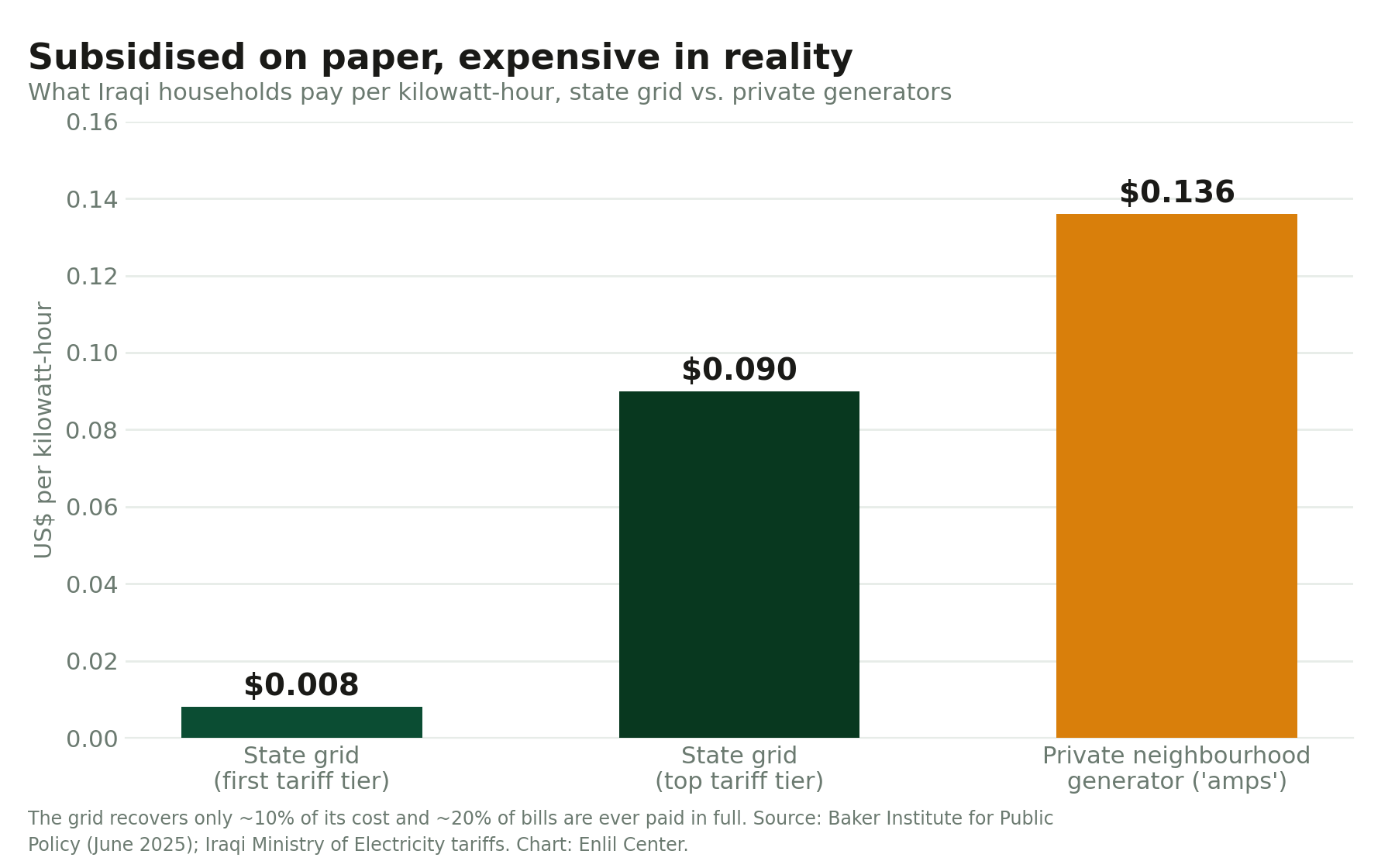
Caption: The state tariff recovers only a fraction of cost, yet households routinely pay far more to private generators for the power the grid fails to deliver. Source: Baker Institute for Public Policy (2025); Iraqi Ministry of Electricity tariffs.
The second is flaring. Iraq burned an estimated 18.2 billion cubic meters (bcm) of associated gas in 2024, according to the World Bank's Global Gas Flaring Tracker — the world's third-largest total, behind only Russia and Iran. That volume is roughly enough, if captured and converted to generation, to power an estimated 33 GW — roughly the size of the shortfall Iraq is trying to plug this summer with Iranian imports and emergency fuel purchases. Flaring at that scale also releases an estimated 36 million tonnes of CO₂ a year, by the World Bank's own estimate. The country is, quite literally, still burning a meaningful part of the solution to its own crisis.
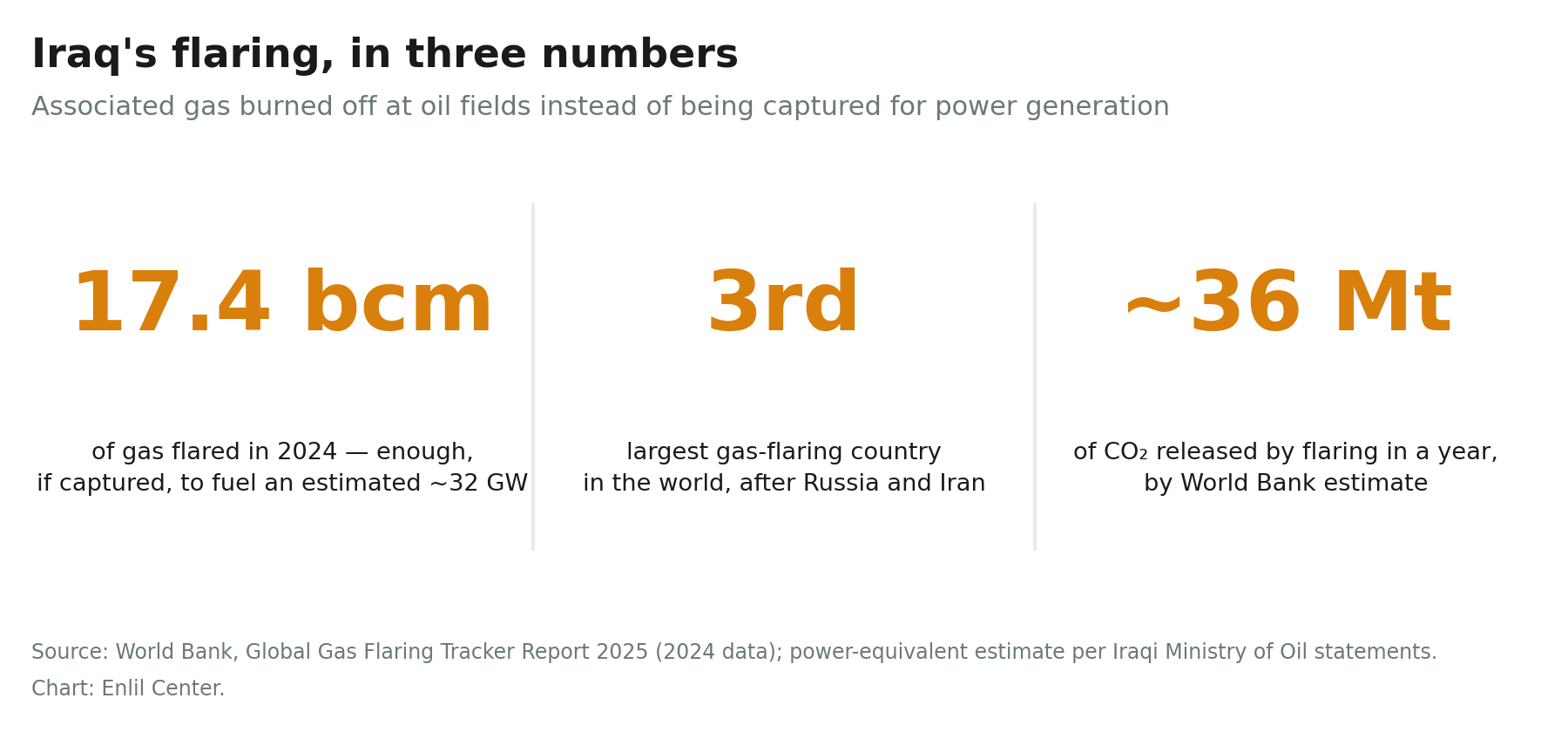
Caption: Iraq flared 18.2 billion cubic metres of gas in 2024 — the world's third-largest volume — while importing gas to keep its power plants running. Source: World Bank, Global Gas Flaring Tracker 2025.
Iraq's electricity mix reflects the same imbalance: World Bank-sourced generation data (via Ember/Our World in Data) shows that of the 149.7 terawatt-hours Iraq generated in 2024, gas and oil together accounted for roughly 98% of it — hydropower and solar made up the rest. That figure has barely moved in years, and it is the underlying reason a single supplier's gas cutoff can put a third of the country's power at risk.
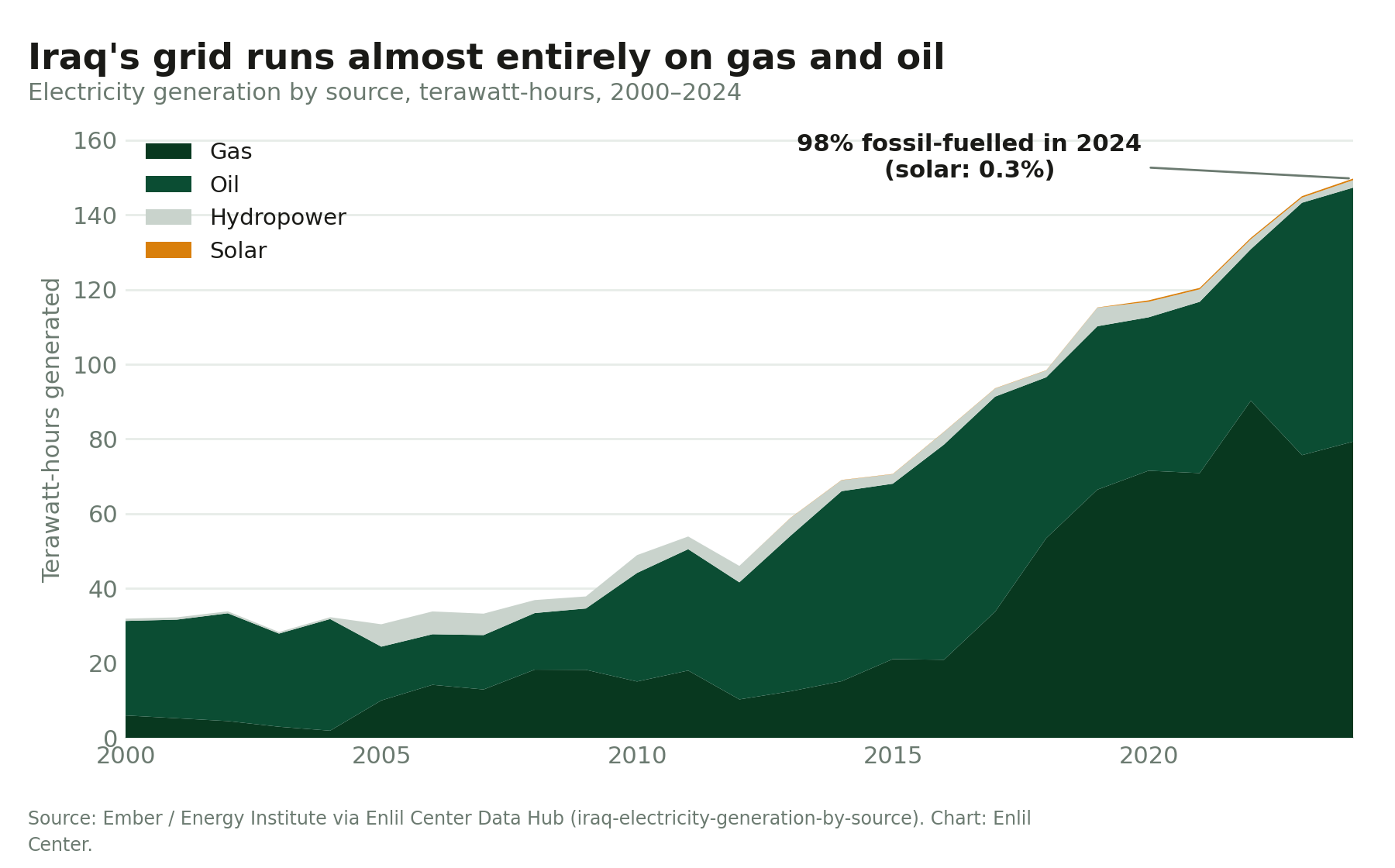
Caption: Gas and oil supplied about 98 percent of the 149.7 terawatt-hours Iraq generated in 2024; solar was 0.3 percent. Source: Ember / Energy Institute, via the Enlil Center Data Hub.
What to watch this summer
Enlil is publishing this analysis before the peak-demand weeks of July and August, which makes it a forecast rather than a verdict. Five indicators will show whether 2026 is worse than 2025 or merely as bad. First, whether actual peak load approaches the ministry's record 62 GW forecast, and how far supply falls below the roughly 30 GW it hopes to deliver. Second, whether Iranian gas flows recover from the 15–20 million cubic metres a day seen since early May, or stay there through the hottest weeks. Third, whether the GCC link energises by the end of August as now promised, or slips again. Fourth, whether the Karbala solar plant's second phase moves from trial operation to commercial supply. And fifth, the political barometer that has never failed to register a bad summer: the size and spread of street protests, which in 2025 began in the south in early July.
The March blackout is the reason these indicators matter. A grid that can lose the whole country to a single gas-supply drop at one Basra plant in the mild weather of early spring has no reserve margin to spend in August. Enlil treats that event, not the June forecast, as the clearest evidence of how the summer is likely to go.
Signs of movement
There are real responses under way, though few will deliver relief in time for this summer's peak. Iraq is pursuing gas-capture and diversification with international partners, targeting an end to routine flaring within the decade, and building solar at scale. The Ministry of Electricity, backed by IRENA's Energy Transition Assessment, is aiming for more than 12,000 MW of solar and over 1,000 MW of wind by 2030. Solar suits Iraq especially well: sunlight is abundant, and output peaks at midday, exactly when air-conditioning load is highest.
The most concrete progress so far is the Karbala solar plant, whose first 22 MW phase entered operation in September 2025, with a further phase reported entering trial operation in March 2026 en route to an eventual 300 MW design capacity. That real progress is visible in Iraq's own installed-capacity data — a jump from 41.6 MW to 63.6 MW between 2024 and 2025, almost entirely attributable to Karbala coming online. But even taken at face value, that leaves Iraq with roughly 0.5% of its own 2030 solar target installed. The distance still to cover is not a rounding error.
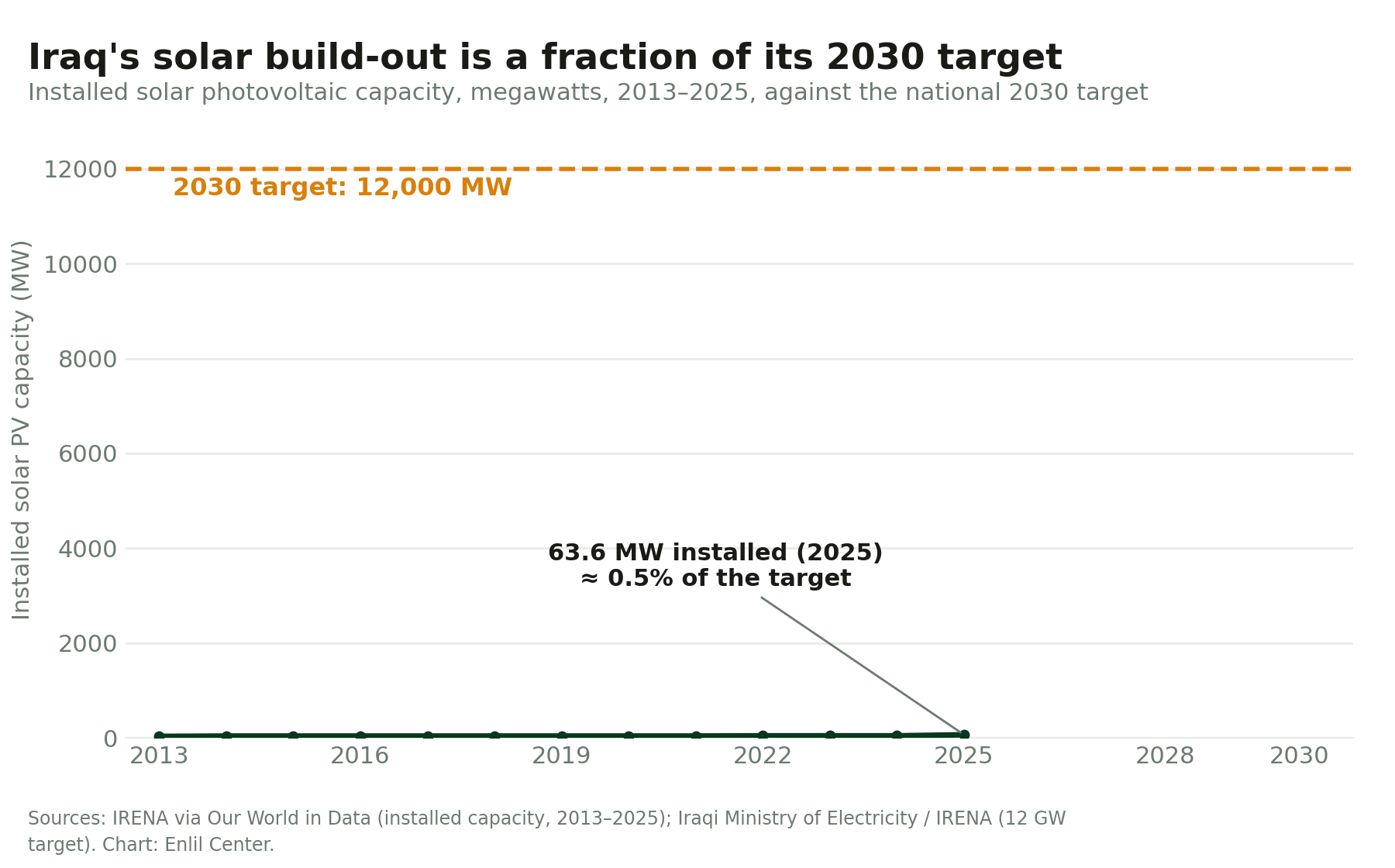
Caption: Karbala's first phase lifted Iraq's installed solar capacity to 63.6 MW in 2025 — about 0.5 percent of the 2030 target. Sources: IRENA via Our World in Data; Iraqi Ministry of Electricity.
Regional interconnection is the other hope, and so far the clearer cautionary tale. The Gulf Cooperation Council power link — the first extension of the Gulf's integrated grid to a country outside the GCC, designed to deliver an initial 500-600 MW to Basra via a new line from Kuwait — was originally due to start in April 2026. The GCC Interconnection Authority has since pushed the timeline to "the end of August at the earliest" — after the peak-demand weeks it was meant to relieve. A second, smaller link with Jordan (150–500 MW) is separately reported to be expected around August 2026. Neither will change the arithmetic of this summer.
The way out
Iraq's electricity crisis is not, at root, a shortage of fuel or sunlight — both are abundant. It is a crisis of structure: under-priced power that bankrupts the utility, wasted gas that should be feedstock, a grid too weak to carry what it generates, and a reliance on a single, volatile neighbour for the gas that keeps the lights on. The 2026 emergency is shaping up to be severe — by the ministry's own forecast, worse than the one before it — but it is also familiar. Iraqis have endured some version of it every summer for a generation.
The encouraging news is that the most important levers are domestic. Capturing flared gas, gradually reforming tariffs while protecting the poorest households, investing in transmission, and scaling solar well beyond Karbala's first phase would together address the deficit far more durably than any emergency fuel purchase or delayed interconnection line. The harder news is that all of them demand sustained political will and years of uninterrupted work — the two things Iraq's energy sector has most consistently lacked, and the two things that still have not clearly arrived.
Enlil expects the outcome of this summer to depend less on emergency fuel purchases than on whether Baghdad treats 2026's forecast shortfall as the floor it needs to build above, rather than a ceiling it can manage down to.