
Summary
- Since the mid-2010s, Iraqi scientists and local authorities have deliberately planted the salt-tolerant grey mangrove, Avicennia marina, along the Shatt al-Arab estuary — a species Iraq's coastline never naturally supported. The goal: stabilize eroding shoreline, filter pollutants, and act as a buffer for the Ramsar-listed Ahwar marshes upstream.
- The pressure the project is planted against has kept getting worse. Ministry of Water Resources data reported by Reuters in September 2025 put peak salinity in central Basra at roughly 29,000 parts per million — up from about 2,600 ppm the year before, and now within reach of open seawater (35,000 ppm). University of Basrah research finds the saline wedge now intrudes roughly 9 meters deep into the estuary.
- Basra also hosts the bulk of Iraq's petroleum infrastructure, and mangrove restoration sites at Khor Al-Zubair sit directly downstream and downwind of it — a second, chronic stressor on trees already at the edge of their natural range.
- The program has grown substantially since it began: a 400-hectare nursery capable of producing a million seedlings a year, a separate Ministry of Agriculture planting effort running since 2019, and — as of a UN delegation visit in May 2026 — roughly 800,000 government-funded and 200,000 UN-funded seedlings, against a local-authority ambition that has grown from 1 million trees (2022) to 11 million.
- Enlil treats that eleven-fold growth in ambition as a genuine sign of political attention, not yet evidence of matching capacity: an independent environmental expert quoted by 964 Media puts the scale actually needed at 50 million trees — meaning even the current target covers roughly a fifth of the stated need. The unit's own project lead has named "the lack of political will" as the biggest obstacle, not funding or biology.
- Documented survival rates for planted seedlings in Khor Al-Zubair's harsh conditions range from about 40–45% to as high as 78% depending on site and method — a wide enough range that Enlil treats aggregate planting totals as a measure of effort, not yet of established forest.
A species Iraq never had, deliberately introduced
The Mesopotamian marshes of southern Iraq once formed one of the largest and most biodiverse wetland systems in the Middle East. Decades of upstream damming, drainage campaigns, and industrial expansion have altered that landscape substantially. Iraq's own coastline, historically, never supported native mangrove forests — the northern Gulf was simply too arid and saline. Since the mid-2010s, that has changed by design: scientists and local authorities have deliberately introduced the salt-tolerant grey mangrove, Avicennia marina, into the Shatt al-Arab estuary and adjacent tidal flats. The species does several jobs at once — stabilizing eroding shoreline, filtering pollutants from water and sediment, storing carbon, and providing nursery habitat for fish and crustaceans that support local fisheries. Enlil treats mangrove planting here as a genuine case of engineered, rather than restored, ecology: Iraq is not bringing back what was lost, it is establishing something that was never there, because the coastline it now has did not exist in its present degraded form when the marshes were intact.
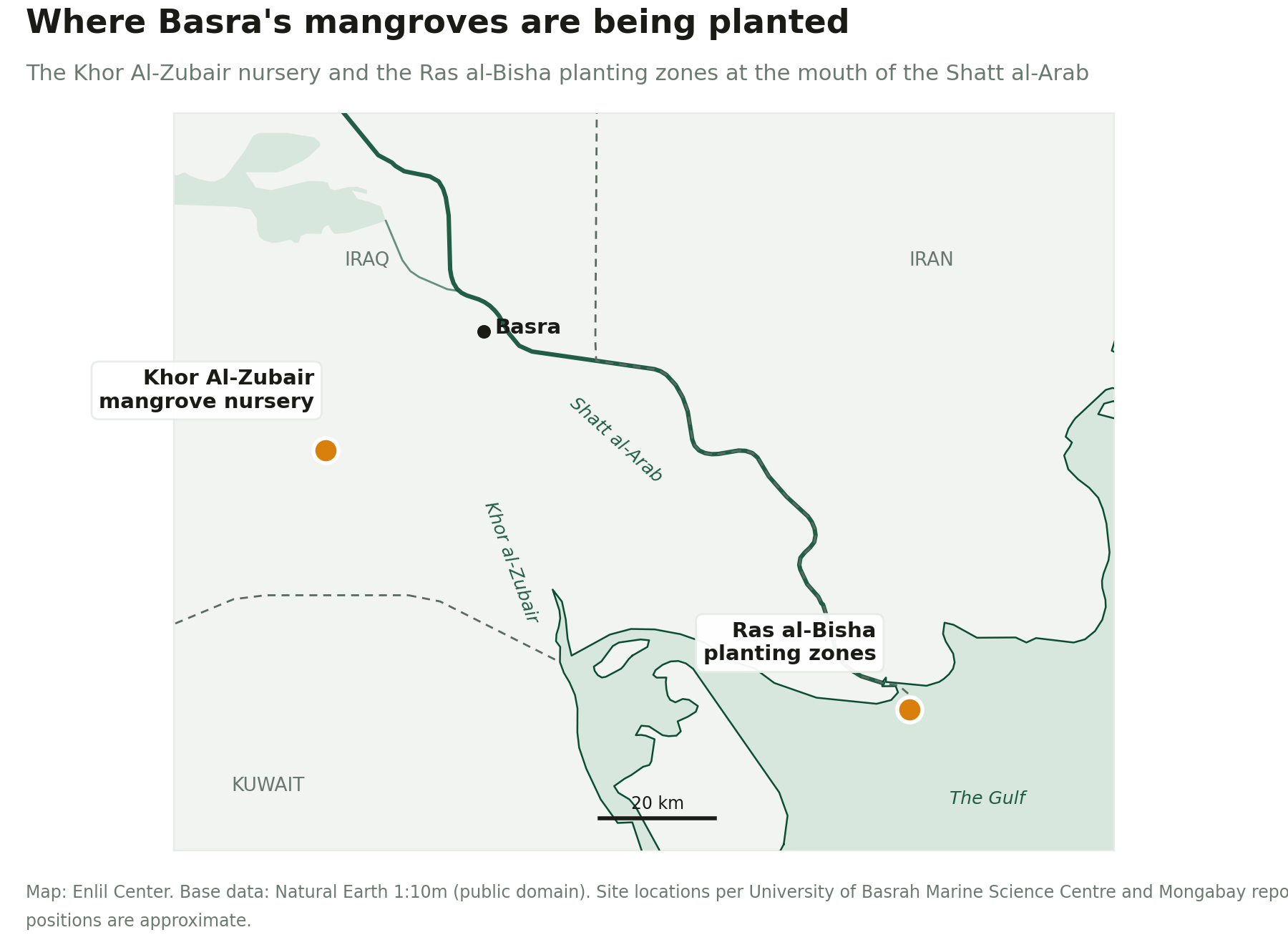
Caption: Where Basra's mangroves are being planted: the Khor Al-Zubair nursery and the Ras al-Bisha planting zones at the mouth of the Shatt al-Arab. Map: Enlil Center; base data Natural Earth.
Two stresses converging on the same young trees
Saltwater intrusion has intensified sharply. Sea-level rise, combined with sharply reduced freshwater inflow from the Tigris and Euphrates due to upstream damming and prolonged drought, has let seawater push deep into the estuary — University of Basrah research finds the saline wedge now reaches roughly 9 meters deep in sections of the Shatt al-Arab. The salinity that results is extreme: Iraq's Ministry of Water Resources reported, in figures picked up by Reuters and other wire services in September 2025, peak levels in central Basra of around 29,000 parts per million — more than ten times the roughly 2,600 ppm recorded the year before, and the worst in 89 years according to ministry spokesman Khaled Shamal, and now close to the 35,000 ppm of open seawater — far past the roughly 1,000 ppm ceiling considered safe for most agricultural and domestic use. The consequence has been agricultural collapse, livestock deaths, and abandoned farmland across large parts of Basra province.
Oil-sector pollution compounds the hydrological stress. Basra hosts most of Iraq's petroleum infrastructure — refineries, petrochemical plants, export terminals — and industrial discharge, gas flaring, and occasional spills put hydrocarbons and heavy metals into the coastal zone. Restoration sites at Khor Al-Zubair sit directly downstream or downwind of this infrastructure. The global scientific literature on oil contamination in mangrove ecosystems documents both acute mortality, through smothering of roots and breathing structures, and chronic sub-lethal effects — reduced photosynthesis, deformed growth, impaired reproduction. Avicennia marina already operates at the extreme edge of its natural range in the northern Gulf; these added stressors raise the odds of restoration failure specifically at the sites closest to Iraq's oil economy — the same economy funding much of the state capacity behind the planting program.
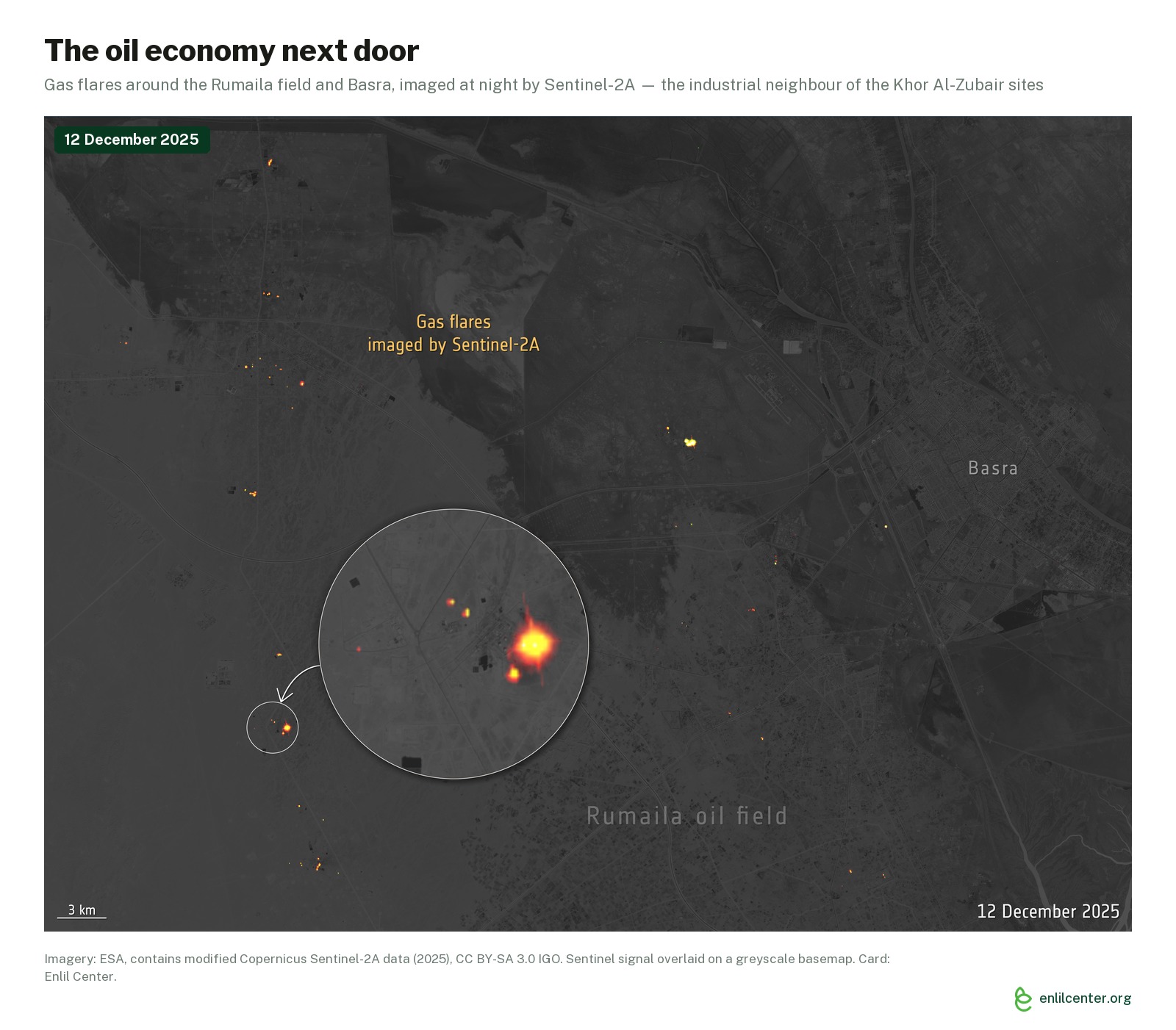
Caption: Gas flares around the Rumaila field and Basra, imaged at night by Sentinel-2A on 12 December 2025 — the industrial neighbour of the Khor Al-Zubair mangrove sites. Imagery: ESA, contains modified Copernicus Sentinel data, CC BY-SA 3.0 IGO.
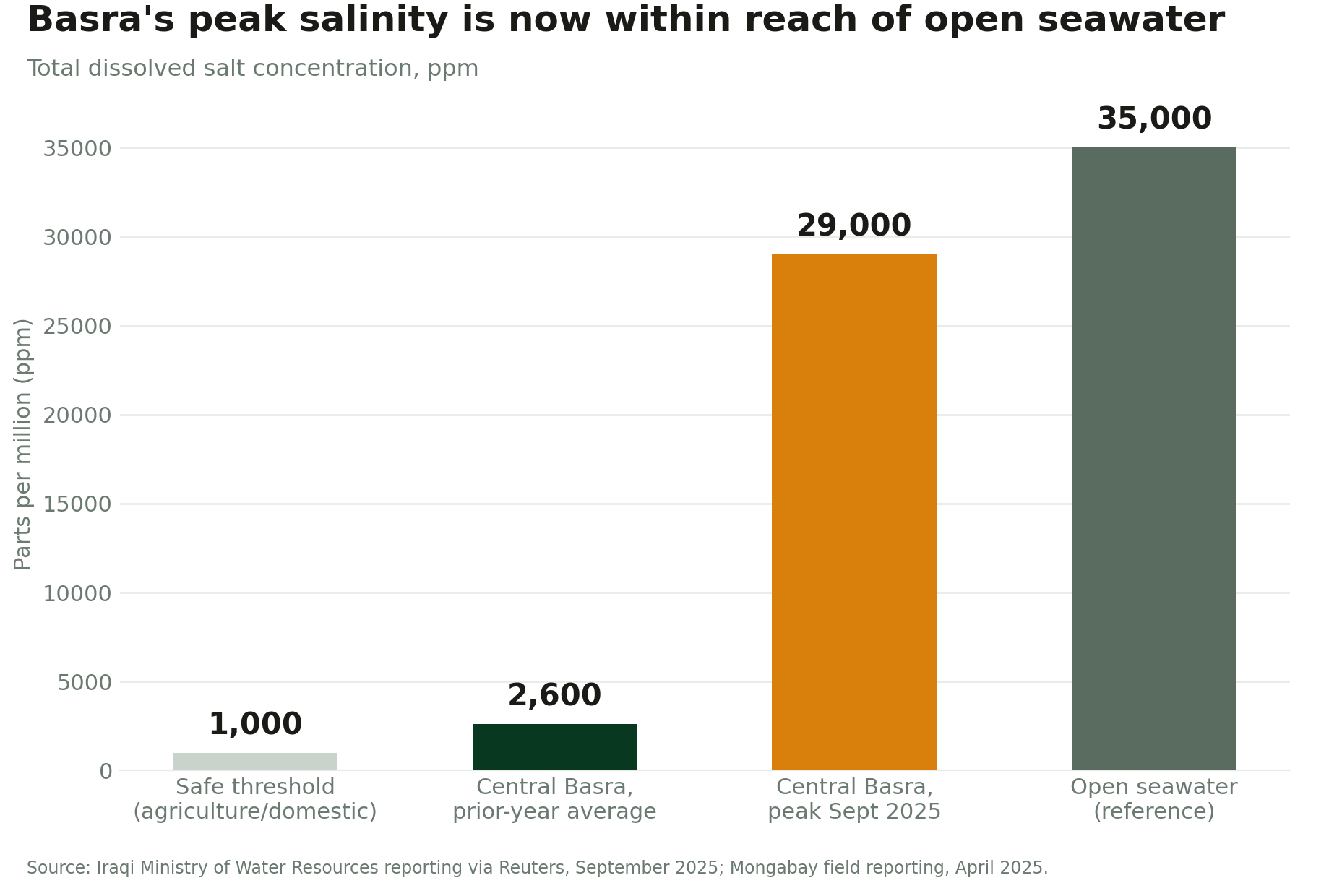
Caption: Central Basra's peak salinity is now close to open seawater and roughly 29 times the safe threshold for agricultural and domestic use. Source: Iraqi Ministry of Water Resources reporting via Reuters, September 2025; Mongabay field reporting, April 2025.
What has actually been planted, and by whom
Two coordinated but distinct programs are driving the work. The first is the nursery and acclimation program led by the University of Basrah's Marine Science Centre, working with the UN World Food Programme, Germany's development ministry, and Iraq's Ministry of Environment. Its 400-hectare Khor Al-Zubair facility can produce up to a million Avicennia marina seedlings a year, with a long-term ambition of restoring roughly 15,000 hectares of degraded coastline over the coming decade. Ayman Abdul Latif Al-Rubaye, who heads the unit, has described the project as "our frontline against salinity, pollution and coastal collapse" — and, separately, named the constraint that matters most: "our biggest challenge is the lack of political will," not funding or plant biology. The second is the Ministry of Agriculture's coastal planting program, running since 2019 through the Basra Agriculture Directorate, which has transplanted more than 1,000 mature mangrove trees along the Ras al-Bisha shoreline using locally adapted nursery stock.
The scale has grown markedly since this restoration effort first drew attention in 2025. By a UN delegation visit in May 2026, government funding covered roughly 800,000 seedlings and UN support a further 200,000, against a local-authority target that has risen from an original 1 million trees in 2022 to 11 million today. Separate reporting on the program's phased rollout puts about 300,000 trees planted in a first phase completed in 2024, with a second phase targeting 500,000 more toward an 800,000-tree goal — broadly consistent with the government-funded figure. Enlil treats the rising target itself as real evidence of political attention to the problem, distinct from the harder question of whether planted seedlings survive.
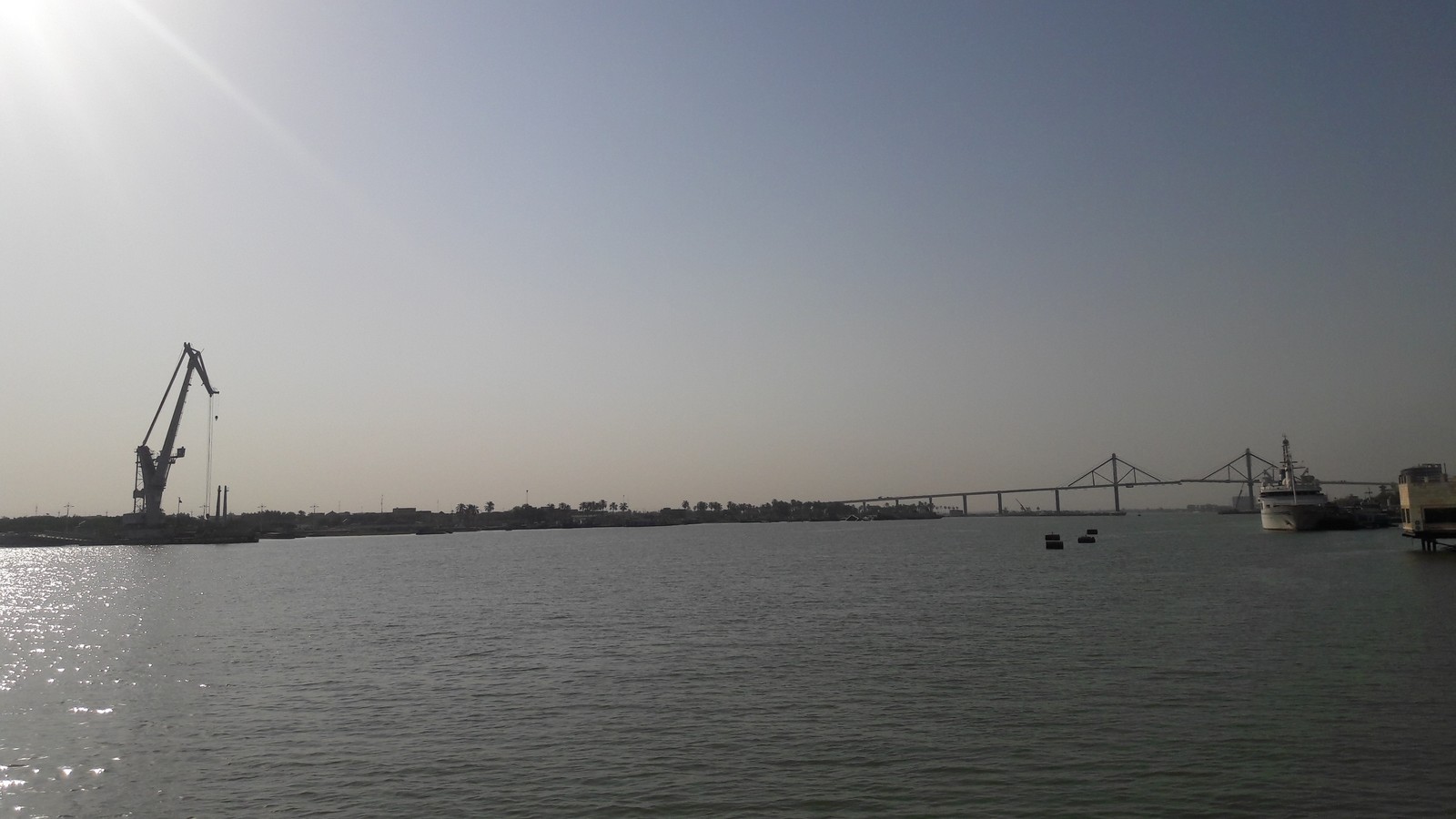
Caption: The Shatt al-Arab at Basra. Seawater now intrudes deep into this estuary, and its salinity — not the planting rate — is what the mangrove seedlings downstream must survive. Photo: Naseem95yak, Wikimedia Commons, CC BY-SA 4.0 (2016).
The gap between ambition and what's needed
An 11-million-tree local-authority target is, on its own terms, a large expansion from the 1-million-tree goal set in 2022. Enlil's stress-test of the program's own framing found a more skeptical benchmark sitting directly alongside it: Alaa al-Badran, an environmental expert quoted in reporting on the same May 2026 UN visit, said the 11 million figure "reflects growing attention to climate issues" but that meeting the region's actual restoration need would require roughly 50 million seedlings and sustained, long-term maintenance — not a one-time planting push. On that reading, even Iraq's most ambitious current target covers roughly a fifth of what an independent expert says the coastline needs.
Survival data sharpens the same caution. Published research on Khor Al-Zubair plantings has recorded outcomes ranging from about 40–45% survival over two years in one study to as high as 78% in another, depending on site conditions and cultivation method. Enlil reads that spread as a sign that "seedlings planted" and "mangrove forest established" are not the same number, and treats any single planting total — 300,000, 800,000, 11 million — as a measure of effort rather than of confirmed, surviving canopy until a program reports survival rates alongside planting counts.
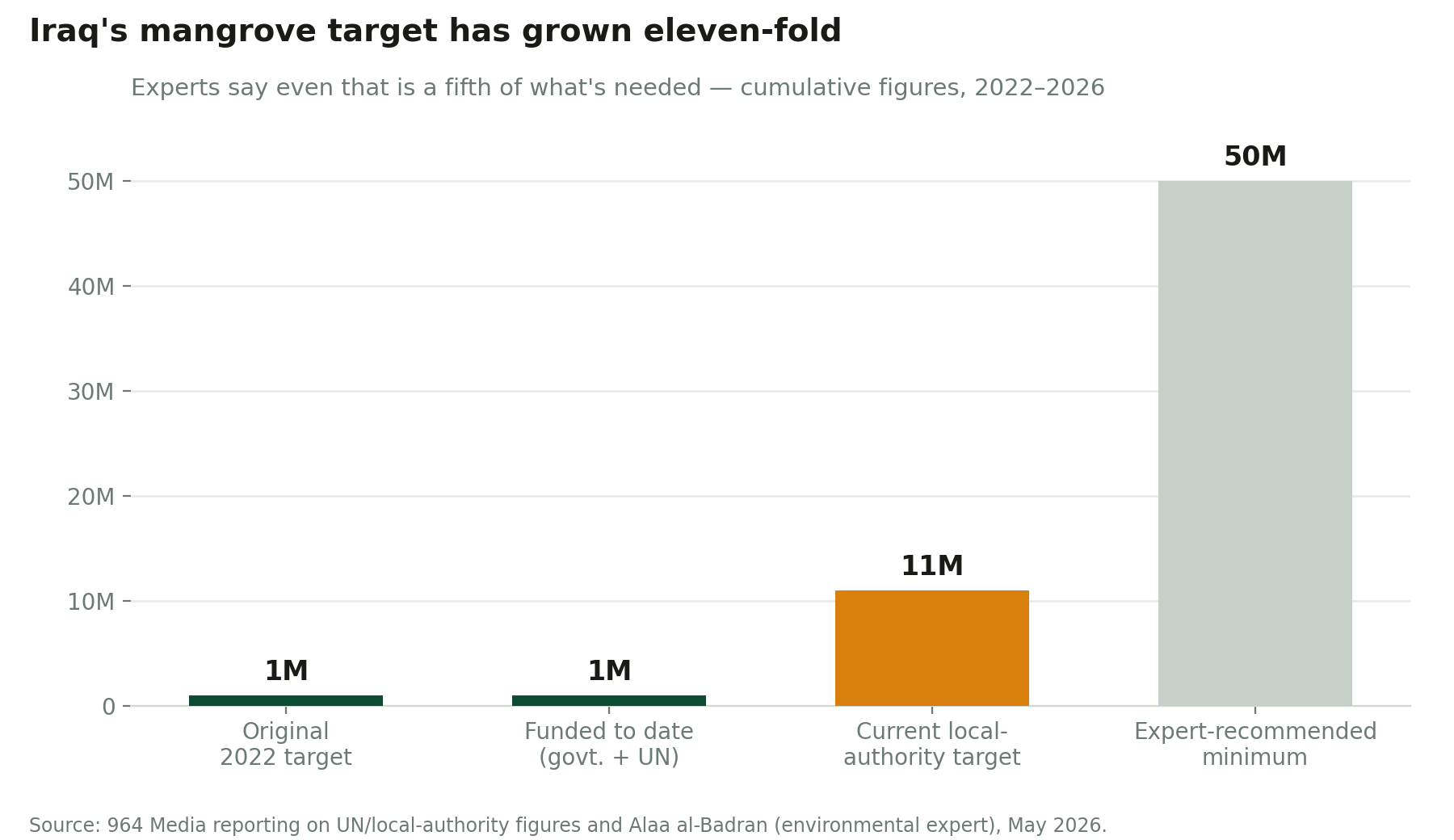
Caption: Iraq's local-authority mangrove target has grown eleven-fold since 2022; an independent expert puts the actual need at roughly five times the current target. Source: 964 Media reporting on UN and local-authority figures, and Alaa al-Badran (environmental expert), May 2026.
What would make this durable
The path forward carries the same obstacles the project has faced since the mid-2010s. Chronic exposure to industrial pollutants continues to threaten young plantings, and coordination between the Environment, Agriculture, and Oil ministries has at times delayed enforcement of discharge rules — the same institutional gap Enlil has documented in Iraq's wider water-pollution response this year. Continued sea-level rise and unpredictable river-flow reductions may outpace the rate at which restored mangroves can establish. Comprehensive long-term monitoring of survival rates, carbon sequestration, biodiversity recovery, and water-quality improvement remains limited, which is precisely what makes independently verifying the program's headline numbers difficult from the outside.
Enlil assesses that three steps would do more than a larger planting target on its own: designating protected coastal buffer zones around active and planned restoration sites with real limits on industrial discharge; formally counting mangrove restoration toward Iraq's Nationally Determined Contribution under the Paris Agreement and its Ramsar Convention obligations for the Ahwar wetlands, which would attach external reporting requirements to the domestic target; and publishing survival rates alongside planting totals, so that "trees planted" and "trees surviving" stop being reported as if they were the same figure. Blue-carbon credit financing and international climate funds could help close the gap between the 11-million and 50-million-tree estimates — but only once monitoring exists to verify what a credit would actually be paying for.
Basra's mangrove program remains a genuine example of deliberate, nature-based adaptation in one of the world's most climate-stressed and industrially polluted coastlines. Whether it becomes a durable buffer for the Ahwar marshes or a partial, hard-to-verify planting effort depends less on how large the next target gets than on whether Iraq starts reporting how many of the trees it plants are still alive.