
Summary
- Iraq is one of 54 United Nations member states with no right-to-information law. Article 38 of the 2005 Constitution guarantees freedom of expression and publication, but no statute turns that into an enforceable right to obtain documents or data from the state.
- The only enacted access law in the country is the Kurdistan Region's Law No. 11 of 2013, a relatively strong text on paper that has never been given implementing regulations.
- Since the 2014–15 fiscal crisis, every federal budget law has carried an article that lets every ministry and governorate impose new service fees and keep most of the proceeds. The current version is Article 21/First of Budget Law No. 13 of 2023, which returns 80 per cent of fee income to the collecting body.
- Under that umbrella, data has become a product. The Meteorological Authority's published schedule charges 50,000 dinars per work-hour of data extraction, and the government's e-services portal lists a flat 25,000-dinar fee for a university student. The 1985 law behind the schedule exempts students and researchers from the price of printed publications, but not from the price of data.
- The federal Right to Access Information bill, approved by Cabinet in October 2023 and still awaiting a final vote, limits the right to Iraqi citizens, lists exemptions with no public-interest test, and makes disseminating exempt information a crime punishable by up to a year in prison.
- Enlil Center proposes five changes: fix Articles 4, 11 and 16 of the draft law; extend the statutory fee waiver from publications to data for students, researchers and non-profits; publish every agency's fee schedule and an open-data licence; issue a federal statistical dissemination policy under the 2023 Statistics Authority law; and stop ministries charging each other.
A fee for the weather
The clearest place to see how Iraq treats public data is a government web page. The Ur e-services portal, run by the Prime Minister's Office, describes how to obtain climate records from the General Authority for Meteorology and Seismic Monitoring. The applicant submits an official letter or request, fills in an information-request form, and waits for the Director General to refer the file to the Climate and Scientific Research Centre. Then, in the portal's own words, the applicant "meets the Climate Centre to discuss the request and determine the financial fees due". Students pay at the finance window and collect a receipt. The page states the rate: 25,000 Iraqi dinars for a university student.
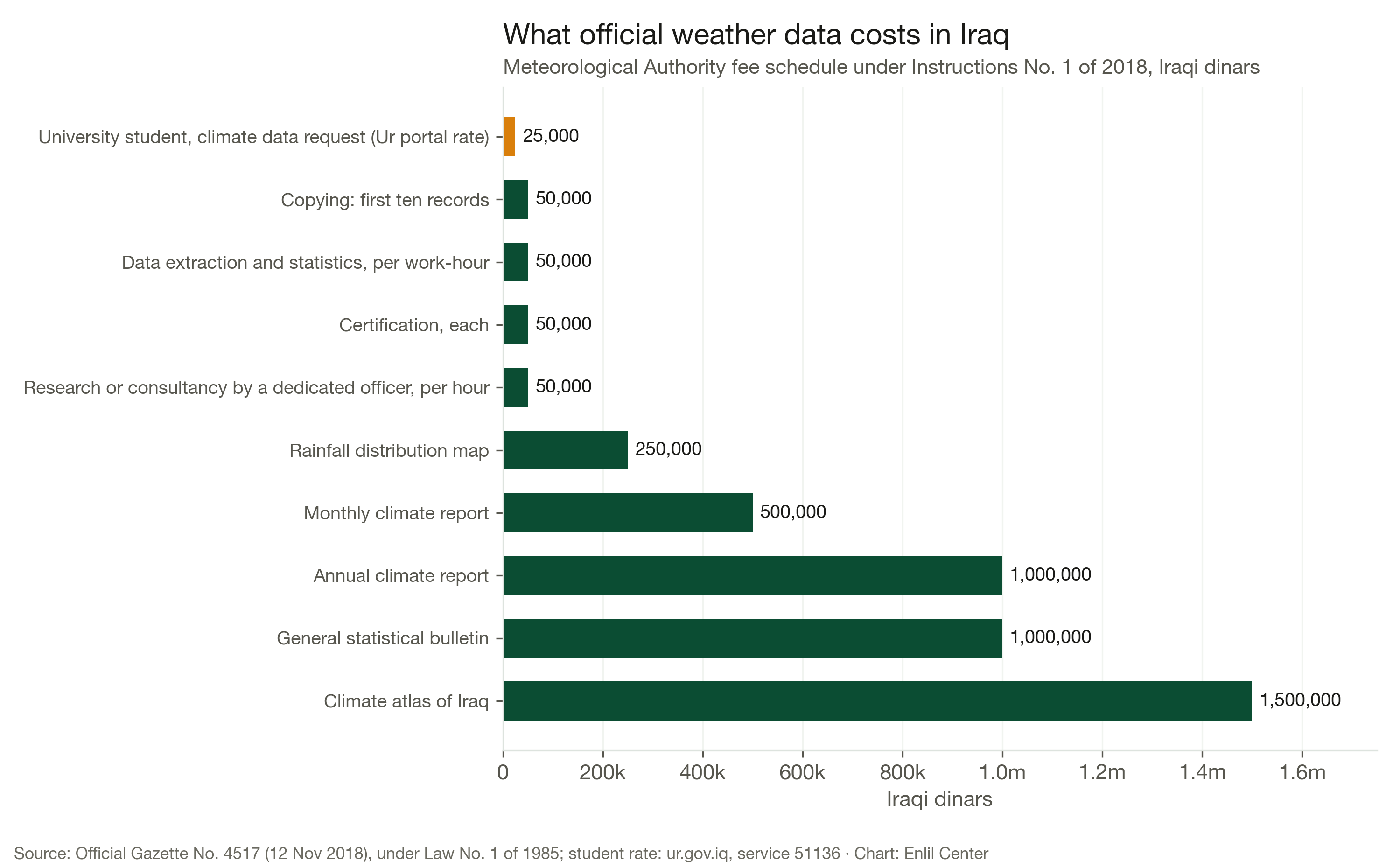
Caption: Figure 1. The published fee schedule of the General Authority for Meteorology and Seismic Monitoring (Instructions No. 1 of 2018) and the student rate stated on the Ur e-services portal. Source: Official Gazette No. 4517; ur.gov.iq.
The price list behind that rate is public too. Instructions No. 1 of 2018, published in the Official Gazette on 12 November 2018, set the Authority's charges under a law from 1985: 50,000 dinars for every hour, or part of an hour, spent on "data extraction and statistics"; 50,000 dinars for the first ten records copied and 250 dinars for each record after that; 50,000 dinars per certification; 1,500,000 dinars for the climate atlas; 1,000,000 dinars for the annual climate report. The 1985 law itself does contain an exemption for "students at all educational levels" and "researchers in scientific institutions", but it applies only to the price of printed publications. It says nothing about data.
Nor does it exempt the Iraqi state from paying itself. The law's exemption list covers international organisations, the Arab League and foreign meteorological services. An Iraqi ministry that needs the Authority's rainfall series writes an official letter, like any other customer, and collects its data "by an official letter issued by the Authority, stamped and certified".
How a budget crisis became a data policy
None of this began as a policy on information. It began as a policy on money. When oil prices collapsed in 2014 and the war against the Islamic State consumed what remained of the budget, the government looked for non-oil revenue wherever it could be found. The Federal Budget Law for 2016 gave it a general tool. Article 26 granted "all ministries, non-ministerial bodies and governorates the authority to impose new fees or service charges and to amend current fees and service charges", by instructions of the minister concerned, "for the purpose of covering the expenses and arrears" of the same body, as an exception to the Financial Management Law.
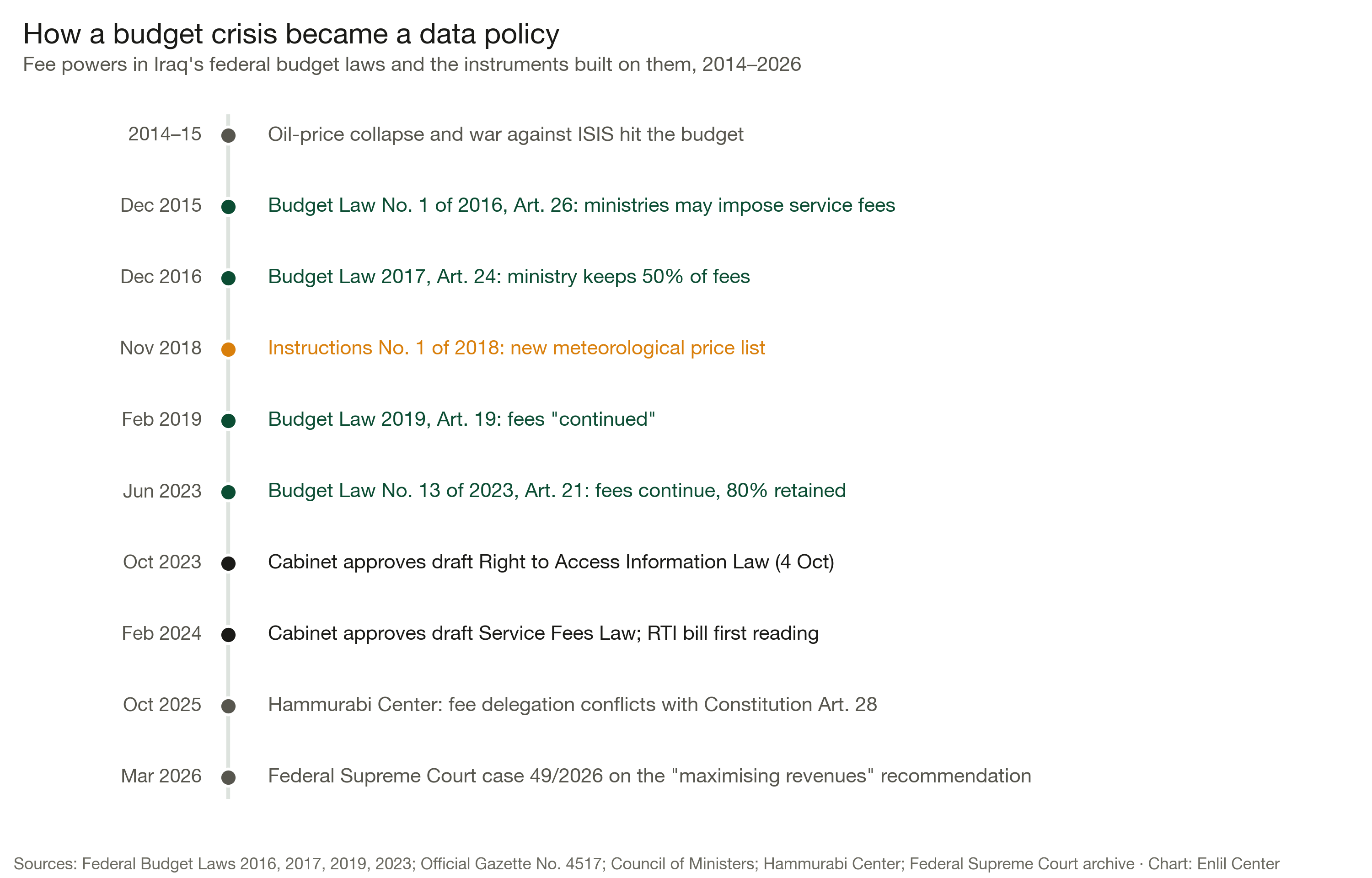
Caption: Figure 2. Fee powers in Iraq's federal budget laws and the instruments built on them, 2014–2026. Sources: Official Gazette; Council of Ministers; Hammurabi Center; Federal Supreme Court archive.
The clause has been renewed in every budget since. The 2017 law repeated it as Article 24 and let the ministry keep half the proceeds. The 2019 law, Article 19, "continued" the fees already imposed and authorised new ones. The three-year Budget Law No. 13 of 2023, in force through 2025, carries it as Article 21/First: ministries "shall continue to exercise their powers to impose fees or service charges that were imposed during the years 2016, 2017, 2018, 2019 and 2021, or to impose new fees or service charges", with 80 per cent of the income accruing to the collecting body and 20 per cent to the treasury. In government communiqués the drive has a name, ta'zim al-iradat ghayr al-naftiya, "maximising non-oil revenues", and it is invoked for everything from customs tariffs to service windows.
The design of the clause matters. Because four-fifths of every fee stays with the agency that collects it, each ministry has a direct interest in pricing what it holds. Data, which costs almost nothing to reproduce and which the state already possesses, is the easiest thing to price. The 2018 meteorological schedule, issued two years after the first budget clause, is one product of that incentive; it replaced a 1999 schedule and raised the cost of an hour of an analyst's time to 50,000 dinars.
Whether any of this is lawful is contested. Article 28 of the Constitution says that "no taxes or fees shall be imposed, amended, collected or exempted except by law", and a delegation to ministers to invent fees by instruction sits uneasily with that text. An analysis published by the Hammurabi Center for Research and Strategic Studies in October 2025, written by a University of Baghdad law professor, argues that the budget-law provision conflicts with Article 28 and cannot be stretched to cover years the text does not name. The government appears to recognise the vulnerability: in February 2024 the Council of Ministers approved a draft Law on Service Fees in Centrally Funded State Departments and sent it to Parliament, where it remains.
The missing right
The fee regime would matter less if Iraqis had a right to ask for information and a duty on the state to answer. They do not. The Centre for Law and Democracy's global classification, updated in February 2026, counts 139 UN member states with a right-to-information law and 54 without; Iraq is in the second group, alongside Egypt, Syria, the United Arab Emirates, Bahrain and Oman. The Global RTI Rating, which scores enacted laws, has never had an Iraqi law to score.
The one exception is regional. In 2013 the Kurdistan Parliament passed the Right to Access Information Law No. 11, which gives every natural or legal person the right to information held by public bodies and by private bodies that run public services. It sets a ten-day response deadline, lists six grounds for refusal, and subjects all of them to a public-interest override. When the Centre for Law and Democracy and the International Federation of Journalists assessed it in 2014, it scored 98 out of 150, which would have placed it 28th among the 95 national laws then rated. Its weakness is not the text but what followed: no implementing regulations, no dedicated commissioner, and oversight parked with the Region's Human Rights Commission, which has no published record of deciding a case under it.
At the federal level, a government-drafted Right to Access Information bill was approved by the Council of Ministers on 4 October 2023 and passed its first reading in Parliament on 14 February 2024. It has not been voted on since. ARTICLE 19's legal analysis of the draft, published in 2024, found three problems that would each disqualify it under international standards. Article 4 limits the right to Iraqi citizens, admitting foreign residents only if they show a "legitimate interest" and only on a basis of reciprocity; a think tank, a university or an NGO as a legal person has no clear standing. Article 11 lists exemptions by document type, including "internal correspondence" and the deliberations of the Council of Ministers, with no test of harm and no public-interest override. Article 16 makes it a crime, punishable by up to a year in prison, to disseminate information that falls under an exemption, with no defence for good faith or public interest. Iraqi journalists and civil-society groups petitioned for amendments in 2024; reporting on the second reading in 2025 indicates the key provisions were unchanged.
Read together with the fee clauses, the draft describes a system in which information is either for sale or off limits, and in which publishing what one has paid for can be a criminal act.
Where it works
The contrast inside Iraq's own institutions is instructive. The Kurdistan Region Statistics Office has had a written Official Statistics Dissemination Policy since June 2014. It treats official statistics as public goods under the United Nations Fundamental Principles, makes the Office's website the primary channel of release, and sets a pricing rule that inverts Baghdad's: public-use microdata are free to government bodies, non-profit academic and research institutions and university students, and chargeable only to the private sector or for commercial use. Any request that takes a technician less than three hours is free.
The federal Statistics and GIS Authority, the former Central Statistical Organization, publishes its bulletins and indicator tables without charge on its website, and its data-request page asks only for an e-mail. The problem is not that Iraqi statisticians want to sell their work. It is that no federal rule requires them not to, and the budget law rewards any agency that does.
What should change
Enlil Center proposes five measures, in order of how quickly they could be done.
First, amend the draft Right to Access Information Law before it reaches a final vote. Article 4 should extend the right to every person and legal entity; Article 11 should replace document-type exemptions with a harm test and a public-interest override; Article 16 should be deleted or confined to officials who leak genuinely classified material, with an explicit defence for publication in the public interest.
Second, extend the exemption already in the 1985 meteorological law from publications to data, and write the same exemption into the draft Service Fees Law for students, researchers and registered non-profits across all ministries. The Kurdistan statistics policy shows the model, and the cost to the treasury is trivial: a ministry's data-sale income is a rounding error in a budget that measures revenue in tens of trillions of dinars.
Third, require every agency that charges for information to publish its fee schedule and legal basis on the Ur portal, as the Meteorological Authority already does, and to release all non-personal datasets under a standard open licence.
Fourth, use the new Statistics and Geographic Information Systems Authority Law No. 32 of 2023 to issue a federal dissemination policy that mirrors the Kurdistan Region's 2014 text, with a rule that official statistics are free by default.
Fifth, end the practice of one state body invoicing another for data. An instruction from the Cabinet Secretariat that inter-ministerial data requests are fee-exempt would cost nothing and would remove the most absurd feature of the current system, in which one ministry pays another for the rainfall record both are supposed to use to plan for the same drought.
Iraq is spending real money to understand its climate, its water and its economy. Charging its own students and institutions to read the results is not resource maximisation. It is a tax on knowing.