
Summary
- Iraq's national climate plans will not matter if governance keeps blocking their implementation. The World Bank's Iraq Country Climate and Development Report models a 3.5 percent real GDP loss from a 20 percent cut in water supply alone, rising to 3.9 percent once higher temperatures are added — and falling to 2.4 percent if Iraq raises water-use efficiency by 20 percent. The gap between those numbers is the size of the opportunity still on the table.
- Iraq is the world's fifth most vulnerable country to falling water and food availability and rising extreme heat, according to the UN Environment Programme's Global Environment Outlook 6 — a ranking UNICEF's own Iraq climate analysis repeats.
- Agriculture is smaller and more volatile in Iraq's economy than the "6 percent of GDP" figure commonly cited suggests: World Bank data puts it at 3.4 percent in 2025, and it has swung between roughly 2 and 4 percent most years since 2016 — the 6 percent-plus reading came from 2020, when oil GDP collapsed and mechanically inflated agriculture's share, not from agricultural growth.
- Extreme heat already affects 35 percent of Iraq's agricultural workers and a similar share of construction workers, per the same World Bank report — a workforce with little formal protection or paid time off during the hottest hours.
- Iraq's oil-production plans depend on water Iraq does not yet reliably have: the Common Seawater Supply Project is meant to pump up to 5 million barrels of treated Gulf seawater a day into southern oilfields by 2028, scaling toward a 12 million-barrel design capacity — not the 8 million barrels sometimes cited, and still years from being fully built.
- Iraq's Ministry of Environment says the country's dust-storm frequency has already climbed from about 243 days a year two decades ago to roughly 272 today, and could reach around 300 days a year by 2050 without mitigation — a trajectory, not a current baseline.
- As of IOM's most recent tracking (September 2025), more than 186,000 Iraqis are displaced by climate and environmental factors — up from the roughly 140,000 recorded in March 2024, the figure originally cited in this piece.
The scale of the threat
Iraq is among the countries most exposed to climate shocks anywhere in the world. The UN Environment Programme's Global Environment Outlook 6 ranks it the fifth most vulnerable country globally to declining water and food availability and rising extreme temperatures — a finding UNICEF's Iraq country office cites directly in its own climate risk analysis. Rising temperatures, falling rainfall, and reduced flow in the Tigris and Euphrates are compounding decades of resource mismanagement.
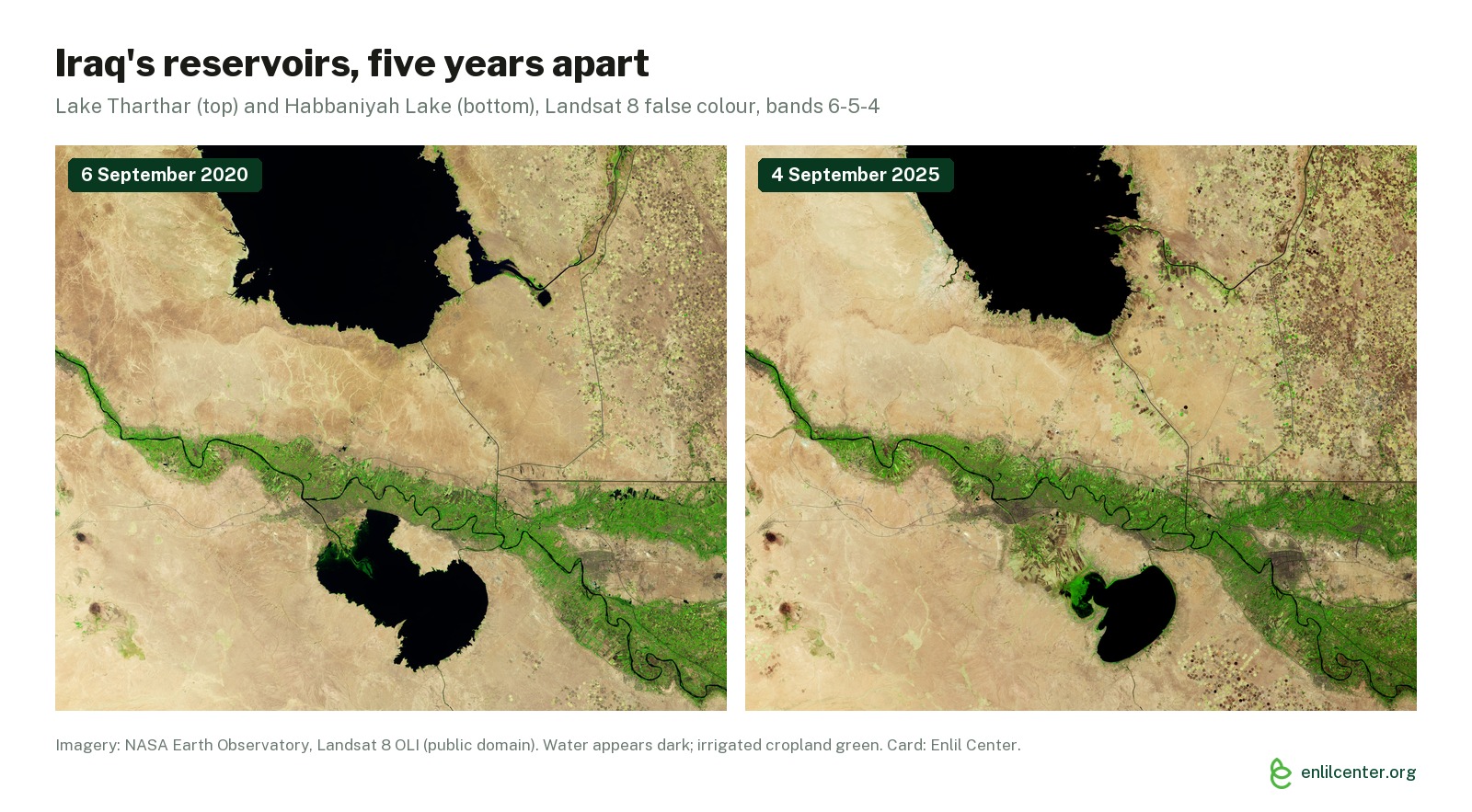
Caption: Lake Tharthar (top) and Habbaniyah Lake (bottom), 6 September 2020 and 4 September 2025. In five years both reservoirs shrank visibly and cropland spread onto the exposed lakebed. Imagery: NASA Earth Observatory, Landsat 8.
The World Bank's Country Climate and Development Report models what a 20 percent reduction in water availability would do to the economy under three scenarios: the water cut on its own, the same cut combined with higher temperatures affecting crop yields, and a version where Iraq has also improved water-use efficiency by 20 percent. The gap between the worst and best of those three numbers — 3.9 percent versus 2.4 percent of GDP — is not a forecasting margin of error. It is the size of the loss Iraq can still choose to avoid.
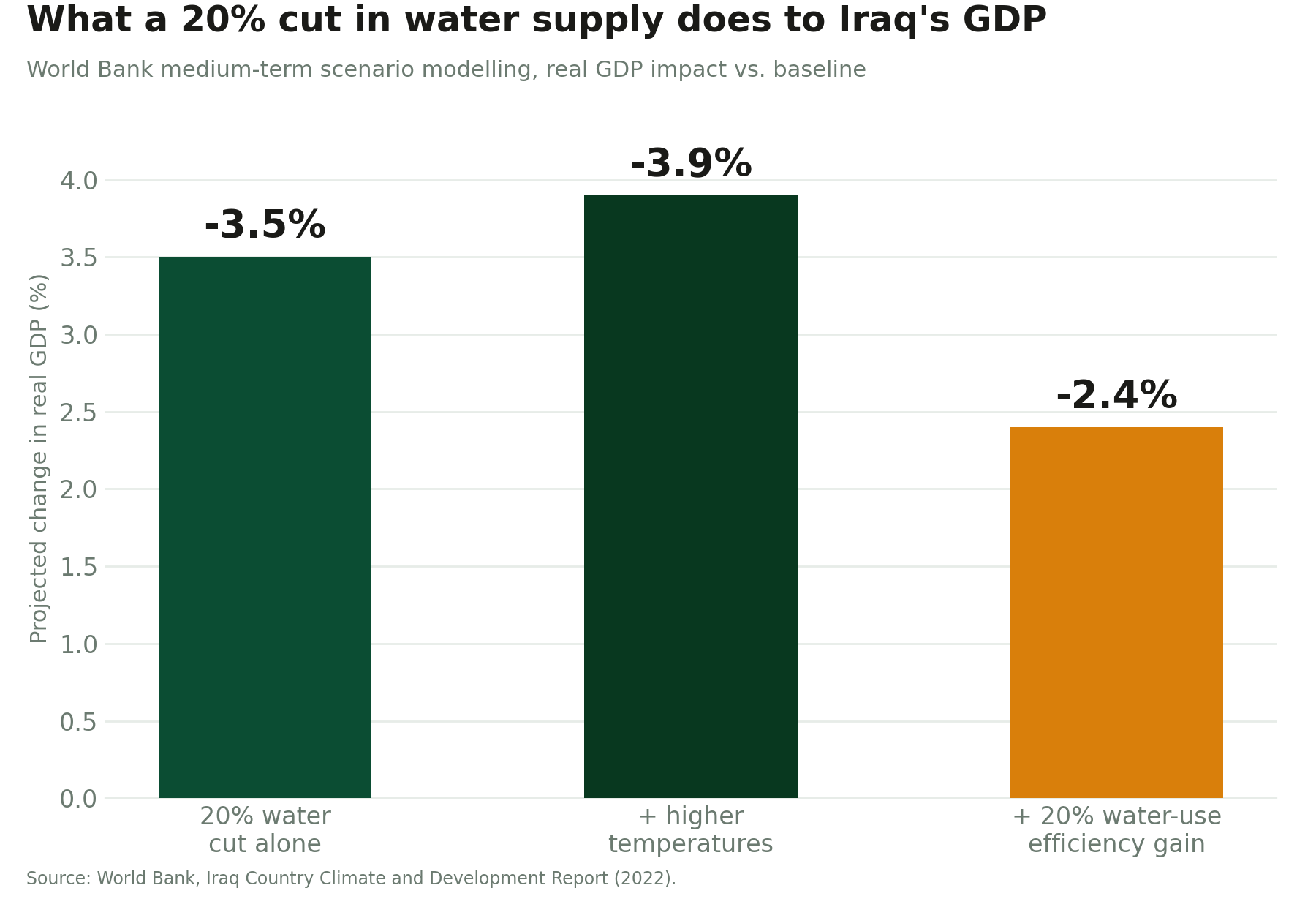
Caption: Bar chart: a 20 percent water cut alone costs Iraq 3.5 percent of GDP, rising to 3.9 percent with higher temperatures, falling to 2.4 percent with a 20 percent efficiency gain.
These are not small numbers for an economy still overwhelmingly dependent on oil revenue. A multi-percentage-point swing in GDP erodes the fiscal space available for everything else — wages, subsidies, reconstruction, debt service — in a country where oil already funds most of the state budget.
Sector by sector
Agriculture and food security. Agriculture is frequently described as roughly 6 percent of Iraq's GDP, but that figure is dated. World Bank data puts agriculture, forestry and fishing value added at 3.4 percent of GDP in 2025, and the sector has been volatile rather than steadily large: it swung between about 2 and 4 percent of GDP in most years since 2016, spiking above 6 percent only in 2020 — when the pandemic-era oil-price collapse shrank the denominator, not when agriculture itself grew. Enlil treats the sector's true weight as smaller and more volatile than commonly assumed, which matters for policy: a shrinking, less formal sector is harder to support through broad subsidies and more exposed to shocks that hit rural livelihoods directly.
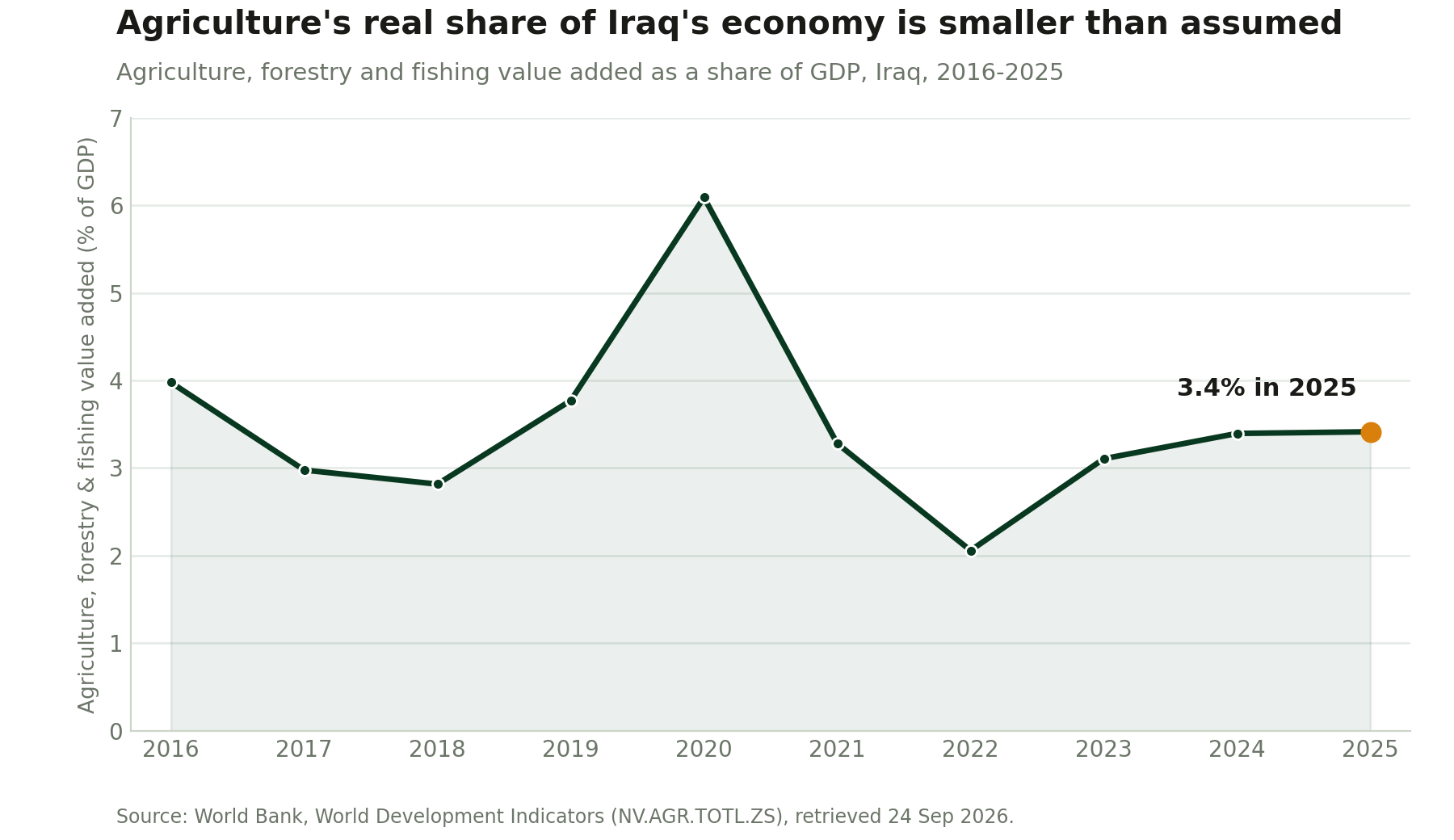
Caption: Agriculture's real share of Iraq's economy, 2016–2025. The 2020 spike reflects the collapse in oil GDP that year, not agricultural growth. Source: World Bank, World Development Indicators.
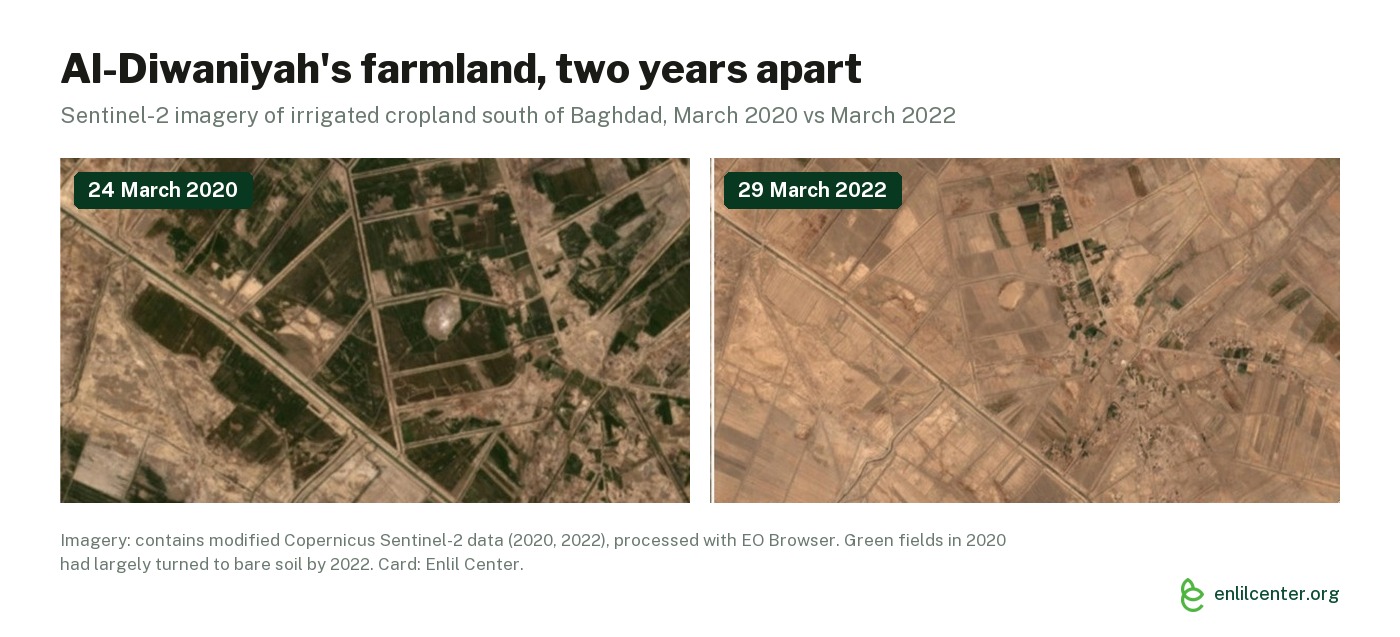
Caption: Irrigated farmland near Al-Diwaniyah, 24 March 2020 and 29 March 2022: green fields largely turned to bare soil in two years. Imagery: contains modified Copernicus Sentinel-2 data, processed with EO Browser.
Labour productivity. Extreme heat already affects 35 percent of Iraq's agricultural workers and a similar share of construction workers, per the World Bank's own modelling. Most of this workforce is informally employed, with little access to paid breaks, cooling, or compensation for hours lost to heat — meaning the productivity loss falls hardest on households with the least ability to absorb it.
Energy and oil. Iraq's plans to expand oil production depend on a water supply that does not yet exist at the scale required. The Common Seawater Supply Project — designed to treat and pump Gulf seawater into ageing southern oilfields to maintain reservoir pressure — is now expected to deliver up to 5 million barrels of water a day in its first phase, targeted for 2028, with a design capacity of up to 12 million barrels a day as later phases come online. That is a different number from the 8 million barrels a day previously cited here, and Enlil treats the project's own schedule, not an assumed 2030 figure, as the more reliable marker: first-phase delivery is not expected before 2028, and the full project has faced years of delay since it was first proposed in 2011. Separately, sand and dust storms are becoming more frequent: Iraq's Ministry of Environment reports the country has gone from roughly 243 dust days a year two decades ago to about 272 today, and warns the figure could reach around 300 a year by 2050 without mitigation — a projected ceiling, not the current reality, though the current trend already disrupts port operations and power generation on a regular basis.
Why inaction persists: the governance bottleneck
The data is not the obstacle. Meaningful adaptation is. The same structural weaknesses visible elsewhere in Iraq's environmental governance — fragmented authority, unclear mandates between ministries and governorates, chronic underfunding of local institutions, and patronage-driven public payrolls — are blocking climate action as well.
National strategies such as the Climate Investment Plan exist on paper, but implementation at the municipal level remains weak. Financing rarely reaches the governorates and districts where the impacts are felt most acutely. Without ring-fenced local budgets, clearer institutional responsibilities, and genuine decentralisation, well-designed national plans will keep failing to reach the ground.
Health and displacement
Rising heat, dust storms, and water-borne disease increase healthcare costs and drive displacement. IOM's Displacement Tracking Matrix recorded roughly 140,000 Iraqis displaced by climate and environmental factors as of March 2024, the figure originally used in this piece; IOM's September 2025 tracking puts the number at roughly 186,000 (31,001 families), spread across 497 locations in central and southern Iraq. Enlil treats the trend — a rising, not falling, displacement count — as the more important signal than either single snapshot.
From inaction to resilience
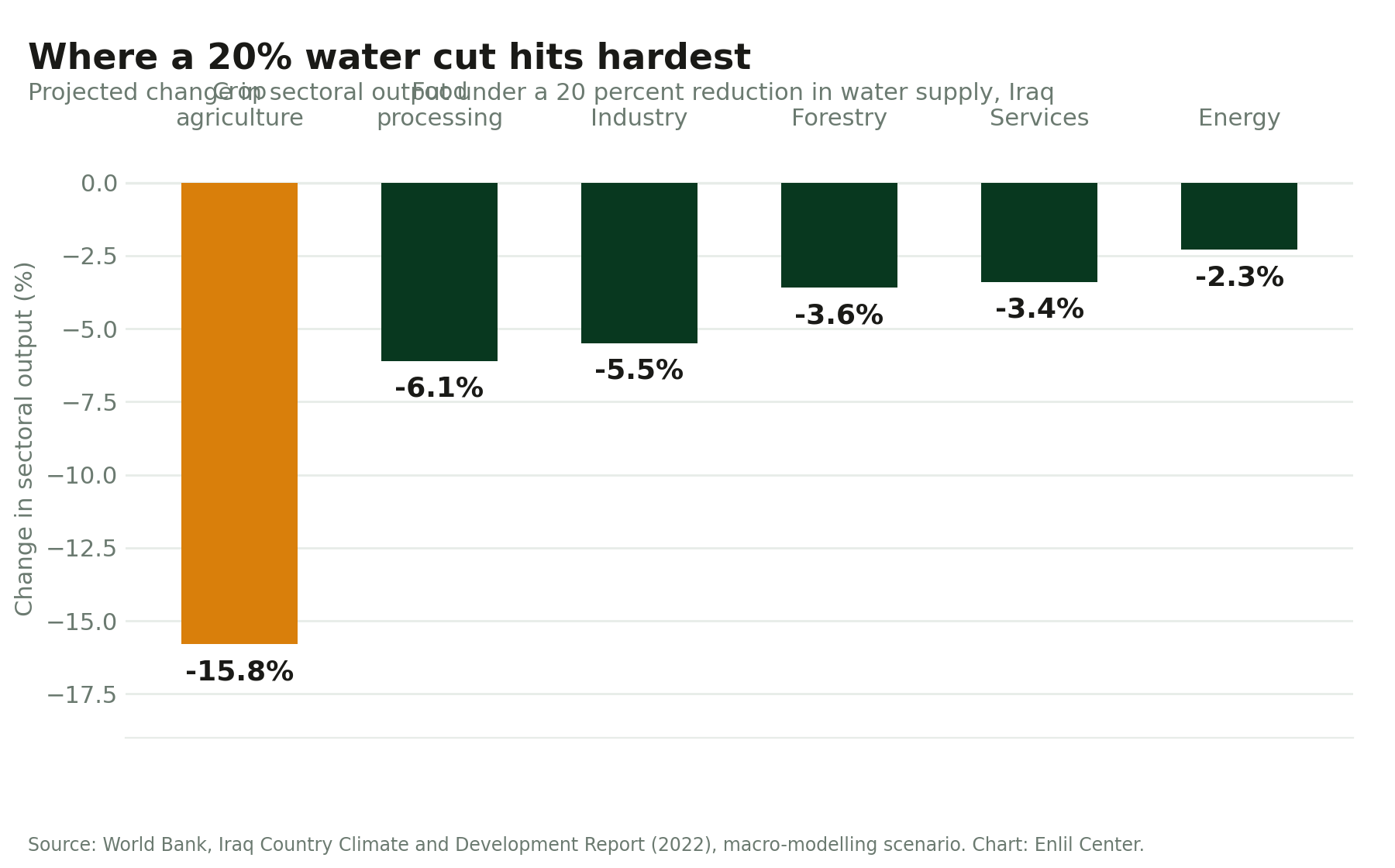
Caption: Projected change in sectoral output under a 20 percent cut in water supply — crop agriculture takes by far the largest hit. Source: World Bank, Iraq Country Climate and Development Report (2022).
Enlil sets out four priorities that follow directly from the evidence above:
- Strengthen local governance. Assign clear climate-adaptation mandates and ring-fenced budgets to governorates and municipalities, linked to performance-based financing rather than discretionary transfers.
- Improve water-use efficiency. Investment in modern irrigation, metering, and pricing reform is what separates the World Bank's 3.9 percent GDP-loss scenario from its 2.4 percent one — the single largest lever Iraq controls domestically.
- Mobilise climate finance on realistic timelines. Accelerate access to international funds such as the Green Climate Fund, and channel revenue directly to local adaptation projects rather than central ministries — while planning around actual project schedules, such as the Common Seawater Supply Project's 2028 first phase, rather than assumed dates.
- Integrate climate into economic planning. Make climate resilience a central pillar of the next National Development Plan, tied explicitly to public-sector reform and diversification away from oil.
The cost of inaction is not abstract, and it is not only measured in GDP. It shows up in a smaller and more volatile agricultural sector, in outdoor workers losing paid hours to heat, in a rising number of families displaced by drought, and in an oil-expansion plan that depends on water infrastructure still years from being built. Enlil expects the gap between Iraq's 3.9 percent and 2.4 percent scenarios to remain open for as long as adaptation is treated as an environmental side issue rather than a core governance reform.