
Summary
- In February 2025, Enlil projected that Tigris-Euphrates flows could fall 25-50 percent that year, threatening Iraqi agriculture through 2030. What actually happened matched or exceeded the low end of that range: 2025 became Iraq's driest year since 1933, with river levels down as much as 27 percent and national reservoir storage collapsing to under 5 billion cubic metres by late 2025, the lowest on record.
- A November 2025 World Weather Attribution study found human-caused warming made the underlying five-year regional drought roughly 30 times more likely, intensifying it to "exceptional" severity — a scale of event that, in a cooler pre-industrial climate, would occur about once every 250 years, and now recurs roughly every three.
- Agriculture absorbed the cost directly. For the 2025-26 season the Ministry of Agriculture halved the river-irrigated wheat area, banned rice cultivation outright, and mandated a shift from flood irrigation to drip and sprinkler systems. Iraq's wheat harvest fell from about 6.3 million tonnes to roughly 5 million — a drop of about a fifth in a single season, arriving nearly a decade earlier than the original 2035 yield-decline projection.
- 2026 brought a real but fragile rebound: reservoir storage recovered to roughly 30 billion cubic metres by spring and about 34 billion by mid-year, and rice cultivation resumed on more than 360,000 dunams. Enlil treats this recovery with caution — it rests on rainfall and upstream dam operations in Turkey and Iran, which control most of the two rivers' flow into Iraq, not on any Iraqi water-security reform.
- Iraq's longer-run indicators did not reverse in 2026: renewable freshwater available per person has fallen every year since the 1960s and sat at about 799 cubic metres in the latest data, well inside international water-scarcity territory, while Iraq's total freshwater withdrawals now exceed its entire internal renewable supply — made possible only by river flow it does not control.
- In November 2025, Iraq and Turkey signed a financial mechanism using Iraqi oil-export revenue to fund Turkish-built water infrastructure in Iraq — a real version of the water-diplomacy leverage Enlil's original brief called for, though one that has drawn domestic criticism for tying access to water to oil revenue.
What Enlil projected, and what happened
In February 2025, this brief projected that the Tigris could lose about a quarter of its flow and the Euphrates as much as half, driven by upstream damming, reduced rainfall and rising temperatures. That projection has since been overtaken by events rather than disproven by them. A November 2025 attribution study by World Weather Attribution, an international scientific collaboration, found that the drought behind those losses was real, severe and made roughly 30 times more likely by 1.3°C of human-caused warming — intense enough to be classified as "exceptional" drought on the standard SPEI scale, a severity that would have been expected roughly once every 250 years in a cooler pre-industrial climate and now recurs approximately every three years. Independent reporting put the actual drop in Tigris-Euphrates water levels during 2025 at up to 27 percent, and multiple outlets, citing Iraq's Ministry of Water Resources, described 2025 as the country's driest year since 1933.
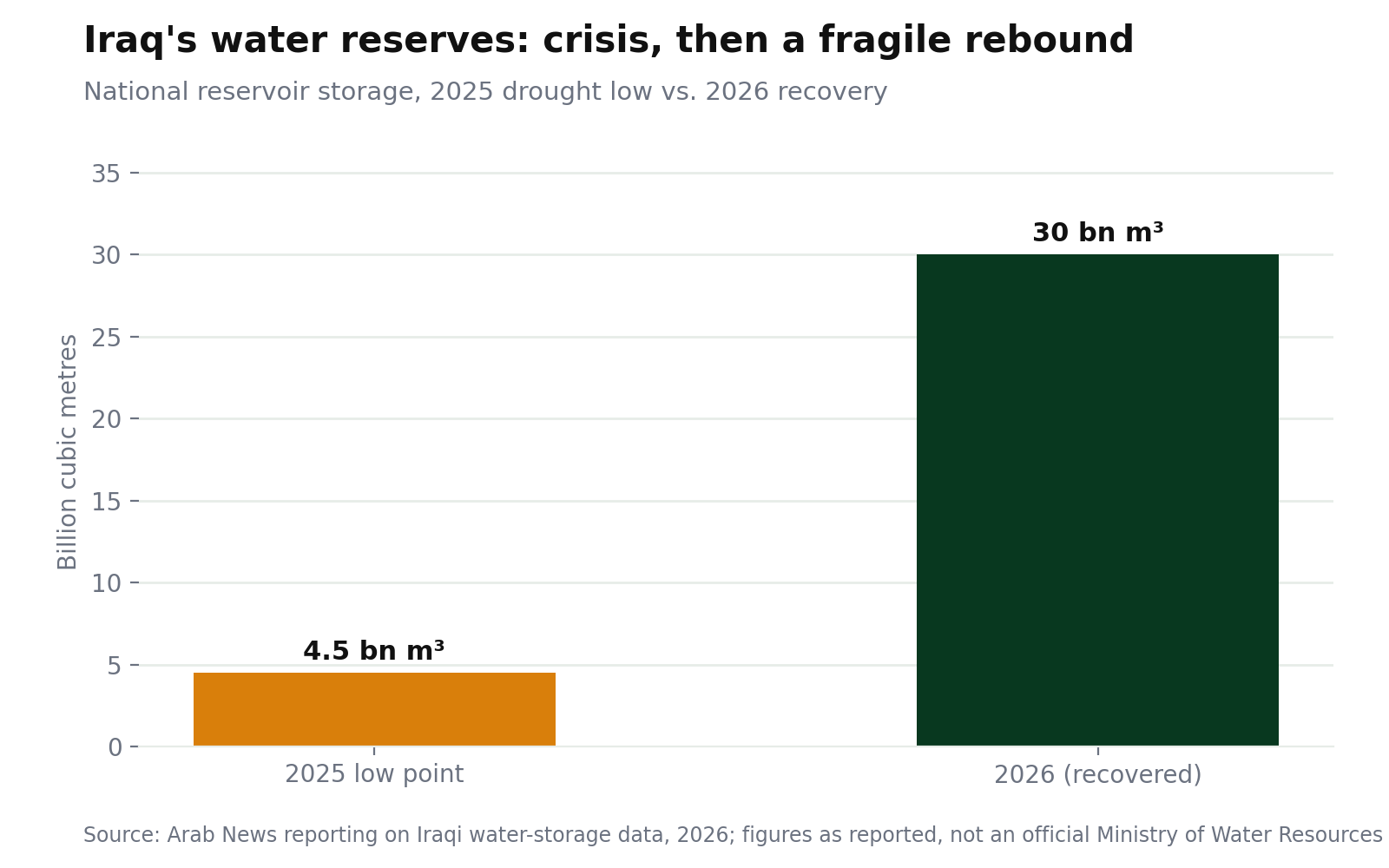
Caption: Iraq's national reservoir storage collapsed to roughly 4.5 billion cubic metres at the 2025 low point, then recovered to about 30 billion cubic metres in 2026 as rainfall and upstream releases improved. Source: Arab News and Iraqi News reporting on Iraqi Ministry of Water Resources storage data, 2025–2026.
Enlil assesses that the direction of the original projection was correct — this is a basin under acute, climate-driven stress — but its framing as a smooth multi-year decline toward 2030 understated how sharply conditions can swing in a single season, in both directions.
The reservoirs nearly ran dry
By the low point of the 2025 drought, Iraq's combined reservoir storage had fallen to roughly 4.5 billion cubic metres — under 5 billion by every published account, and the lowest since records began in 1933 — a level water-policy specialists described as critical. Some Iraqi and regional reporting put the country's share of the two rivers at less than 35 percent of what bilateral allocations would theoretically provide — a figure Enlil treats as a reported claim rather than a settled statistic, since it depends on which allocation framework is used as the baseline, but one broadly consistent with the reservoir data. The recovery that followed was real: by spring 2026, storage had rebounded to an estimated 30 billion cubic metres, and to about 34 billion by mid-year according to Iraqi News, driven by improved rainfall and, importantly, by upstream dam releases that Iraq does not control. Water-policy expert Harry Istepanian, quoted in Arab News, summarized the risk in the recovery itself: "The recovery is real, but it is not yet sustainable... the gains could be reversed within one dry season."
What it did to the harvest
Agriculture carried the immediate cost. For the 2025-26 season, Iraq's Ministry of Agriculture capped river-irrigated wheat cultivation at about 1 million dunams, roughly half the area planted the previous season, and required farmers to adopt drip or sprinkler irrigation in place of open-canal flood irrigation. Rice, one of the most water-intensive staple crops, was banned outright for the season, with only a token 200 dunams permitted under exception. In Diyala governorate, wheat production fell by more than half. Nationally, the International Grains Council estimated Iraq's wheat harvest at about 5 million tonnes for 2026, down from roughly 6.3 million tonnes the year before — a fall of about a fifth in a single season. Iraq's original 2025 brief had projected a 20 percent yield decline by 2035; in practice, a comparable-sized shock arrived in a single bad year, nearly a decade sooner than modeled, which Enlil reads as evidence that the basin's agricultural system is more volatile, not more resilient, than the original linear projection assumed.
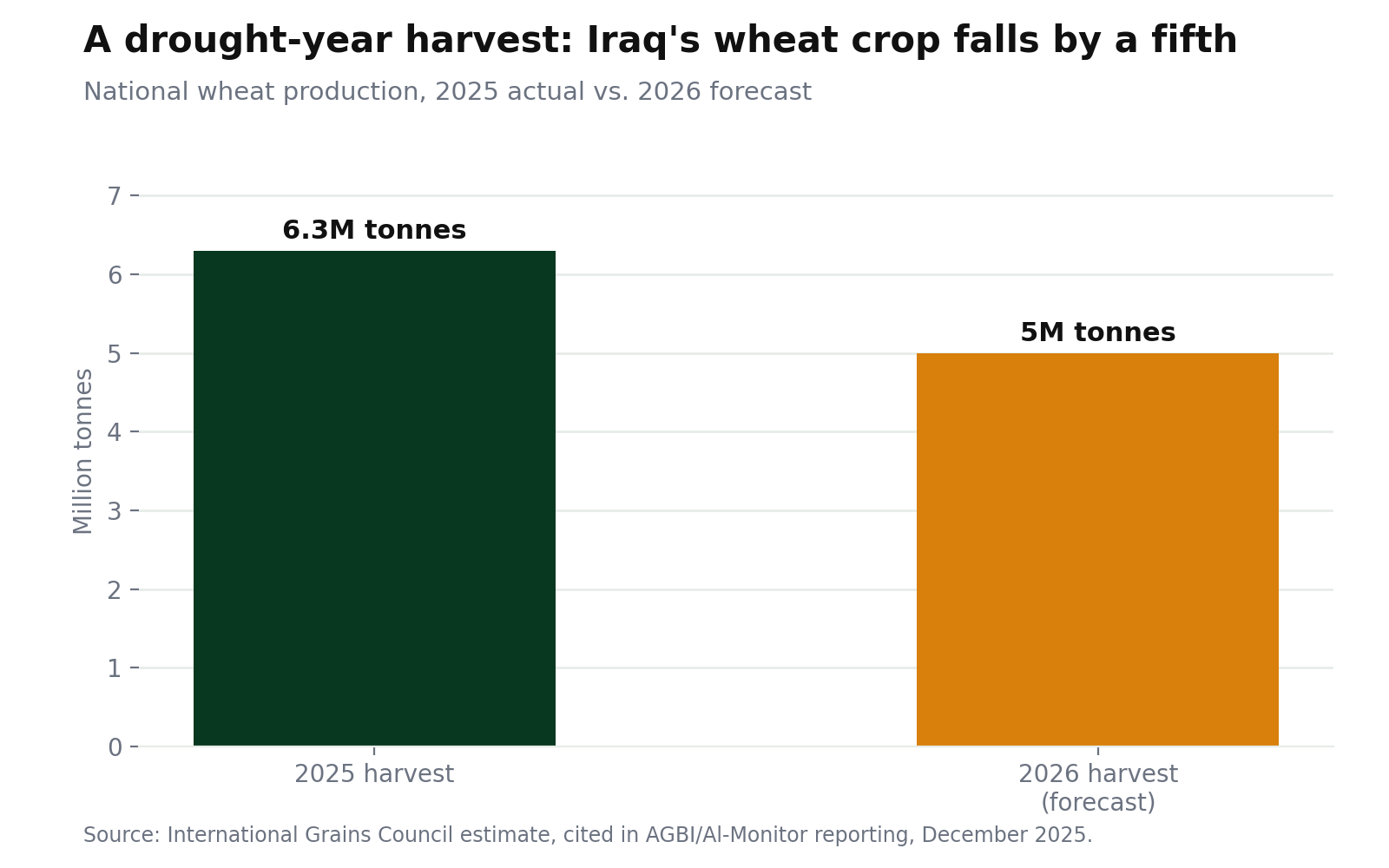
Caption: Iraq's wheat harvest fell by roughly a fifth between the 2025 and 2026 seasons, a decline of the magnitude Enlil's 2025 brief had projected for 2035. Source: International Grains Council estimate, cited in AGBI and Al-Monitor reporting, December 2025.
As reservoirs recovered through 2026, the restrictions eased in step: the government approved rice cultivation on more than 360,000 dunams that summer, up from the 200-dunam exception the previous year — a direct illustration of how tightly Iraq's agricultural planning is now rationed against reservoir levels, season to season, rather than set by longer-term planning.
A recovery Iraq did not create
The 2026 rebound is worth treating carefully rather than as evidence the crisis has passed. Turkey and Iran control most of the flow that reaches Iraq's rivers, and 2026's improvement reflects rainfall and upstream operating decisions as much as anything Iraq itself changed. This is the same dynamic examined at greater length in Enlil's companion analysis on Iraq's broader water dependence, "Iraq Is Living on Borrowed Water": Iraq's freshwater withdrawals now exceed the water it generates within its own borders, so its position in any given year is set largely by decisions made upstream. Against that backdrop, the November 2025 agreement between Iraq and Turkey — a financial mechanism that channels Iraqi oil-export revenue into Turkish-built water infrastructure projects inside Iraq, starting with three water-harvesting and three land-reclamation projects — is a genuine, concrete step toward the kind of binding water diplomacy Enlil's original brief called for. It has also drawn real domestic criticism: some Iraqi politicians and water specialists have argued that tying water access to oil revenue departs from established principles of water diplomacy, in which water is treated as a shared right rather than a commodity.
The long-run numbers that did not reverse
Two indicators in Enlil's Data Hub did not improve in 2026, and they describe the structural vulnerability underneath any single year's weather. Renewable freshwater available per person in Iraq has declined almost every year since the 1960s, crossed the internationally recognized water-scarcity threshold of 1,000 cubic metres per person around 2013, and stood at about 799 cubic metres in the most recent World Bank data. Separately, Iraq's total freshwater withdrawals reached about 120 percent of its internal renewable water resources in 2022 — meaning the country draws more water each year than it generates within its own borders, a gap that only transboundary river flow can fill. Agriculture remains the dominant claim on that water: roughly three-quarters of total withdrawals in the most recent data, down from a volatile 91 percent in 2019 but still the largest single use by a wide margin.
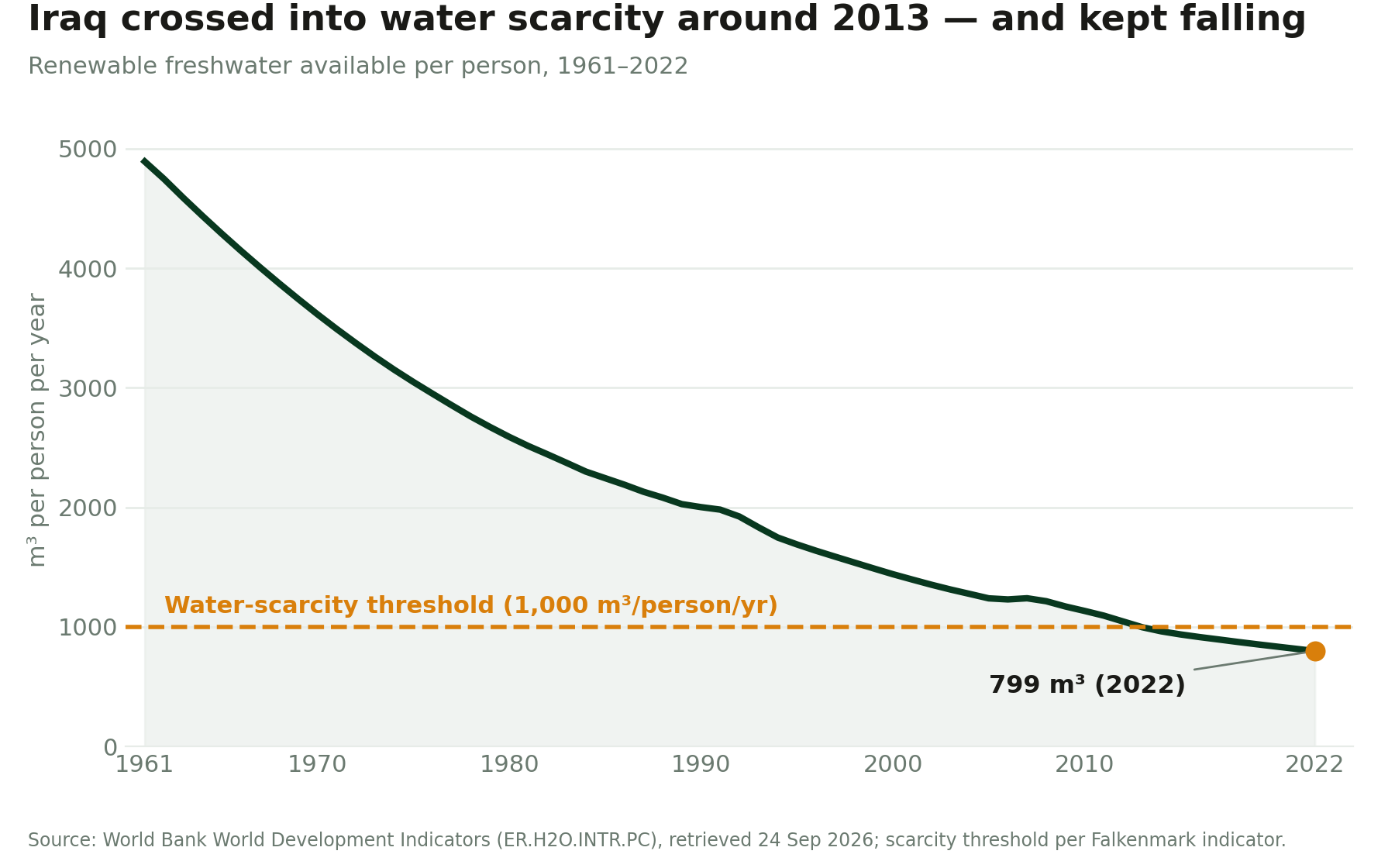
Caption: Iraq crossed the international water-scarcity threshold of 1,000 cubic metres per person around 2013 and has continued falling since — a decline that predates, and will outlast, any single year's drought or recovery. Source: World Bank World Development Indicators, retrieved 2026.
What would change the trajectory
Enlil's original recommendations largely hold, with two now partly underway rather than hypothetical. Irrigation modernization — replacing open-canal flood irrigation with drip and sprinkler systems — moved from a policy suggestion to a formal 2025-26 government mandate, though enforcement and farmer uptake at scale remain unverified. Water diplomacy with Turkey moved from an aspiration to an actual, if contested, financial agreement. What remains largely unaddressed is domestic network efficiency — the losses between treated or diverted water and the water that actually reaches a farmer's field — and a statutory minimum flow guarantee for the basin's most vulnerable users, including the southern marshes, which continue to face record salinity even as national reservoir figures recover. Enlil expects the next two to three seasons, not the original 2030 horizon, to be the period that determines whether 2025 was a singular shock Iraq adapted around, or the first of a recurring pattern the country's institutions have not yet built the durability to absorb.