 |
Issue 1 · 20 October 2026 | Every week, the decisions and data behind Iraq's energy, water and climate policy, read from ministries, the cabinet and official statements. Every item links to its source. | This week in 60 seconds | • | The IMF chief pledged “money and policy support” for an Iraq programme. | | • | The 2027 budget missed its 15 October deadline, still built on $58 oil. | | • | Oil exports are running above 3.4 million barrels a day in October, the minister says. | | • | The US sanctioned a private Iraqi bank, with a wind-down deadline of 30 October. | | • | The Prime Minister asked Turkey for a comprehensive water agreement. |
|
| Money and the budget | IMF chief: Iraq will get “money and policy support”Closing the IMF and World Bank Annual Meetings in Bangkok on 17 October, Managing Director Kristalina Georgieva said the Fund will back Iraq “very firmly”: “We will get to Iraq both money and policy support.” She gave no amount, programme type or timeline, and no IMF press release has followed. Finance Minister Falih al-Sari attended the meetings. Why it matters. It would be Iraq's first IMF financing since the 2016 Stand-By Arrangement, coming ten days after the devaluation and with no 2026 budget law in force. Sources: Al Jazeera · Shafaq News · Al-Mada (Arabic) | The 2027 budget misses its 15 October deadlineFinance Committee members had said the draft would reach parliament by 15 October, the date set by the Financial Management Law. On 20 October MP Khalid Sido Aziz said it was still being prepared and reviewed by the Council of Ministers and the Finance Ministry. As described by committee members on 6 October, it assumes oil at $58 a barrel, 217 trillion dinars of spending and a 50 trillion deficit. Why it matters. Brent traded at $110 on 20 October, almost double the draft's oil price, so the deficit and salary arithmetic will change if the assumptions are revised. Sources: Al-Mada (Arabic) · Shafaq News, draft figures · Shafaq News, Brent | Oil revenue down 53% in seven monthsFinance Ministry accounts cited by Susan Abdullah Mohammed, head of the General Authority for Monitoring Federal Revenue Allocations, put January–July oil revenue at 30.4 trillion dinars, against 65 trillion a year earlier. Total federal revenue fell to 39.1 trillion from 72 trillion, while non-oil revenue rose to about 8.7 trillion from 7.1 trillion. Why it matters. These are the cash numbers behind the devaluation: spending of 65.4 trillion dinars left a 26.3 trillion deficit in seven months. Sources: Shafaq News | US sanctions a private Iraqi bankOn 15 October the US Treasury designated the International Development Bank for Investment and Finance, saying it was “initially established by Iranian companies to support the Iranian economy and supply Iran with U.S. dollars”. A general licence allows wind-down transactions until 30 October. The bank rejected the accusations and said protecting depositors is its priority; its deposits exceeded 2.6 trillion dinars at the end of March, according to Securities Commission data reported by Al-Modon. Why it matters. It tests depositor confidence in private banks in the month of the devaluation. We found no Central Bank statement on the bank by 20 October. Sources: US Treasury · OFAC General License FF · Shafaq News, bank's response · Al-Modon (Arabic) | Cushioning the devaluationCabinet exempted imported food and medicine from customs duties on 13 October, backdated to 7 October, and the Agriculture Ministry reopened imports of potatoes, tomatoes and onions the next day. The Central Bank set a traveller allowance of $2,000 every two months, up to six times a year, from 18 October, and on 20 October said it had met all pending import-transfer requests. Why it matters. The state is giving up customs revenue to hold down prices, while Baghdad exchange shops still quoted 1,682 dinars per dollar on 20 October, about 11% above the official cash rate of 1,520. Sources: Prime Minister's Office (Arabic) · Central Bank, travel allowance · Central Bank, import transfers · Shafaq News, market rate | Oil, gas and electricity | Exports above 3.4 million barrels a day, minister saysOil Minister Basim Mohammed Khudair said on 19 October that crude exports in October average more than 3.4 million barrels a day, against about 3 million in September, moving through Hormuz despite the disruption, Turkey's Ceyhan port and by truck across Syria. A day earlier the Prime Minister, visiting the ministry, ordered it to raise production capacity and revenue and assigned the Deputy Prime Minister for Energy Affairs to oversee production and exports. Why it matters. Attaqa estimates exports averaged about 1.6 million barrels a day in January–September, so a sustained 3.4 million would transform the revenue picture. The ministry's official September figures have not yet been published. Sources: Asharq Al-Awsat, citing INA (Arabic) · Attaqa (Arabic) · Prime Minister's Office (Arabic) | BP takes over operations at four Kirkuk fieldsOn 15 October North Oil and North Gas handed operations at Kirkuk, Bai Hassan, Khabbaz and Jambur to a Joint Operating Authority, with the Oil Minister calling BP a “strategic partner”. The project targets 450,000 barrels a day of oil and the use of 500 million standard cubic feet a day of gas. Why it matters. These are North Oil fields, where the ministry has promised zero flaring by end‑2027. No date was given for reaching either target. Sources: Ministry of Oil (Arabic) | Najaf solar: ACWA asked to study 2 GW with storageThe Electricity Minister asked Saudi Arabia's ACWA Power to speed up its commercial offer for an investment solar plant in Najaf and to study raising it from 1,000 to 2,000 MW with 30% battery storage, according to a ministry release of 13 October. The talks took place on the sidelines of an energy conference in Riyadh. Why it matters. It doubles the size on the table and adds storage, but the project is still at the offer stage, with no contract. Sources: Ministry of Electricity (Arabic) | New power units held up at HormuzThe Electricity Ministry said on 18 October that equipment for two 125 MW combined-cycle units, at South Baghdad Gas 1 and Khor al-Zubair, is stuck in the Strait of Hormuz; the units are due “before next summer”. On 19 October it returned Samarra thermal unit 1 to the grid at 552 MW, with plans to raise it to 630 MW. Why it matters. The shipping disruption is now delaying new generating capacity, not only oil exports, ahead of next summer's peak. Sources: Ministry of Electricity, Hormuz (Arabic) · Ministry of Electricity, Samarra (Arabic) | Water and farming | PM asks Turkey for a comprehensive water agreementReceiving Turkish Foreign Minister Hakan Fidan in Baghdad on 17 October, the Prime Minister called for activating the water agreements and memoranda already signed, and stressed “the importance of concluding a comprehensive agreement on water”. No new agreement was announced. Why it matters. Baghdad is now asking for a broader deal than the framework already signed; what it would cover has not been made public. Sources: Prime Minister's Office (Arabic) · 964 | Marshes improve, but not everywhereWater Resources Ministry spokesman Khalid Shamal told INA on 18 October that the marshes have improved after five years of drought, crediting spring rain, the removal of encroachments on feeder rivers and channel clearing. He said some areas still suffer from drought because of low inflows and climate change. Why it matters. The ministry acknowledges only a partial recovery as winter allocations begin, and it published no storage or release figures this week. Sources: INA (Arabic) · 964 | Climate and environment | Iraq starts preparing for COP31The Presidency held a seminar on Iraq's environmental challenges on 15 October as part of preparations for the UN climate conference in Antalya, with Environment Minister Sarwa Abdulwahid taking part. President Nizar Amedi received the minister the same day and called for stronger plans on pollution and climate change. Why it matters. COP31 opens in Antalya in November. Iraq's new climate plan relies on international finance for most of its ambition, and the conference is where it has to make that case. Sources: Ministry of Environment (Arabic) · Presidency (Arabic) | New on the Enlil Data Hub | 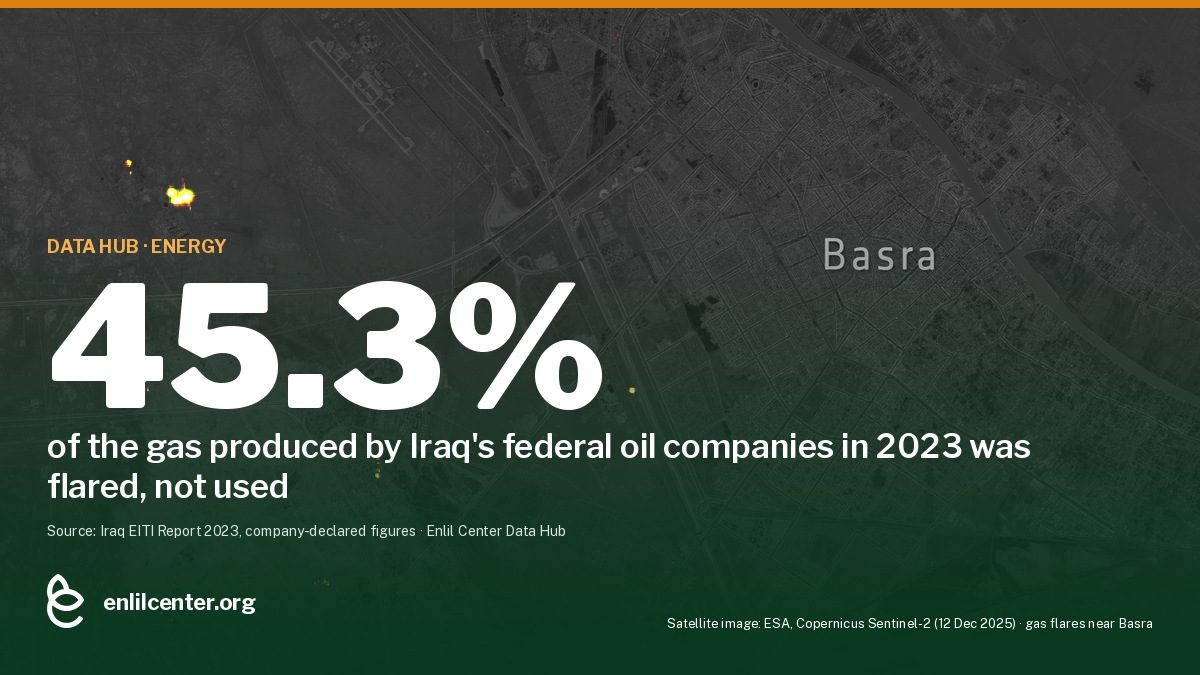 | Official, company-declared gas-flaring data from six years of Iraq EITI reports, plus the dinar's official rate and the Central Bank's rate tiers. Gas flared by oil company, 2023 → Share of gas flared, 2017–2023 → Official exchange rate since 2004 → Central Bank rate tiers → | What to watch | • 30 October: the US wind-down licence for the International Development Bank expires. • Whether the 2027 budget reaches parliament, and at what oil price. • The Oil Ministry's official September export and revenue figures. • Green Climate Fund Board, 26–29 October: none of the 21 proposals is for Iraq. | Iraq Policy Monitor is published weekly by Enlil Center for Environment and Sustainable Development, Baghdad. We summarise and link; we do not republish. Spot an error? Reply and we will correct it next week. enlilcenter.org · Header photo: Mohammed Sardar / Wikimedia Commons, CC BY-SA 4.0 ← Previous issue: Issue 0, 12 October 2026 |
|
|