
Iraq's Climate Negotiation Handbook
Iraq's 333-page negotiating handbook for COP28, prepared with UNDP and the Ministry of Environment. Enlil Center authored its Mitigation chapters, the Energy Security brief and the COP28 Position Paper.
Abstract
- Iraq's Climate Negotiation Handbook is a 333-page reference prepared for the Iraqi delegation ahead of COP28 in Dubai (November–December 2023), commissioned by UNDP with the Ministry of Environment. It walks negotiators through every major UNFCCC track — climate science, the Convention's architecture, mitigation, adaptation, loss and damage, finance, technology and capacity building — and then applies each to Iraq.
- Othman Kareem of Enlil Center, working as a consultant to UNDP, drafted three of its sections: the Mitigation chapters (NDCs, Article 6 cooperative approaches, carbon markets, ITMOs and the Article 6.4 mechanism), the Iraq's Energy Security policy brief, and Section D, Iraq's Position Paper for COP28, which sets out a background, expected action and a probable Iraqi position for every COP28 agenda item.
- The Energy Security brief documented the gap the delegation was negotiating from: peak demand of 36,560 MW in summer 2022 against a design capacity of 37,149 MW, of which the grid delivered no more than 22,250 MW in July 2022, with over 2,380 MW lost in transmission and distribution — and an IEA projection of 68 GW of demand against 58 GW of capacity by 2030.
- Section C's policy briefs give the delegation Iraq-specific evidence on the marshes, water security, food security, energy, biodiversity, the country's Green Climate Fund programme and its potential voluntary-carbon-market projects — the material a negotiator needs to turn a general negotiating line into a national ask.
- Enlil treats the Handbook as Iraq's first attempt at an institutional negotiating memory: a document that lets a new delegation start from what the last one knew, rather than from zero.
What the Handbook is
Iraq sends a delegation to the UN climate conference every year, and every year most of its members are negotiating the process for the first time. The Handbook was built to close that gap. Section A explains the process and the meetings — the science, the institutional structure of the UNFCCC, and each negotiating track in turn. Section B goes article by article through the Paris Agreement and Iraq's stocktaking under it. Section C collects the policy briefs a negotiator needs on Iraq's own files. Section D is the position paper for COP28 itself.
The format is deliberately practical. For each COP28 agenda item, Section D gives the background, the action the COP will be invited to take, and a probable Iraqi position — so that a delegate in a contact group has a starting line rather than a blank page. That structure, repeated across forty-odd agenda items, is what makes the document usable in a negotiating room rather than only in a briefing.
Enlil Center's contribution
Othman Kareem, Enlil Center's Director of Research & Policy, led the drafting of three components as a consultant to UNDP. The first is the mitigation material in Section A: what mitigation means under the Convention, how Nationally Determined Contributions work, and — most relevant for Iraq — how Article 6 of the Paris Agreement structures cooperative approaches, internationally transferred mitigation outcomes, emissions trading, accounting and the Article 6.4 crediting mechanism. For a country with the world's third-largest gas-flaring volume, Article 6 is where climate diplomacy and revenue meet, and the chapters are written to make that connection explicit.
The second is the Iraq's Energy Security brief in Section C. It sets out the electricity supply-demand gap from Ministry of Electricity data, the country's dependence on imported gas and fuel, the roughly US$40 billion of capital spent on the power sector between 2007 and 2021, and the case that renewable generation is an energy-security measure before it is a climate one.
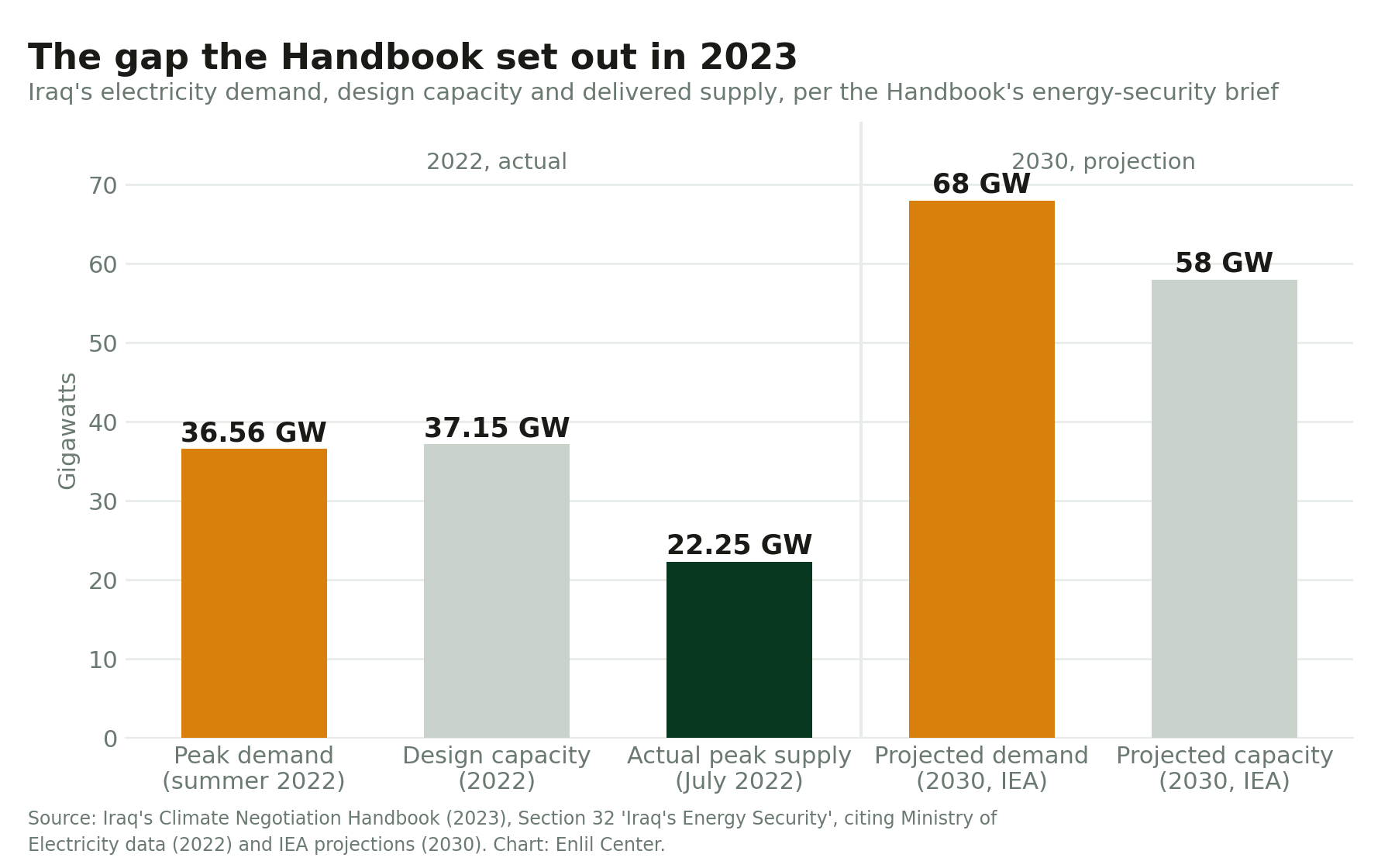
Caption: The supply gap the Handbook documented for negotiators: Iraq delivered barely 60 percent of its design capacity at the 2022 summer peak, and the IEA projected demand outrunning capacity by 10 GW in 2030. Source: the Handbook's Section 32, citing Ministry of Electricity and IEA data.
The third is Section D, the COP28 position paper. It covers every item on the COP28, CMP18 and CMA5 agendas — the subsidiary bodies' reports, non-Annex I reporting, the Adaptation Committee, the Warsaw International Mechanism for loss and damage, finance, technology transfer, capacity building and response measures — and for each one states where Iraq's interest lies and what the delegation should say.
Why it matters
Iraq's negotiating positions have historically lived in the heads of a few officials and left with them. A written handbook, updated each cycle, is the difference between a delegation that accumulates leverage and one that re-learns the process every December. Enlil assesses that the Handbook's lasting value is less any single position it recommends than the template it establishes: background, action, probable position, for every item, every year.
The full 333-page Handbook is available as a PDF below. Enlil's related analysis of Iraq's climate diplomacy since COP28 is published in the Articles section.
Cite the Enlil brief
An Enlil Center brief on this report, with a permanent DOI, is archived on Zenodo: Kareem, O. (2026). Iraq's Climate Negotiation Handbook: Enlil Center's contribution and assessment. Enlil Center Brief. Zenodo. https://doi.org/10.5281/zenodo.23241751
The same brief is also posted on SSRN (https://papers.ssrn.com/sol3/papers.cfm?abstract_id=7584878) and OSF (https://osf.io/29b8f/).
Video
Downloads
Data behind this report
Series from the Enlil Data Hub — each chart is downloadable with its source.
Sources & citations
This report could not be found. Back to Research & reports