
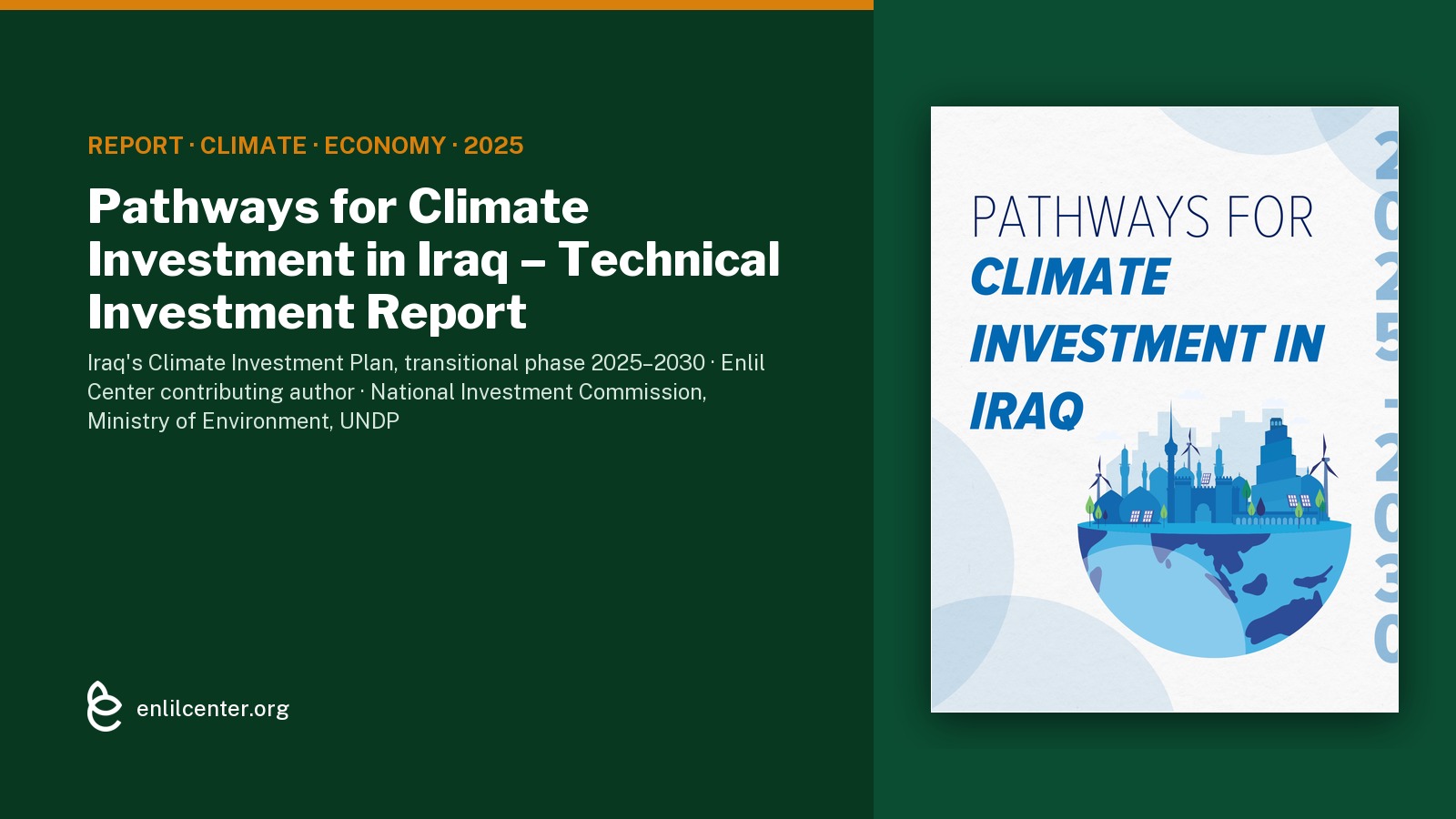
Pathways for Climate Investment in Iraq – Technical Investment Report
The technical report behind Iraq's first Climate Investment Plan: US$82.85 billion of sector-by-sector investment need to 2030, a measured 2021 emissions baseline, and five funding streams. Othman Kareem of Enlil Center, working as a consultant to UNDP, was a contributing author.
Abstract
- Pathways for Climate Investment in Iraq is the technical report behind Iraq's first Climate Investment Plan (CIP): a transitional plan for 2025–2030, submitted in late 2024 and formally endorsed in February 2025, prepared with the National Investment Commission and the Ministry of Environment and supported by UNDP. Othman Kareem of Enlil Center, working as a consultant to UNDP, was a contributing author.
- The report estimates that strengthening Iraq's economy against climate impacts while shifting to low-carbon energy requires about US$82.85 billion of investment by 2030, of which US$36.85 billion is identified as priority initiatives for the next five years. Electricity (US$23.25bn), transport (US$13.4bn) and the oil-and-gas transition (US$11.8bn) are the largest lines; water (US$7.5bn) and agriculture (US$5.1bn) carry the highest benefit-to-cost ratios.
- It draws on Iraq's first Biennial Transparency Report, which puts national emissions at 205.3 million tonnes of CO₂-equivalent in 2021: energy industries alone account for a third, transport a sixth, and fugitive emissions from fuels — flaring and leaks — a further 12 percent.
- Iraq has implemented roughly US$2.3 billion of adaptation and mitigation projects in the last three years and has US$16 billion planned for the next five, US$13.4 billion of it in mitigation. The report organises future finance into five funding streams, from research and capacity building to governorate-level renewable energy and methane capture.
- Enlil assesses the CIP's central contribution as sequencing: it is the first Iraqi document to put a price on climate resilience sector by sector and to separate what the budget can carry from what needs foreign investment — which is also its central risk, since the estimates are the authors' own and depend on capital the state does not yet have.
What the plan is for
Iraq's economy earns most of its revenue from the sectors it must decarbonise, and suffers most from the climate impacts it has contributed least to: the country accounts for about 0.27 percent of global greenhouse-gas emissions. The CIP starts from that tension. Phase I, which this report covers, is a transitional plan for 2025–2030 that maps the strengths and weaknesses of each economic sector, the climate impacts bearing on it, and the investment that would let it adapt. Phase II, planned for 2030–2050, is meant to scale that into project-level investment plans for every governorate.
The report grew out of Iraq's first national pavilion at COP28 in Dubai and the interest it generated among government and international partners in a tailored investment plan — one that contributes to economic diversification while strengthening the water and agriculture sectors that climate change hits first.
What the numbers say
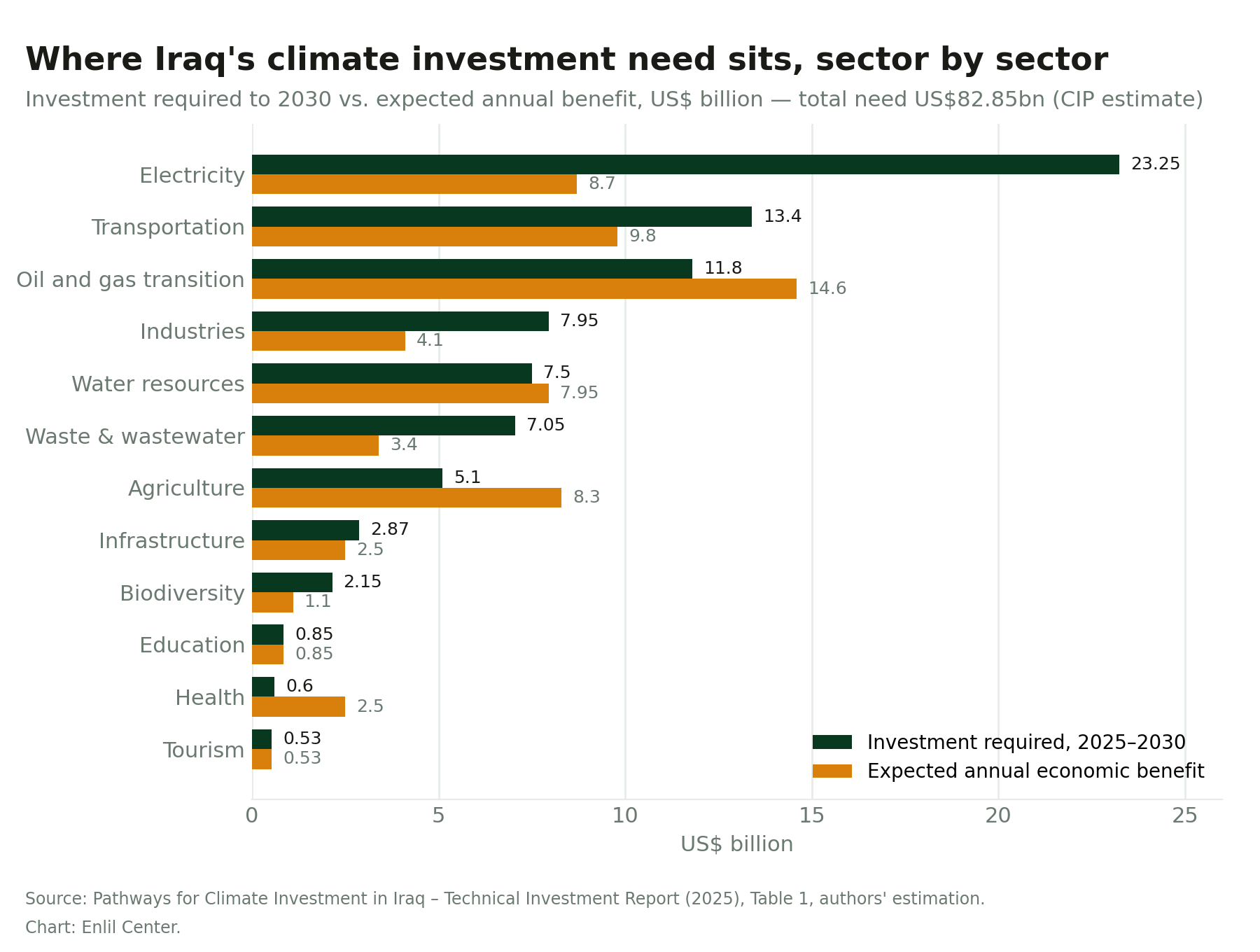
Caption: The CIP's sector-by-sector estimate of investment required to 2030 against the expected annual economic benefit. Electricity needs the most capital; water and agriculture return the most per dollar. Source: Pathways for Climate Investment in Iraq (2025), Table 1, authors' estimation.
The headline figure is US$82.85 billion of investment needed by 2030 across twelve sectors, with US$36.85 billion of it identified as near-term priorities — modernising cement production, cleaner petrochemical technologies, energy efficiency in metals, recycling and material recovery, sustainable agriculture and the rest of a priority list the report costs one by one. The pattern in the table is the argument: the capital-heavy lines are mitigation (electricity, transport, oil and gas), while the highest returns per dollar sit in adaptation (water resources and agriculture, where estimated annual benefits exceed the investment itself).
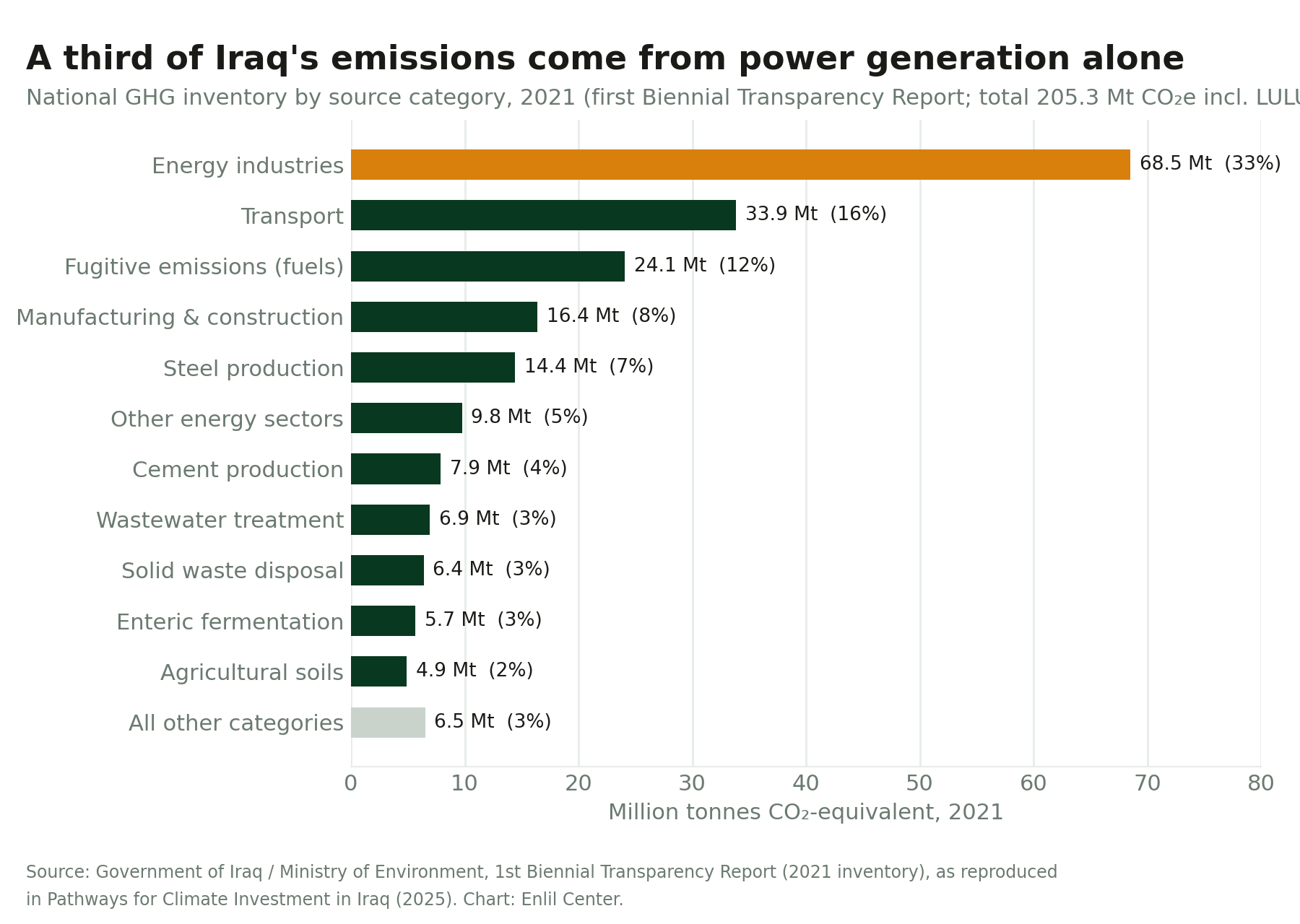
Caption: Iraq's greenhouse-gas inventory for 2021, as reproduced in the report from the country's first Biennial Transparency Report. Power generation, transport and fugitive emissions from fuels together make up more than 60 percent of the 205.3 million tonnes total. Source: Government of Iraq, 1st BTR (2021 inventory), via Pathways for Climate Investment in Iraq.
The emissions baseline underneath the plan comes from Iraq's first Biennial Transparency Report, issued in June 2025 under the Ministry of Environment's coordination: 205.3 million tonnes of CO₂-equivalent in 2021 including land use. Energy industries contribute 33 percent, transport 16 percent, fugitive emissions from fuels 12 percent, and manufacturing and steel a further 15 percent. That distribution is why the CIP's mitigation money concentrates on electricity, gas capture and industry: those are where the tonnes are.
How it proposes to pay for it
The report is candid that the national budget cannot carry the transition alone and that a stepwise approach needs direct and indirect foreign investment. It sorts the opportunity into five funding streams: research, innovation, technology transfer and capacity building; adaptation projects in the water and agriculture sectors; combined adaptation-and-mitigation projects that cut emissions while strengthening community resilience; renewable-energy scale-up at governorate and district level; and methane and gas-capture projects that need large upfront capital and dedicated technology transfer. It also records what is already moving — about US$2.3 billion implemented in the past three years, split evenly between adaptation and mitigation, and US$16 billion planned for the next five — and notes Iraq's commitment under the Global Methane Pledge.
Enlil's reading
Enlil, whose Director of Research & Policy contributed to the report, treats its estimates as what they are labelled: the authors' estimation, built from sector consultations rather than audited project pipelines. Their value is not precision but structure. For the first time, an Iraqi government document puts a sector-by-sector price on climate resilience, separates the part the budget can fund from the part that needs outside capital, and ties both to a measured emissions baseline. Enlil expects the test of the CIP to be Phase II — whether the 2030–2050 plan turns these envelopes into governorate-level projects with owners, timelines and financing — and will track the datasets behind the plan in the Data Hub as they update.
The full 201-page technical report is available as a PDF below.
Cite the Enlil brief
An Enlil Center brief on this report, with a permanent DOI, is archived on Zenodo: Kareem, O. (2026). Pathways for Climate Investment in Iraq: Enlil Center's summary and assessment of the technical report behind Iraq's first Climate Investment Plan. Enlil Center Brief. Zenodo. https://doi.org/10.5281/zenodo.23241753
The same brief is also posted on SSRN (https://papers.ssrn.com/sol3/papers.cfm?abstract_id=7584899) and OSF (https://osf.io/29b8f/).
Video
Downloads
Data behind this report
Series from the Enlil Data Hub — each chart is downloadable with its source.
Sources & citations
This report could not be found. Back to Research & reports