 |
Issue 3 · 16 November 2026 | Every week, the decisions and data behind Iraq's energy, water and climate policy, read from ministries, the cabinet and official statements. Every item links to its source. | This week in 60 seconds | • | The 2027 budget missed its 15 November date; the cabinet has still not voted on it. | | • | The Baghdad market dollar touched 170,000 dinars per $100, about 12% above the official cash rate. | | • | Iraq and the IMF closed talks in Amman on a reform programme for 2027–2029. | | • | The Oil Ministry said Hormuz is still closed and Iraq is holding to its OPEC+ ceiling of 4.431 million barrels a day. | | • | At COP31 the President cited the loss of more than half of Iraq's farmland, while negotiators defended fossil fuels. |
|
| Money and the budget | 2027 budget misses 15 November; cabinet vote still pendingFinance Minister Falih Sari said on 16 November that the 2027 budget “will be approved soon in the Council of Ministers, after its financial articles are reviewed”, and that creating the new Ministry of Economy and Governance had forced a review of its items. The cabinet session on 10 November took no budget decision, and on 11 November the chair of parliament's Finance Committee, Udai Awad, still expected the draft on 14 November. Sari also announced a move to make all contract and daily-wage staff permanent, counting their previous years of service. Why it matters. The bill is now a month past the 15 October submission date set by the Financial Management Law, and the payroll it must carry keeps growing. Sources: INA, Finance Minister (Arabic) · Prime Minister's Office, cabinet session 10 Nov (Arabic) · INA, Finance Committee chair (Arabic) | The dollar gap widens againOn 29 October the Central Bank governor said the gap between the market and official rates had fallen from 24% “to 9%”, and on 1 November Deputy Prime Minister Mohammed Tamim said the market rate “will certainly fall” close to the official one, citing $3 billion in US cash shipments over two months. On 2 November the Central Bank raised the travellers' cash allowance from $2,000 to $3,000, up to six times a year. By 15 November Baghdad exchanges were quoting about 170,000 dinars per $100, according to Shafaq News; the official cash rate is 1,520 dinars per dollar. Why it matters. At about 12% above the cash rate, the gap is wider than the 9% the governor gave two weeks earlier, despite the extra cash dollars. Sources: INA, Central Bank governor (Arabic) · INA, Deputy PM (Arabic) · INA, travellers' allowance (Arabic) · Shafaq News, market rate (Arabic) | Iraq and the IMF make progress on a 2027–2029 programmeIraq and the IMF closed talks in Amman on 11 November with “progress in the negotiating track towards a reform programme supported by the Fund”, the Finance Ministry said. Sari said the discussions set out a medium-term reform path for 2027–2029, covering public finance, a clear monetary framework, state and private banks, anti-money-laundering rules, electricity reform and governance. Expert-level work continues; no amount or terms were announced. Why it matters. It would be Iraq's first IMF-supported programme since the Stand-By Arrangement that ended in 2019. Sources: Ministry of Finance (Arabic) · INA (Arabic) | Non-oil revenue reaches 23% of incomeThe Prime Minister's financial adviser Mazhar Mohammed Saleh said on 9 November that revenue in January–August 2026 was about 45.4 trillion dinars, of which 34.7 trillion came from oil and about 10.6 trillion from other sources, around 23%. The Customs Authority reported October revenue of more than 526 billion dinars, against 259 billion in October 2025. On 10 November the cabinet reviewed the state accounts to the end of August, which the Finance Committee says it needs before debating the 2027 bill. Why it matters. These are the first official revenue figures for 2026, and customs receipts doubled in the month after the devaluation. Sources: INA, PM's financial adviser (Arabic) · Ministry of Finance, customs (Arabic) | US extends the sanctioned bank's wind-down to 1 DecemberOn 29 October the US Treasury's sanctions office replaced its earlier licence for the International Development Bank for Investment and Finance, which was due to expire on 30 October, with General License FF-1. It authorises transactions needed to wind down dealings with the bank until 1 December 2026. No new statement from the Central Bank or the Finance Ministry on the bank was published in the first half of November. Why it matters. Counterparties of the bank, including holders of salary accounts there, now have until 1 December rather than 30 October. Sources: US Treasury, OFAC 29 Oct | Oil, gas and electricity | Hormuz still closed; Iraq holds to its OPEC+ ceilingIn a clarification on 6 November, the Oil Ministry said that despite “the continued closure of the Strait of Hormuz” it is keeping production and exports going to fund the federal budget, and that Iraq raised output in October, without giving a figure. It said Iraq remains committed to its OPEC+ ceiling of 4.431 million barrels a day and will seek to raise it next year, as a consultancy hired by OPEC assesses members' maximum sustainable capacity. The ministry has not published its official October export figure. Why it matters. Iraq's case for a higher 2027 quota rests on that capacity review, while the export route it depends on is disrupted. Sources: Ministry of Oil (Arabic) · Ministry of Oil, OPEC+ meeting (Arabic) | Output targets of 7 million by 2030 and 10 million by 2032, Region includedReceiving Kurdistan Region Prime Minister Masrour Barzani in Baghdad on 9 November, Prime Minister Ali al-Zaidi set targets of 7 million barrels a day in 2030 and 10 million in 2032, “including the production of the Region's fields, which is about one million barrels a day”. They discussed the management of oil fields under the constitution, oil and non-oil revenue, Region salaries, the Region's share of the 2027 budget and the oil and gas law. A day earlier, meeting officials and MPs, the Prime Minister gave the 10 million target as 2030. Why it matters. It is the first official production plan to count the Region's output, but the government has now given two different years for 10 million barrels. Sources: Prime Minister's Office, Barzani meeting (Arabic) · Prime Minister's Office, 8 Nov (Arabic) | Exports and contracts: Mediterranean pipeline talks and Chevron's West Qurna 2The Prime Minister received the consortium behind a pipeline from Basra via Haditha to ports “on the Mediterranean and the Red Sea” on 5 November and promised to remove “all obstacles”; on 14 November the Oil Minister chaired a meeting on the technical, contractual and economic terms of the Basra–Haditha, Haditha–Fishkhabour and Haditha–Baniyas lines. After meeting Chevron on 3 November, the minister said “agreements have been reached”, with signing of the West Qurna 2 contract planned for the end of this year and talks continuing on the Nasiriya field and four exploration blocks. Why it matters. Both are about moving more oil without the Gulf: a bypass route still in negotiation, and a major US upstream contract with a signing date. Sources: Prime Minister's Office (Arabic) · Ministry of Oil, pipeline (Arabic) · Ministry of Oil, Chevron (Arabic) | Two official dates for ending gas flaringThe Oil Minister told the Gas Exporting Countries Forum's Secretary-General on 8 November that Iraq is on course to “stop gas flaring in 2029”. Three days later, at COP31, the President said Iraq had cut flared associated gas by 75% and aims for “zero routine flaring by 2030”. On 10 November the Deputy Oil Minister for Gas ordered a feasibility study for a national pipeline to carry liquefied petroleum gas from south to north. Why it matters. The government now has two flaring deadlines in public, one year apart. Sources: Ministry of Oil (Arabic) · Presidency, COP31 speech (Arabic) · Ministry of Oil, LPG pipeline (Arabic) | Electricity: units back for winter, generator prices to the Integrity CommissionThe Electricity Ministry returned several units to service after maintenance, including Wasit thermal unit 6 at 600 MW on 15 November and Musayyib thermal unit 1 at its design capacity of 250 MW on 11 November, and says work continues on a 1,500 MW, 400 kV substation in Karbala under a Siemens loan. On 3 November the Prime Minister ordered a larger electricity share for Kirkuk and referred private-generator pricing to the Integrity Commission. The ministry published no national generation or import figures in the period. Why it matters. Winter maintenance decides how much capacity is ready for the summer 2027 peak, but there is no published system-wide figure to judge it. Sources: Ministry of Electricity, Wasit (Arabic) · Ministry of Electricity, Musayyib (Arabic) · Ministry of Electricity, Karbala (Arabic) · Prime Minister's Office (Arabic) | Water and farming | Cabinet adopts water committee decisions on Mosul Dam and the riversAt its 3 November session the cabinet approved recommendations of the Supreme National Water Committee: daily-wage workers at Mosul Dam move to contracts with a 50% hazard allowance “after the end of the work of the Italian company Trevi”, and a committee will choose the first package of priority projects under the Tigris–Euphrates protection initiative and secure its funding. Polluting ministries must treat their waste, and provinces must run sewage treatment plants before discharging into rivers. Why it matters. It turns the committee's October decisions on river pollution into cabinet orders, and marks the end of Trevi's maintenance work at Mosul Dam. Sources: Prime Minister's Office, cabinet session 3 Nov (Arabic) | Water raised with Erdogan; storage above 30 billion cubic metresPresident Nizar Amedi met Turkey's President Erdogan in Antalya on 12 November, with Water Resources Minister Muthanna al-Tamimi present; the Presidency said they discussed “the water file and the importance of intensifying coordination to reach sustainable solutions that guarantee Iraq's water rights”. No agreement or release figures were announced. On 10 November the Water Resources Ministry spokesman said storage “has exceeded 30 billion cubic metres” and that rains allow more water to be sent to the marshes and Basra, according to Al-Sabah newspaper as relayed by other outlets. Why it matters. It is the first head-of-state contact on water since the financing mechanism of the Turkey framework agreement came into force on 1 September. Sources: Presidency (Arabic) · Al-Naeem, relaying Al-Sabah (Arabic) | A million-farm plan, paddy exports and relief on wheat rentsOn 7 November the Prime Minister met the agriculture and water ministers on an initiative of farms of “20–25 dunams per family” across 15 provinces using modern irrigation. The same day the Agriculture Ministry opened exports of paddy rice, saying production covers local demand. On 10 November the minister ordered a pause in collecting farmland rents “until their dues for wheat marketing are paid in full”. Why it matters. Iraq is expanding irrigated land and exporting rice, a water-intensive crop, while farmers are still waiting to be paid for this year's wheat. Sources: Prime Minister's Office (Arabic) · Ministry of Agriculture, paddy exports (Arabic) · Ministry of Agriculture, rents (Arabic) | Climate and COP31 | The President's COP31 case: half the farmland lost, a 20% water deficit by 2040Speaking at COP31 in Antalya on 11 November, President Nizar Amedi said climate change had caused the “loss of more than 50% of agricultural land” and the forced displacement of about 20,000 people, and that scientific estimates put Iraq's water deficit at 20% of its needs by 2040. He called for the Loss and Damage Fund to be activated and for fragile states to get green finance “without obstacles and bureaucracy”. He said Iraq has brought 1,430 MW of renewable energy into service and raised its target to 14,000 MW by 2030. Why it matters. These are the figures Iraq will use in its requests for climate and loss-and-damage finance. Sources: Presidency, full speech (Arabic) | Negotiators reject fossil-fuel commitmentsIn the Global Stocktake talks, Iraq's negotiators insisted decisions impose no “additional requirements or obligations on developing countries”, the Environment Ministry said. At the closing plenary of the first week, on 15 November, the delegation restated its position “rejecting any harm to national interests, foremost those related to fossil fuels”, and opposed commitments that would curtail the right of states to development. Why it matters. Iraq goes into COP31's final week opposed to fossil-fuel transition language, while asking for climate finance in the same conference. Sources: Ministry of Environment, 11 Nov (Arabic) · Ministry of Environment, 15 Nov (Arabic) | Environment Minister presses the Green Climate FundOn 14 November Environment Minister Sarwa Abdul-Wahid asked the Green Climate Fund's head for the Middle East, Dr Amjad al-Mahdi, for more funding for Iraq and faster review of projects submitted to the Fund's next Board meeting, which the Fund has scheduled for 20–23 April 2027. During the conference the ministry also launched Manara, a climate-data sharing platform built with GIZ, announced a new project funded through the NDC Partnership, and agreed with Jordan and Egypt to prepare joint dust-storm projects. No amounts were given. Why it matters. Iraq's concrete climate-finance moves at COP31 so far are requests and platforms; the next chance for Board approval is April. Sources: Ministry of Environment, GCF (Arabic) · Ministry of Environment, Manara (Arabic) · Green Climate Fund, decision B.45/22 | New on Enlil | 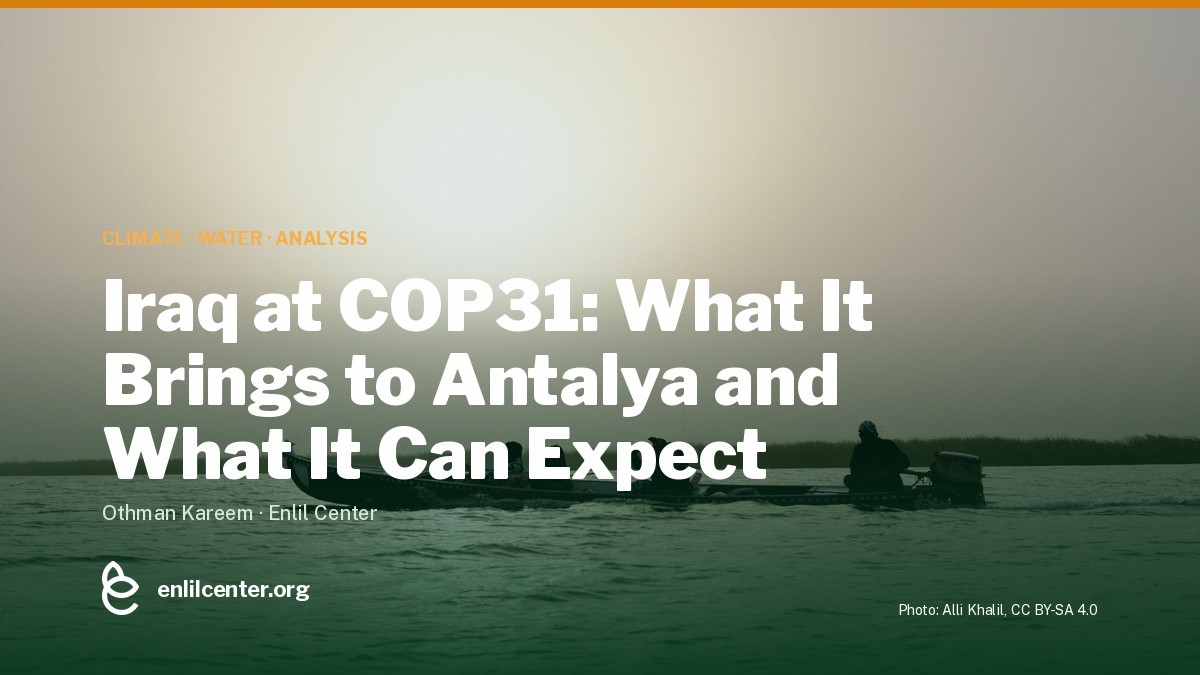 | Our COP31 explainer sets out what Iraq brought to Antalya: a climate plan costed at $72.2 billion, an emissions record that differs from international estimates, and climate funds that have approved far more for Iraq than they have paid out. Three new Data Hub series come with it. Read: Iraq at COP31: What It Brings to Antalya and What It Can Expect → NDC 3.0 cost by component → Greenhouse gas emissions: national vs international estimates → Climate fund projects: approved vs disbursed → | What to watch | • The cabinet's vote on the 2027 budget and its referral to parliament. • 20 November: COP31 closes; watch the final Global Stocktake text and Iraq's position on it. • 1 December: the US wind-down licence for the International Development Bank expires. • The first official inflation figure covering a full month after the devaluation, and the Oil Ministry's October export figure, both still unpublished. | Iraq Policy Monitor is published weekly by Enlil Center for Environment and Sustainable Development, Baghdad. We summarise and link; we do not republish. Spot an error? Reply and we will correct it next week. enlilcenter.org · Header photo: Mohammed Sardar / Wikimedia Commons, CC BY-SA 4.0 | ← Previous issue: Issue 2, 27 October 2026 |
|
|