 |
Issue 2 · 27 October 2026 | Every week, the decisions and data behind Iraq's energy, water and climate policy, read from ministries, the cabinet and official statements. Every item links to its source. | This week in 60 seconds | • | The 2027 budget is now due in parliament on 15 November, a month late. | | • | The Central Bank barred the US-sanctioned International Development Bank from all dollar dealings. | | • | Cabinet removed the last 5% duty on imported solar systems; grid-connection rules are with the State Council. | | • | ExxonMobil signed an MoU for the second phase of seawater supply to Basra's oil fields. | | • | The water minister said Iraq is seeking formal river agreements with both Turkey and Iran. |
|
| Money and the budget | 2027 budget pushed to 15 November, with 120,000 new postsParliamentary Finance Committee chair Udai Awad said on 26 October that sending the budget bill to parliament “has been postponed to 15 November”, a month after the 15 October date set by the Financial Management Law. Two days earlier the Prime Minister chaired a meeting on the draft with the Deputy Prime Minister and the Finance Minister, and directed that all contract and daily-wage workers be made permanent staff and that 120,000 new contract posts be created in the 2027 budget, divided among provinces by population, with a dedicated hiring platform. Why it matters. The draft was built on $58 oil and 217 trillion dinars of spending; the new posts add to the payroll before the bill has even reached parliament. Sources: Prime Minister's Office (Arabic) · 964, Finance Committee chair (Arabic) | Central Bank bars the sanctioned bank from dollar dealingsA week after the US Treasury designated the International Development Bank for Investment and Finance, a Central Bank circular to all banks barred it from dealing in US dollars “in any form”, according to 964 and Shafaq News, which reported the document. Central Bank spokesman Mahmoud Dagher confirmed it and called the step “normal”, one “any central bank in the world” takes when a bank faces sanctions. 964 reports the bank must clear its dollar accounts by the end of October. Why it matters. It is the Central Bank's first action since the designation, just before the US wind-down licence expires on 30 October. Nothing has been said publicly about how depositors will be treated. Sources: 964 (Arabic) · Shafaq News · US Treasury, OFAC actions 15 Oct | PM: more cash dollars, and a target of 1,550 dinarsIn an interview with Al-Iraqiya reported on 24 October, Prime Minister Ali al-Zaidi said the government had raised cash-dollar supplies from $140 million to half a billion dollars a month and was working to raise US cash shipments to more than $1 billion a month. He said the aim is to bring the dollar back to 155,000 dinars per $100 or less. Why it matters. Baghdad exchange shops quoted 168,000 dinars per $100 on 25 October, about 10% above the official 152,000, almost three weeks after the devaluation. Sources: Arabi21, PM interview (Arabic) · 964, market rates (Arabic) | Salaries paid, and more state creditThe Finance Ministry began paying October salaries on Sunday 25 October. The same week it raised the Real Estate Bank's 2026 housing initiative by 1 trillion dinars and opened applications for Rafidain Bank salary advances on the Super Key app from 24 October, in batches of 5,000. Why it matters. Payroll is being met on time despite the revenue squeeze, and the state banks are lending more, not less. Sources: Ministry of Finance, salaries (Arabic) · Ministry of Finance, Real Estate Bank (Arabic) · Ministry of Finance, Rafidain advances (Arabic) | Oil, gas and electricity | The last 5% duty on solar goes, and grid rules are on the wayOn 20 October the Cabinet scrapped customs duties on imported solar energy systems, a step the Electricity Minister had requested on 23 September. Duties and taxes on panels, inverters, cables and batteries had already been cut from 33% to 5% in February, according to the head of the National Team for Renewable Energy. The ministry says it has drafted 40-article instructions that would let citizens connect their solar systems to the national grid through smart meters, and has sent them to the State Council for legal drafting before they return to the Cabinet. Why it matters. It removes the last 5% left after February's cut, and no start date has been announced. Selling rooftop power to the grid still depends on rules that have not been issued. Sources: Prime Minister's Office, Cabinet decisions (Arabic) · Ministry of Electricity (Arabic) · INA, February cut to 5% (Arabic) | ExxonMobil signs for seawater supply, phase twoBasra Oil Company and ExxonMobil signed a memorandum of understanding on 21 October on the second phase of using seawater, with capacity of up to 2.5 million barrels a day, to support field pressure. The Oil Ministry said it adds to TotalEnergies' 5 million barrel-a-day project. No terms or timeline were published. Why it matters. Water injection is what limits how far southern output can grow; this is an MoU, not yet a contract. Sources: Ministry of Oil (Arabic) | Gas capture: Artawi at 96%Deputy Oil Minister for Gas Ezzat Saber Ismail said on 22 October that the Artawi early-gas project (AG25) is 96% complete. It is designed to take 50 million standard cubic feet a day of raw gas and produce more than 40 million of dry gas. The larger gas processing project for Majnoon, West Qurna 2 and Artawi is 36% complete, with a first phase of 300 million cubic feet a day. Why it matters. The Basra, Missan and Dhi Qar oil companies flared 95% of the gas burned by federal oil companies in 2023, so southern capture projects like these decide whether flaring falls. Sources: Ministry of Oil (Arabic) · Enlil Data Hub, from Iraq EITI | Baghdad and Erbil agree to set timelinesDeputy Prime Minister for Energy Mohsen al-Mandalawi, with the oil and electricity ministers, met Kurdistan Region Prime Minister Masrour Barzani in Duhok on 25 October. They discussed mechanisms for exporting and marketing oil and organising revenues, and agreed to set “clear timelines” for resolving the files. No figures or texts were published. Why it matters. Oil exports and revenue sharing feed directly into the 2027 budget that is now due on 15 November. Sources: Ministry of Oil (Arabic) · Ministry of Electricity (Arabic) | Grid: first Mosul–Kirkuk 400 kV line, and a northern supply contractThe Electricity Ministry energised the East Mosul–Kirkuk 400 kV line for the first time on 26 October: 154 km and 385 towers, funded by the ministry. On 20 October the Cabinet also authorised the northern transmission company to sign a contract to supply 600 to 1,000 MW; the supplier was not named. Why it matters. Both add to northern supply before next summer's peak, but the source of the 600–1,000 MW is not yet public. Sources: Ministry of Electricity (Arabic) · Prime Minister's Office, Cabinet decisions (Arabic) | Water and farming | Water minister: formal agreements with Turkey and IranSpeaking to INA at the ninth Cairo Water Week, Water Resources Minister Muthanna al-Tamimi said the government is working “to reach formal agreements with Turkey and Iran to regulate the management of the Tigris, the Euphrates and the cross-border rivers”, securing Iraq's water share. It follows the Prime Minister's call on 17 October for a comprehensive water agreement with Turkey. Why it matters. Iran is now named alongside Turkey, but no new agreement was signed this week. Sources: INA (Arabic) | Shatt al-Arab barrage moves to detailed designOn 20 October the Cabinet allowed the Water Resources Ministry to invite reputable international firms directly to prepare detailed designs for the second phase of a barrage across the Shatt al-Arab at Al-Ma'qil, with a regulator at Karmat Ali in Basra. No cost or timeline was given. Why it matters. The barrage is meant to hold back the seawater that pushes up the Shatt al-Arab into Basra; direct invitations are faster than an open tender. Sources: Prime Minister's Office, Cabinet decisions (Arabic) | Crop imports opened until 31 DecemberThe Cabinet authorised the Agriculture Ministry on 20 October to open imports of all agricultural crops until 31 December 2026, “to secure food security”. On 26 October the ministry denied social-media reports that it had banned imports of apples, bananas, kiwi, pomegranates, cowpeas, green peppers and garlic, saying “all the listed items may be imported”. Why it matters. Opening all crop imports in the winter season sets aside the usual protection for local produce, to keep prices down after the devaluation. Sources: Prime Minister's Office, Cabinet decisions (Arabic) · Ministry of Agriculture (Arabic) | Climate and environment | Adaptation plan still to come as COP31 nearsYousif Muayad, director of the National Climate Change Centre, told INA on 22 October that the ministry plans to launch the national adaptation plan this year with UNEP, covering 13 sectors with water, agriculture and health first. He said “the biggest challenge” is moving from strategies and plans to projects on the ground. The Environment Minister met Kurdistan Region representatives on Iraq's negotiating delegation the same week to prepare for COP31 in Antalya. Why it matters. Iraq goes to COP31 with its climate plan submitted but its adaptation plan not yet launched, and officials name finance as the bottleneck. Sources: INA (Arabic) · Ministry of Environment (Arabic) | New on Enlil | 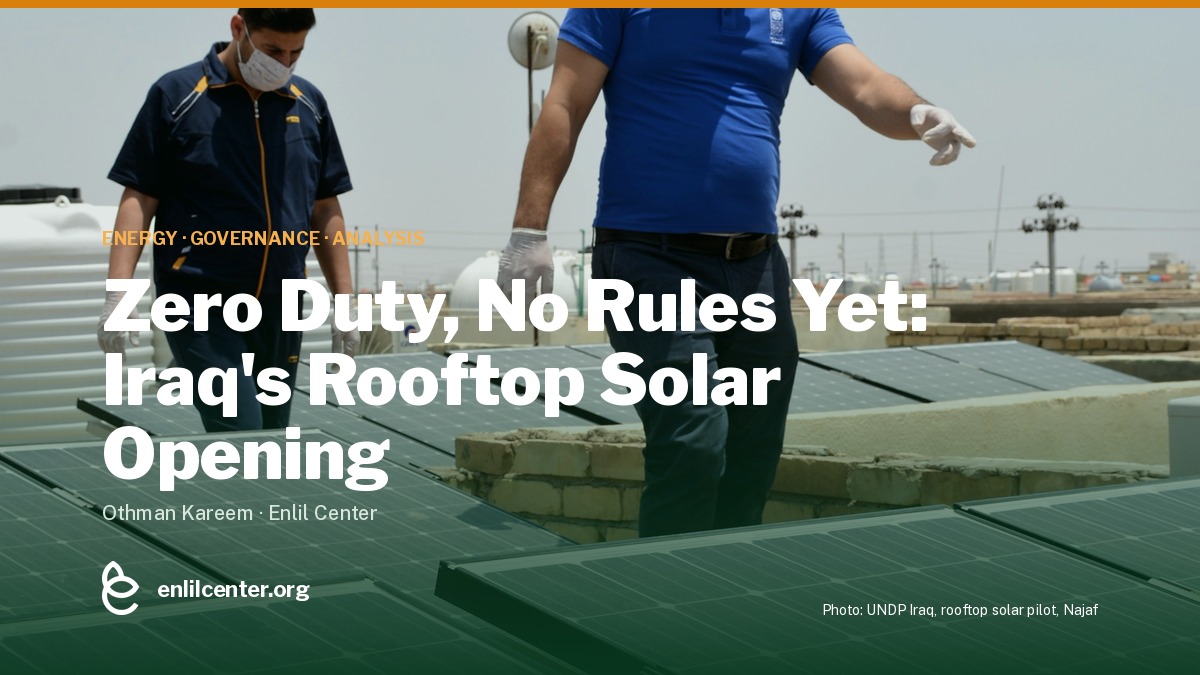 | Our new analysis finds that Iraq imported about 1.9 GW of solar panels in 2025, thirty times the 63.6 MW official statistics count, and that households are buying them to escape the generator, not the grid. Four new Data Hub series come with it. Read: Zero Duty, No Rules Yet: Iraq's Rooftop Solar Opening → Solar panel and battery imports from China, 2022–2025 → Residential electricity tariff tiers → Electricity load demanded vs supplied by governorate, 2025 → Solar PV yield by city → | What to watch | • 30 October: the US wind-down licence for the International Development Bank expires, the same day as the Central Bank's dollar deadline. • Green Climate Fund Board, 26–29 October: the final list of 21 proposals includes none for Iraq. • The Oil Ministry's official September and October export figures, still unpublished. • Early November: the first inflation figure covering a full month after the devaluation. • 15 November: the new date for the 2027 budget to reach parliament. | Iraq Policy Monitor is published weekly by Enlil Center for Environment and Sustainable Development, Baghdad. We summarise and link; we do not republish. Spot an error? Reply and we will correct it next week. enlilcenter.org · Header photo: Mohammed Sardar / Wikimedia Commons, CC BY-SA 4.0 ← Previous issue: Issue 1, 20 October 2026 |
|
|